
 EN
EN

In a factory, yogurt is made by standardizing milk, homogenizing and heat-treating it, cooling it to the correct inoculation temperature, adding a starter culture, fermenting it to a target acidity, cooling it again, and then filling and storing it under controlled conditions. The key production logic is simple: prepare a consistent milk base, create safe conditions for the selected culture, control acid development, protect the yogurt's structure, and prevent contamination after pasteurization.
The exact equipment arrangement depends on the product. Set yogurt ferments inside its retail cup, while stirred yogurt ferments in a tank before cooling, mixing, and filling. Drinking yogurt needs additional shear or homogenization to reduce viscosity. Greek-style or concentrated yogurt requires a separator or membrane system, and ambient yogurt requires additional heat treatment and hygienic or aseptic packaging. For that reason, a factory should define the product and package before choosing a yogurt production line.
Industrial Yogurt Production Process at a Glance
The following is the standard flow for stirred yogurt, the most useful reference process for understanding an industrial yogurt line:
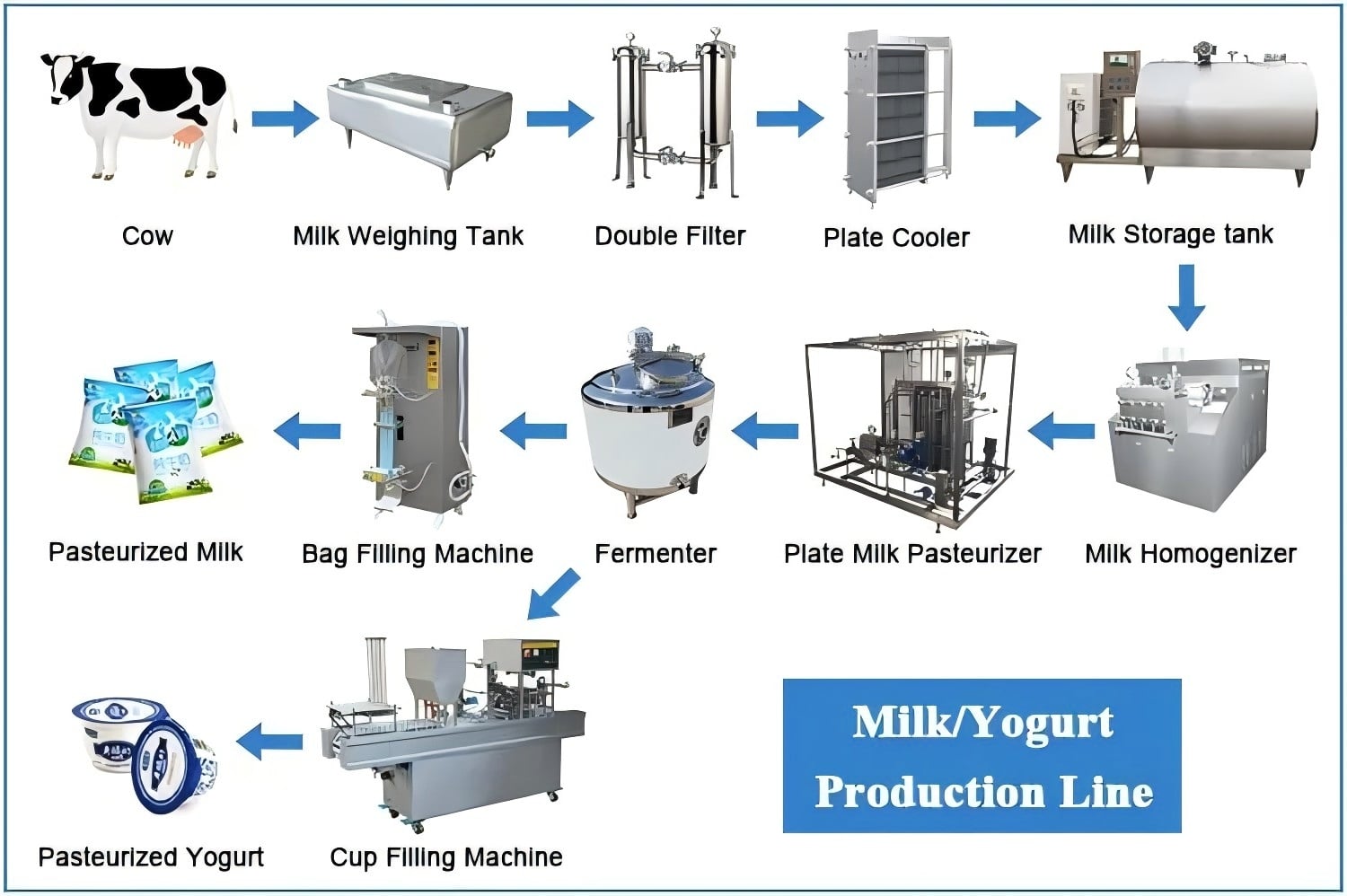
For set yogurt, the sequence changes after culture addition: the inoculated milk is filled first, fermented in the package, cooled without disturbing the gel, and then transferred to cold storage.
Step 1 — Raw Milk Reception and Quality Testing
Production begins at the milk reception area. The incoming milk is weighed or measured with a flow meter, sampled, filtered, and transferred to refrigerated storage. Plants typically check temperature, smell and appearance, acidity or pH, fat, protein or total solids, density, microbial quality, and the possible presence of antibiotic or cleaning-chemical residues. The exact acceptance tests depend on local regulations and the factory's quality plan.
This step affects the entire batch. High microbial counts increase the load on heat treatment, while antibiotic residues can inhibit the starter culture and cause slow or failed fermentation. Raw milk should therefore move through a closed, hygienic route and spend as little time as practical between reception, chilling, and processing.
Typical equipment includes a receiving station, sanitary filter or clarifier, sampling point, flow meter or weighing system, transfer pump, chilled milk storage tank, and laboratory instruments.
Step 2 — Milk Standardization and Ingredient Mixing
Standardization gives every batch the intended composition. A cream separator and inline standardization system can adjust fat content. Protein and total solids may be increased with skim milk powder, milk protein concentrate, evaporation, or membrane concentration. Higher milk solids can improve body and reduce whey separation, but excessive solids or poorly dispersed powders may create chalkiness or a sandy texture.
Sugar, stabilizers, or other permitted ingredients may also be mixed into the milk base according to the formulation. Powders should be dispersed completely under controlled temperature and agitation. A high-shear mixer, powder induction unit, or recirculating mixing tank can shorten hydration time and reduce lumps. If powder addition introduces too much air, vacuum deaeration may be added before homogenization.
Formulation changes must be checked against local labeling rules. They can also affect fermentation: for example, a high sugar concentration in the milk before inoculation can slow culture activity. The production recipe should therefore be developed together with the process settings rather than treated as a separate decision.
Step 3 — Homogenization
Homogenization forces warm milk through a narrow valve at high pressure, breaking large fat globules into smaller, more evenly distributed particles. This helps prevent a cream layer and contributes to a smoother, more stable yogurt texture.
A common industrial starting range for yogurt milk is 200–250 bar at approximately 65–70°C. One-stage or two-stage homogenization may be used, depending on fat content, solids, stabilizers, and the required texture. The correct pressure is not simply the highest possible pressure: excessive treatment can add cost and may not suit every recipe. See the available milk homogenizer configurations when planning this section of the line.
Homogenizer capacity should match the pasteurizer's flow rate. Pressure stability, valve condition, feed temperature, and upstream deaeration all affect the result.
Step 4 — Pasteurization
Yogurt milk normally receives a stronger heat treatment than ordinary pasteurized drinking milk. The purpose is not only to reduce unwanted microorganisms; it is also to denature whey proteins so that they interact with casein and help form a firmer, more stable gel.
A widely used reference condition is 90–95°C with about 5 minutes of holding time. Other validated time–temperature combinations may be selected for a particular recipe and plant. A plate or tubular heat exchanger can be used, with a holding section sized for the required residence time and automatic temperature control to prevent underprocessed product from moving forward.
The heat-treatment program must be validated for the actual product, flow rate, local food-safety rules, and equipment. Calling every heat treatment “pasteurization” can hide an important design issue: yogurt-milk heat treatment is chosen for both microbial control and texture development. The milk pasteurizer must therefore be selected around the required temperature, holding time, viscosity, and line capacity.
Step 5 — Cooling and Starter Culture Addition
After heat treatment, the milk is cooled rapidly to the inoculation temperature required by the starter culture. For conventional thermophilic yogurt cultures, this is commonly around 40–45°C. The culture supplier's specification should control the final setpoint.
Starter culture is added under hygienic conditions, either into the fermentation tank or inline as the milk enters it. The culture must be distributed uniformly without introducing contamination or unnecessary air. Direct-vat-set frozen or freeze-dried cultures are common in industrial production, but dosage and handling are supplier-specific.
Everything downstream of pasteurization is a high-hygiene zone. Sanitary valves, closed transfer, filtered tank vents, clean operator practices, and a verified CIP cycle are essential because there is normally no later kill step for refrigerated yogurt.
Step 6 — Fermentation
During fermentation, Streptococcus thermophilus and Lactobacillus delbrueckii subsp. bulgaricus convert part of the milk's lactose into lactic acid. As pH falls, the casein network forms and the milk changes into a yogurt gel.
For a typical stirred yogurt, a useful starting window is:
- Temperature: approximately 42–43°C
- Time: approximately 4–5 hours
- End point: commonly pH 4.2–4.5
These numbers are not universal specifications. Culture strain, inoculation rate, milk composition, sugar level, tank size, heat treatment, and desired flavor can all change the fermentation curve. The operator should follow pH development, time, and temperature together rather than relying on a timer alone.
Once the validated target pH is reached, cooling should begin promptly. A delay allows post-acidification to continue, producing a sharper flavor and potentially a brittle gel with greater whey separation. An industrial yogurt fermentation tank should provide controlled heating and cooling, suitable agitation, hygienic venting, and access for CIP.
Step 7 — Cooling and Texture Control
Cooling slows culture activity and establishes the final texture. For stirred yogurt, the gel is broken gently as the product leaves the fermentation tank. It may pass through a smoothing device and a plate or tubular cooler before reaching a buffer tank.
The first cooling stage commonly brings stirred yogurt to roughly 15–22°C for handling and filling, followed by final cooling in the package to approximately 2–6°C, subject to the product specification and local rules. Pumps, pipe diameters, valves, bends, cooler pressure drop, agitation speed, and buffer time should be selected to limit shear.
Too little shear may leave an uneven gel; too much shear can permanently reduce viscosity and promote whey separation. Texture control is therefore a line-design issue, not only a recipe issue.
Step 8 — Fruit and Flavor Addition
Fruit preparations, syrup, flavors, colors, or other permitted inclusions are normally metered into stirred yogurt after initial cooling and before filling. A synchronized dosing pump and a sanitary static or dynamic mixer help maintain the specified fruit-to-yogurt ratio without overworking the gel.
Fruit preparation is a major contamination risk because it enters after the milk's heat treatment. It should have a validated microbiological specification and suitable heat treatment, packaging, storage, and connection procedure. Whole fruit or particulates also affect pump selection, valve passage, pipe diameter, mixing method, and filler design.
For fruit-on-the-bottom set yogurt, fruit may be dosed into the cup before the inoculated milk is filled. Low-pH ingredients must be kept from interfering with culture activity or weakening the gel.
Step 9 — Filling and Packaging
The filling machine portions the product into cups, bottles, pouches, or cartons and closes each package with a lid, foil, cap, or seal. It may also apply a date code and support downstream inspection, labeling, sleeving, case packing, or palletizing.
Filling is one of the highest-risk points for post-pasteurization contamination. The filler should have a hygienic product path, cleanable nozzles, controlled package handling, and a sanitation concept appropriate for the target shelf life. Fill accuracy, seal integrity, headspace, product temperature, and package cleanliness should be checked during production.
The combined filling capacity should be balanced with upstream batch size and fermentation scheduling. If yogurt waits too long in a buffer tank, viscosity and flavor can change and whey separation can increase.
Step 10 — Cold Storage
After filling, refrigerated yogurt is moved to cold storage to complete cooling and stabilize the structure. A typical storage target is approximately 2–6°C, but the legal and product-specific requirement takes precedence. The cold room should support uniform airflow, temperature monitoring, lot identification, and first-in/first-out stock rotation.
The cold chain continues during loading, transport, distribution, and retail. Shelf life cannot be determined by one processing temperature alone; it must be established by a validated product, packaging, hygiene, and storage program.
Equipment Required for a Yogurt Factory
A complete yogurt factory normally combines the following core systems:
| Equipment | Main function | Important selection points |
|---|---|---|
| Milk reception and storage tank | Receives, filters, chills, and holds raw milk | Daily intake, storage time, cooling duty, agitation, level control |
| Mixing tank | Dissolves powders and blends ingredients | Powder type, viscosity, heating, shear, recirculation, deaeration |
| Homogenizer | Reduces fat-globule size and improves stability | Flow rate, working pressure, stages, feed temperature |
| Pasteurizer / yogurt-milk heat-treatment unit | Provides the validated heating and holding program | Product viscosity, temperature, holding time, heat recovery, automation |
| Fermentation tank | Maintains inoculation and fermentation conditions | Batch size, temperature uniformity, agitation, pH measurement, hygienic venting |
| Cooling system | Stops acid development and controls texture | Product viscosity, cooling rate, pressure drop, chilled-water capacity |
| Fruit dosing and blending system | Adds fruit or flavor consistently | Dosing accuracy, particle size, shear, hygienic connections |
| Filling and sealing machine | Portions and closes the final package | Cup/bottle/carton, volume range, inclusions, hygiene level, output |
| CIP system | Cleans tanks, pipes, heat exchangers, and filler circuits | Circuit design, chemical recovery, temperature, flow velocity, validation |
Supporting utilities may include a cream separator, deaerator, sanitary pumps and valves, a boiler or hot-water system, chilled water or glycol, compressed air, process water treatment, electrical controls, a laboratory, and refrigeration for cold storage.
Set Yogurt vs Stirred Yogurt Production
Both products use similar milk preparation, but the location of fermentation changes the downstream line.
| Factor | Set yogurt | Stirred yogurt |
|---|---|---|
| Fermentation location | Inside the retail package | In an insulated fermentation tank |
| Sequence after inoculation | Fill → incubate → cool → cold store | Ferment → break gel gently → cool → add fruit → fill → cold store |
| Gel handling | Package remains still while gel forms | Gel is mechanically handled after fermentation |
| Key extra equipment | Accurate culture dosing, cup filler, incubation room, cooling tunnel or chamber | Fermentation tanks, gentle transfer pump, cooler, texture-control device, buffer tank |
| Main design risk | Vibration or movement during gel formation | Excessive shear and long buffer holding time |
| Fruit format | Often fruit-on-the-bottom or flavor dosed before filling | Fruit commonly blended inline before filling |
If one factory will make both types, shared milk-preparation equipment may be practical, but downstream routing, fermentation scheduling, package handling, and cooling capacity must be designed for both processes.
Key Process Parameters
The table below provides engineering starting points, not final production specifications.
| Parameter | Typical reference range | Why it matters |
|---|---|---|
| Yogurt-milk heat treatment | 90–95°C, about 5 min | Microbial control and whey-protein denaturation for gel strength |
| Homogenization | 200–250 bar at about 65–70°C | Fat distribution, cream stability, mouthfeel, and viscosity |
| Inoculation / fermentation temperature | Commonly 40–45°C; often 42–43°C for conventional thermophilic culture | Culture growth rate, flavor, and batch time |
| Fermentation time | Often 4–5 h for stirred yogurt | Depends strongly on culture, recipe, and inoculation rate |
| Target pH | Commonly 4.2–4.5 | Flavor, gel formation, and point at which cooling begins |
| Initial stirred-yogurt cooling | Approximately 15–22°C | Slows acidification while allowing controlled handling and filling |
| Final refrigerated storage | Approximately 2–6°C | Limits post-acidification and supports refrigerated shelf life |
Every setpoint should be confirmed through trials and hazard-control validation for the actual milk, culture, additives, package, equipment, and local regulations.
Common Yogurt Production Problems
Yogurt is too thin
Possible causes include low protein or total solids, insufficient yogurt-milk heat treatment, unsuitable homogenization, a weak or poorly handled culture, incomplete fermentation, or excessive shear after the gel forms. Review raw-material composition, the real holding time at temperature, fermentation curves, and downstream pressure drop before simply adding more stabilizer.
Whey separation occurs
Syneresis can result from low solids, unstable heat treatment, excessive acidification, rough pumping, vibration during set-yogurt incubation, temperature fluctuations, or a stabilizer mismatch. Map where the separation first appears—tank, filler, package, or shelf-life test—to narrow the cause.
The texture is grainy
Graininess may come from poorly hydrated powders, protein imbalance, excessive solids, overly rapid acidification, local overheating, incorrect stabilizer use, or rough gel handling. Check ingredient dispersion and temperature uniformity as well as fermentation.
Acidity varies between batches
Likely causes include variable milk composition, culture dosage, inoculation temperature, fermentation-tank temperature, antibiotic residues, phage problems, uneven mixing, or delayed cooling. Logged pH-versus-time curves are more useful than an end-point reading alone.
Yeast, mold, or bacterial contamination appears
Investigate raw-material controls, CIP coverage, rinse verification, tank vents, seals and dead legs, fruit preparation, filler sanitation, package hygiene, operator practices, and cold-chain records. Fruit addition and filling deserve particular attention because they occur after milk heat treatment.
How to Choose a Yogurt Production Line
Begin with the product specification, not a machine list. A supplier needs the following information to size and arrange the line correctly:
- Capacity: required liters per hour, batch size, daily output, shifts, and planned expansion.
- Product type: set, stirred, drinking, Greek-style, probiotic, fruit, or heat-treated ambient product.
- Raw material: fresh cow, goat, or camel milk; reconstituted milk powder; or another validated base.
- Packaging: cup, bottle, pouch, or carton; fill volume; package dimensions; closure; particles; and required filling speed.
- Automation level: manual, semi-automatic, or PLC-controlled recipe, routing, temperature, pH, and CIP management.
- CIP strategy: number of circuits, tank and pipe coverage, chemical handling, recovery, verification, and production changeover time.
- Utilities: available steam or hot water, chilled water or glycol, electricity, compressed air, potable/process water, drainage, and cold-room capacity.
- Site constraints: building dimensions, hygiene zoning, floor loading, access, ceiling height, wastewater limits, and future expansion.
Also compare line proposals by mass balance and schedule. Tank volumes, pasteurizer flow, fermentation residence time, cooling duty, filler speed, and CIP downtime must work together. A fast filler cannot compensate for insufficient fermentation capacity, and a large fermentation area cannot compensate for undersized cooling.
Frequently Asked Questions
What is the basic process of making yogurt in a factory?
The basic process is raw milk reception, standardization, ingredient mixing, homogenization, yogurt-milk heat treatment, cooling, culture addition, fermentation to target pH, cooling, flavor addition if required, filling, and refrigerated storage. Set yogurt is filled before it ferments.
At what temperature is yogurt fermented?
Conventional thermophilic yogurt is often fermented around 42–43°C, within a common inoculation range of roughly 40–45°C. The correct temperature comes from the selected starter culture and product specification.
How long does industrial yogurt fermentation take?
Stirred yogurt often takes about 4–5 hours under typical conditions, but time varies with culture, dosage, milk composition, sugar, inoculation temperature, and target pH. pH should determine the endpoint, not the clock alone.
Why is yogurt milk heated to 90–95°C?
This treatment reduces competing microorganisms and denatures whey proteins, which helps build a firmer gel and reduce whey separation. The exact holding program must be validated for the product and equipment.
What pH is yogurt when fermentation is complete?
Many industrial processes begin cooling at approximately pH 4.2–4.5. The chosen endpoint depends on the culture, flavor target, texture, and expected post-acidification.
What is the main difference between set and stirred yogurt equipment?
Set yogurt needs package incubation and controlled package cooling because it ferments in the cup. Stirred yogurt needs fermentation tanks, gentle gel-breaking and transfer, product cooling, and usually a fruit-blending route before filling.
Can one line make yogurt from milk powder?
Yes, a suitable line can prepare a reconstituted milk base, but it needs adequate powder mixing, hydration, filtration or deaeration where required, and recipe control before homogenization and heat treatment.
Is a CIP system necessary for a yogurt factory?
For an industrial closed process, a properly designed and validated CIP system is a core hygiene requirement. It should cover tanks, pipes, heat exchangers, and other product-contact circuits without leaving dead zones.
Plan Your Yogurt Production Project
The best yogurt line is designed around the product, process schedule, and package—not around a generic equipment list. Weishu supplies yogurt processing solutions that can include milk reception and storage, mixing, homogenization, heat treatment, fermentation, cooling, filling, and CIP.
Explore the Weishu Yogurt Production Line, then send us these four details:
- yogurt type and formulation concept;
- required hourly or daily capacity;
- package type and fill volume;
- available steam, cooling, power, water, and plant space.
Contact Weishu for a process-flow recommendation and equipment configuration for your yogurt project.
Table of Contents
- Industrial Yogurt Production Process at a Glance
- Step 1 — Raw Milk Reception and Quality Testing
- Step 2 — Milk Standardization and Ingredient Mixing
- Step 3 — Homogenization
- Step 4 — Pasteurization
- Step 5 — Cooling and Starter Culture Addition
- Step 6 — Fermentation
- Step 7 — Cooling and Texture Control
- Step 8 — Fruit and Flavor Addition
- Step 9 — Filling and Packaging
- Step 10 — Cold Storage
- Equipment Required for a Yogurt Factory
- Set Yogurt vs Stirred Yogurt Production
- Key Process Parameters
- Common Yogurt Production Problems
- How to Choose a Yogurt Production Line
-
Frequently Asked Questions
- What is the basic process of making yogurt in a factory?
- At what temperature is yogurt fermented?
- How long does industrial yogurt fermentation take?
- Why is yogurt milk heated to 90–95°C?
- What pH is yogurt when fermentation is complete?
- What is the main difference between set and stirred yogurt equipment?
- Can one line make yogurt from milk powder?
- Is a CIP system necessary for a yogurt factory?
- Plan Your Yogurt Production Project