
 EN
EN
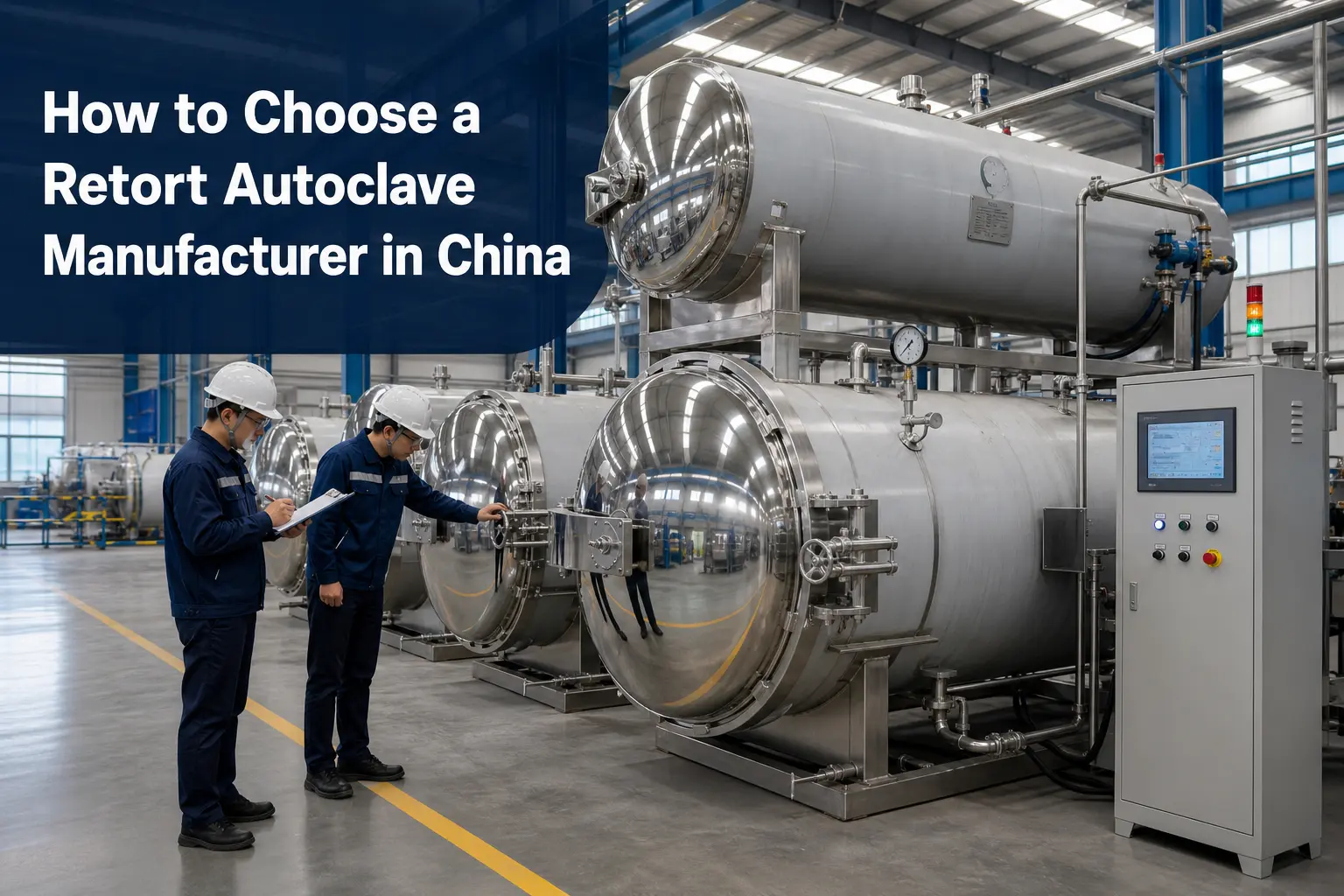
To choose a retort autoclave manufacturer in China, start with your food, package, required throughput, utilities, and destination-market requirements—not with a generic machine price. Then verify the supplier’s actual manufacturing and engineering capability, pressure-vessel documentation, material traceability, thermal-process knowledge, control and record functions, customization process, factory acceptance test, and installation support. Compare quotations on the same technical basis and evaluate total cost of ownership rather than purchase price alone.
The objective is not to build the longest supplier list. It is to shortlist companies that can explain how their machine fits your packaged product and support the proposal with drawings, component details, documentation, and a test plan.
Retort, Autoclave, and Sterilizer: What Do the Terms Mean?
In food processing, a retort is a pressure vessel used to thermally process sealed food packages. Depending on the product and process, it heats containers under controlled temperature and pressure, holds them for a defined period, and then cools them under controlled conditions.
The terms retort autoclave, food retort sterilizer, and food sterilization retort are often used for the same category of equipment. “Autoclave” by itself is broader and can also describe equipment used in unrelated sectors. In this guide, it refers only to industrial food equipment for packaged products—not medical, dental, laboratory, or pharmaceutical autoclaves.
Terminology varies among retort autoclave suppliers in China, so look beyond the name. Confirm the heating medium, circulation method, package movement, pressure control, cooling sequence, basket format, and controls.
Common Food Retort Configurations
Manufacturers may offer several configurations. Availability and design details differ by supplier, so treat these as categories to discuss, not as a list of features that every manufacturer provides.
- Steam retorts expose the load to steam. Venting, air removal, and steam distribution are important design questions.
- Water immersion retorts process the load in hot water and can provide controlled counterpressure.
- Water spray or cascade retorts circulate heated water over the load. Ask how flow is distributed and cold spots are evaluated.
- Steam-air retorts use steam with compressed air for pressure control; mixing and circulation affect temperature uniformity.
- Rotary or agitating retorts move the product. Speed, headspace, viscosity, package strength, and product texture all matter.
Selection must be based on the product-package-process combination. A configuration that performs well with a metal can containing a low-viscosity product may not be appropriate for a flexible pouch, glass jar, plastic tray, or a product with particulates. Ask each manufacturer to explain why the proposed method is suitable and what information is still needed before final selection.
Define the Application Before Requesting a Quote
A useful quotation begins with a useful process brief. Prepare the following five groups of information before contacting manufacturers.
1. Product
Describe the food category, pH classification if known, viscosity, particle size, fill weight, initial temperature, sensitivity to overcooking or agitation, and whether multiple recipes will run on the system. Do not expect a supplier to approve a scheduled process from incomplete data.
2. Package
Provide package material, dimensions, net weight, closure, basket orientation, and photos or drawings. Package deformation and seal integrity depend on internal package pressure, retort pressure, heating, and cooling.
3. Capacity
Specify output per hour or shift, batch size, daily shifts, changeover frequency, and expected growth. Request the capacity calculation: containers per basket, baskets per batch, estimated cycle time, handling allowance, and batches per shift. Vessel volume alone does not prove capacity.
4. Utilities and Site Conditions
List steam pressure and capacity, electricity, compressed air, cooling-water temperature and flow, process-water quality, drainage, installation space, access, and floor constraints. Identify utilities not yet selected because assumptions can materially change performance and cost.
5. Target Market and Compliance
State where the equipment will operate and the food will be sold. Request a document list mapped to applicable requirements. “Export standard” is not a sufficient specification: pressure-equipment rules, electrical conventions, labeling, language, food-contact documents, and inspections vary.
Eight Criteria for Evaluating a Manufacturer
1. Actual Manufacturing and Engineering Capability
Confirm who manufactures the pressure vessel, assembles the system, performs subcontracted work, and owns the mechanical, electrical, and control design. During a video audit or visit, review material receiving, welding, assembly, control-panel work, testing, and completed equipment. Match the facility, nameplates, drawings, and company identity.
Engineering quality is visible in the questions a supplier asks. A credible team should request application data before freezing the design and should be able to explain water flow, pressure control, basket arrangement, component access, and cleaning considerations.
2. Pressure-Equipment Compliance and Documentation
Ask which design code or standard will govern the vessel and what documentation is included. Depending on the project, this may involve design calculations, material certificates, welding documentation, welder qualifications, inspection records, pressure-test reports, safety-device information, drawings, manuals, and certificates.
Ask for the exact certificate scope, issuing body, model coverage, and document package. Your local engineer, inspection body, importer, or authority should confirm whether it is sufficient in the destination market.
3. Materials and Manufacturing Quality
Specify product-contact and non-contact materials, stainless-steel grades, plate thicknesses, surface finish where relevant, gasket materials, insulation and cladding, piping specification, and corrosion allowances if applicable. Ask how material grades are verified and traced.
Review welds, internal finish, drainage, pipe support, access, and possible residue traps. A material name does not replace a bill of materials, certificates, and inspection records.
4. Thermal-Process and F0 Knowledge
The manufacturer should understand heat penetration, heat distribution, cold spots, come-up time, holding time, cooling, counterpressure, and the meaning of lethality or F0 in thermal processing. It should also distinguish machine control from process authority.
The supplier may provide hardware, controls, data, and test support, but a qualified thermal-process authority should establish or accept the scheduled process where required. Ask how the retort supports distribution testing and which ports, sensors, records, or fixtures are available.
5. PLC Control and Process Records
Request a functional description rather than simply asking whether the machine has a PLC. Review how recipes are created and protected, how operators log in, which variables are controlled, how alarms and interlocks behave, what happens after a power or utility interruption, and how a batch can be safely recovered or rejected.
Confirm recorded values, sampling interval, storage, export format, time synchronization, audit functions if required, and batch identity. Ask about backups, software access, electrical drawings, and replacement procedures.
6. Customization and Design Review
Customization should be a controlled engineering process. Ask for a requirement specification, general arrangement drawing, process and instrumentation information, utility list, basket and loading design, component schedule, electrical standard, interface list, and formal drawing approval before fabrication.
Clarify which changes are included, which cost extra, and what happens after approval. This reduces late changes caused by access, voltage, steam, or basket-layout problems.
7. Factory Acceptance Test
Agree on the FAT scope before placing the order. It may include document review, dimensional and visual inspection, component verification, pressure or leak tests as applicable, dry-cycle and water-cycle operation, valve and pump checks, temperature and pressure control, alarms, interlocks, recipe operation, record export, rotation where specified, and a review of spare parts and manuals.
Define acceptance criteria, instruments, calibration evidence, sample load, attendees, language, and punch-list closure. For product testing, define who supplies samples and what the test can prove.
8. Installation, Training, and After-Sales Support
Clarify responsibility for unloading, positioning, utility connections, commissioning, process validation, operator and maintenance training, travel, visas, accommodation, remote support, and translation. Ask for the installation prerequisites before shipment.
The spare-parts proposal should identify commissioning, wear, and critical spares, lead times, and locally replaceable components. Establish the warranty start, exclusions, response channel, remote support, and third-party component responsibility.
Compare Quotations and Total Cost of Ownership
Normalize every quotation in a comparison sheet. At minimum, compare usable basket capacity, expected cycle assumptions, vessel and piping materials, heating and circulation method, pressure control, rotation or agitation, included pumps and valves, control hardware, sensors, data recording, safety devices, documentation, FAT, packaging, freight terms, commissioning, training, warranty, spares, exclusions, and lead time.
Then evaluate total cost of ownership. Include utilities per batch, labor for loading and operation, water consumption, cleaning time, maintenance access, consumables, spare-parts availability, downtime risk, service travel, expected package loss, and the cost of adding missing documentation or local compliance work. A low initial price can become expensive if the capacity calculation is optimistic, utilities are undersized, controls lack usable records, or commissioning is excluded.
Red Flags When Screening Suppliers
Be cautious if a supplier:
- quotes from vessel diameter alone without asking about the product and package;
- guarantees a process result before reviewing application data or testing;
- cannot explain whether it is the manufacturer, integrator, or trading company;
- refuses to identify design assumptions, exclusions, or subcontracted work;
- offers certificates that cannot be matched to the company, model, or scope;
- substitutes component brands or materials without written approval;
- provides no drawings, utility schedule, FAT protocol, or document list;
- claims one configuration is ideal for every package and recipe;
- asks for full technical acceptance before the agreed tests are complete; or
- gives a delivery promise without linking it to design approval, payment, materials, and inspection milestones.
RFQ Checklist for Retort Autoclave Suppliers in China
Send the same structured RFQ to every shortlisted supplier:
- company and project location;
- food type, recipe characteristics, viscosity, particulates, fill weight, and initial temperature;
- package material, dimensions, closure, orientation, and photos or drawings;
- required output, batch size, shifts, and product mix;
- target process temperature and scheduled process information, if already established;
- preferred retort method, if known, and whether rotation is required;
- available steam, electricity, compressed air, cooling water, drainage, and installation space;
- destination-country pressure, electrical, documentation, and inspection requirements;
- required control, recipe, alarm, user-access, and batch-record functions;
- requested drawings, certificates, material records, manuals, and FAT documents;
- installation, commissioning, training, warranty, remote support, and spare-parts expectations; and
- required delivery term, Incoterm, destination, project schedule, and quotation validity.
Ask the supplier to return a completed compliance table with “included,” “excluded,” “deviation,” and “to be confirmed” against each requirement. This makes comparison faster and exposes hidden assumptions.
When Is a Hot-Water Retort a Good Fit?
A hot-water retort deserves consideration when packaged foods require controlled heat transfer together with controlled pressure through heating and cooling. Water immersion, spray, cascade, and hot-water-return designs are not identical, but they use heated water as the principal heat-transfer medium and can be engineered for a range of sealed packages.
For a useful comparison, ask each supplier to map the complete water circuit. The proposal should identify the heating source, hot-water storage or return arrangement if used, circulation pumps, distribution points, heat exchanger if applicable, temperature sensors, pressure-control devices, cooling-water route, drains, and recovery steps. Review how the design limits temperature stratification and how trapped air is managed. A flow diagram and control narrative are more informative than a claim of “uniform heating.”
Cycle economics also matter. Request the assumed water volume, steam demand, cooling-water demand, come-up time, holding time, cooling time, and time between batches. Compare these values only when load, starting temperature, target process, and utilities are equivalent. Faster heating is not an advantage if it exceeds the package limit, damages texture, or creates difficult-to-control pressure changes.
Hot water can be particularly relevant when package protection and controlled counterpressure are important. Flexible packages, plastic containers, glass, and other formats can react differently as internal pressure changes. The manufacturer should review the package’s temperature and pressure limits, headspace, seal design, loading pattern, and cooling behavior instead of selecting a cycle by package name alone.
Circulation is central. Ask how hot water reaches the full load, how flow is balanced, where temperature sensors are placed, how the system controls come-up and cooling, and how distribution will be tested. For a rotary design, also define rotation speed, mechanical restraint, container movement, headspace, product viscosity, and the desired effect on heat transfer and texture.
A hot-water retort is not automatically the best choice for every product. Compare it with steam, steam-air, and other water-based configurations using trial data, package requirements, utility demand, cycle time, process-authority input, cleaning needs, and lifecycle cost. The correct decision is the configuration that can repeatedly deliver the scheduled process while protecting package integrity and product quality.
What Weishu Offers for Food Retort Sterilization
Weishu’s current Retort Sterilizer (Auto Clave) product page describes a hot-water returning food retort sterilizer for packaged foods. The system circulates high-temperature, high-pressure hot water and uses internal product rotation to support heat transfer. The listed control system uses a PLC with a touch screen and controls temperature, pressure, and rotation speed.
The page lists SUS304/SUS316L as material options, CE certification, and a minimum order quantity of one unit. It also displays a 30-day delivery time. Actual material selection, certificate scope, configuration, production schedule, and delivery date should be confirmed for each project before order placement.
The listed applications include packaged foods in cans, glass bottles, plastic bags and boxes, and compound-film packages. Suitability still depends on the specific food, package, process schedule, and required output. Buyers should send application details so the configuration can be discussed against their operating conditions rather than relying on a general product label.
Frequently Asked Questions
Which are the retort autoclave manufacturers in China?
There is no single useful answer based only on a company list. The relevant manufacturers are those that can meet your product, package, capacity, utility, documentation, and destination-market requirements. Build a shortlist using the eight criteria in this guide, then compare proposals through a common RFQ, design review, and FAT plan.
Should I choose a retort based on price per liter?
No. Vessel volume does not show usable load, cycle time, heat distribution, package protection, controls, or documentation. Compare output under stated assumptions and calculate total cost of ownership.
Who defines F0 and the sterilization schedule?
The required lethality and schedule depend on the food, package, process, and applicable rules. A qualified thermal-process authority should establish or accept it where required. The supplier should provide the controls, data, and test provisions needed to execute it.
What should be completed before shipment?
Complete drawing approval, document review, inspections, FAT, punch-list closure, packing review, spare-parts check, installation prerequisites, and commercial milestones. Keep signed records of deviations and approvals.
Final Manufacturer Selection Checklist
Before awarding the order, confirm that:
- application fit and capacity calculations are documented;
- standards, certificate scope, and document deliverables are agreed;
- materials, components, controls, and substitutions are specified;
- thermal-process and validation responsibilities are divided;
- drawings and utilities have been reviewed by the plant team;
- FAT scope and acceptance criteria are contractual;
- installation, training, warranty, service, and spares are defined; and
- the commercial comparison includes exclusions and total cost of ownership.
Discuss Your Food Retort Application
If you are evaluating a hot-water food retort sterilizer, review Weishu’s food retort sterilizer to understand the current equipment design and available project information. When you are ready to discuss your application, contact Weishu with your product description, package drawings or photos, required output, available utilities, destination country, and documentation requirements. These details will help the team discuss a suitable configuration and prepare a project-specific quotation.
Table of Contents
- Retort, Autoclave, and Sterilizer: What Do the Terms Mean?
- Common Food Retort Configurations
- Define the Application Before Requesting a Quote
-
Eight Criteria for Evaluating a Manufacturer
- 1. Actual Manufacturing and Engineering Capability
- 2. Pressure-Equipment Compliance and Documentation
- 3. Materials and Manufacturing Quality
- 4. Thermal-Process and F0 Knowledge
- 5. PLC Control and Process Records
- 6. Customization and Design Review
- 7. Factory Acceptance Test
- 8. Installation, Training, and After-Sales Support
- Compare Quotations and Total Cost of Ownership
- Red Flags When Screening Suppliers
- RFQ Checklist for Retort Autoclave Suppliers in China
- When Is a Hot-Water Retort a Good Fit?
- What Weishu Offers for Food Retort Sterilization
- Frequently Asked Questions
- Final Manufacturer Selection Checklist
- Discuss Your Food Retort Application