
 EN
EN
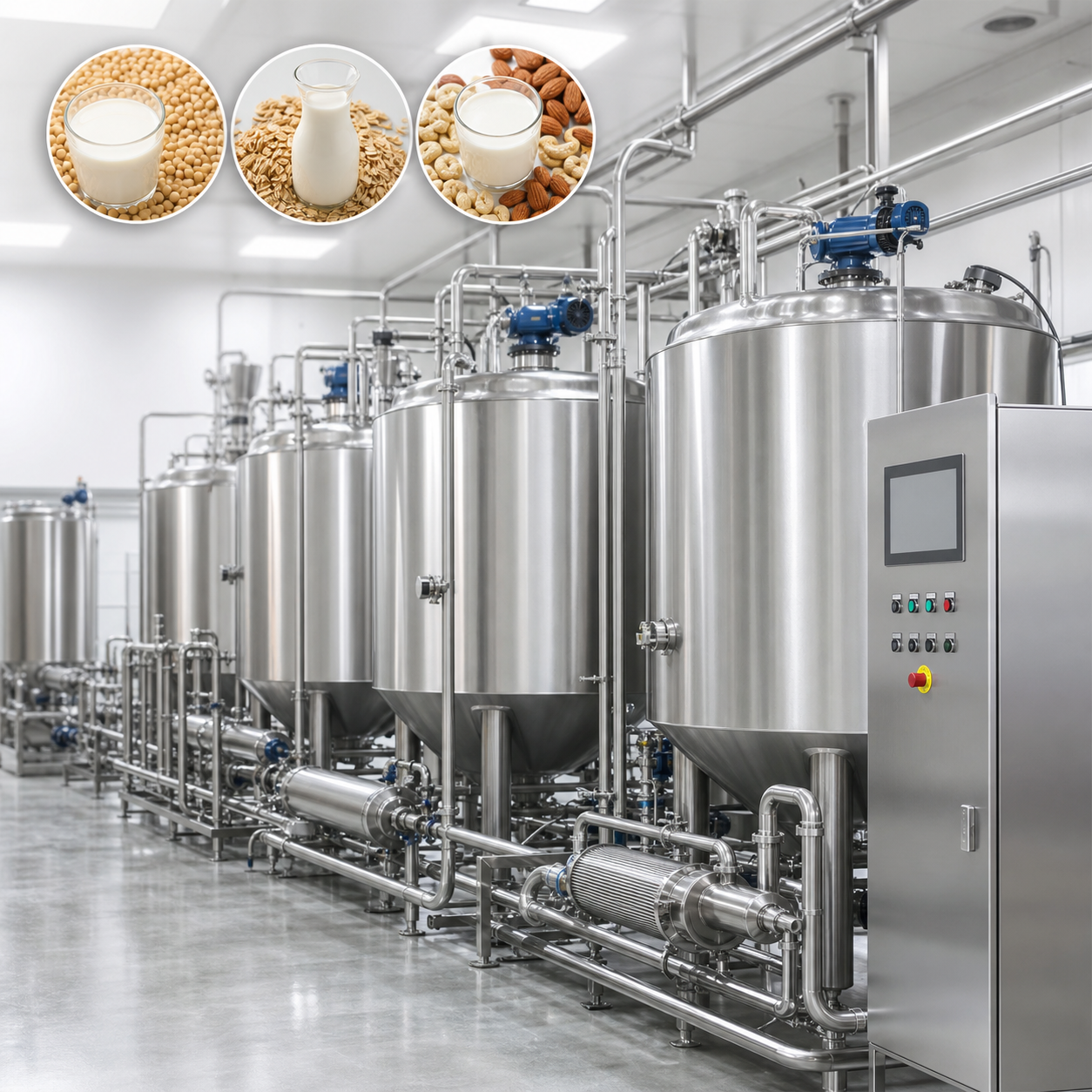
Choosing a plant based milk production line is not simply a matter of comparing machine prices or rated output. The right system depends on your raw material, recipe, production capacity, packaging format, shelf-life target and preferred level of automation.
An oat milk processing line, for example, needs a different upstream process from an almond or walnut milk plant. Likewise, a refrigerated beverage requires a different heat-treatment and filling setup from a shelf-stable product.
This guide explains how to plan a plant-based beverage processing system, match the core machines and prepare a more accurate request for quotation.
What Does a Complete Plant Based Milk Production Line Include?
A complete plant milk processing line normally covers raw material preparation, extraction or slurry preparation, separation, blending, deaeration, homogenization, heat treatment and filling. The exact configuration changes with the ingredient because oats, peanuts, almonds and walnuts behave differently during grinding, heating and storage.
Instead of selecting isolated machines, buyers should evaluate the entire process—from incoming raw materials to the finished package.
How Does the Process Run from Raw Material to Packaging?
A typical commercial plant milk production process includes the following stages:
- Raw material preparation: Cleaning, sorting, soaking, roasting, peeling or milling, depending on the ingredient.
- Extraction or slurry preparation: Water is added before wet grinding, powder dispersion or controlled hydration.
- Separation: Screens, filters or separators remove coarse fiber and insoluble particles when required.
- Formulation: Water, oil, sugar, minerals, stabilizers and flavors are added in a sanitary mixing system.
- Deaeration: Entrained air is reduced to limit oxidation, excessive foam and filling problems.
- Homogenization: Fat droplets and suspended particles are reduced and dispersed to improve texture and physical stability.
- Heat treatment: Pasteurization or UHT processing is selected according to the product and distribution model.
- Filling and packaging: The beverage is filled under hygienic or aseptic conditions suited to its shelf-life target.
- CIP cleaning: Tanks, pipelines, heat exchangers and filling circuits are cleaned using a validated clean-in-place program.
The sequence is not identical for every non-dairy beverage. The ideal position of deaeration and homogenization, for instance, depends on product viscosity, heat-treatment conditions and filling temperature.
How Does the Process Change for Oat, Almond, Peanut and Walnut Milk?
Oat beverages contain starch, so viscosity control is one of the main processing challenges. Depending on whether the factory uses whole oats, oat flour or a prepared oat base, production may involve milling, slurry preparation, enzymatic hydrolysis, enzyme inactivation and fiber separation.
If hydrolysis is insufficient, the oat slurry may remain too thick to pump, homogenize or heat efficiently. If it goes too far, the drink may become overly sweet or lose body. Enzyme dosage, holding time, temperature and pH therefore need to be tested against the target recipe.
A nut milk processing line follows a different route. Almonds, peanuts and walnuts may require soaking or roasting, optional peeling, wet grinding and separation before formulation. These choices affect extraction yield, color, flavor and sediment formation.
For that reason, a serious equipment supplier should ask what form of raw material you plan to use—not simply whether you want to produce “plant milk.”
How Should You Select Plant Milk Equipment and Production Capacity?
Select each machine using the beverage’s actual viscosity, solids content, temperature and operating schedule—not just its nominal water capacity. Every major unit must also be sized as part of one continuous production system.
A 5,000 LPH homogenizer cannot deliver a 5,000 LPH line if the separator, UHT sterilizer or filling machine becomes the bottleneck.
What Oat Milk Processing Line Equipment Is Required?
A typical oat milk processing line equipment package may include:
- Raw material cleaning and conveying equipment;
- Milling or powder-feeding system;
- Slurry preparation and enzyme-reaction tanks;
- Heating and cooling system;
- Enzyme-inactivation section;
- Filtration or separation equipment;
- Mixing and formulation tanks;
- Vacuum deaerator;
- High-pressure homogenizer;
- Pasteurizer or tubular UHT sterilizer;
- Buffer and storage tanks;
- CIP cleaning station;
- Filling and packaging equipment.
Not every oat beverage factory needs every machine. A plant using raw oats requires more upstream processing than one using oat flour, concentrate or a ready-made oat base.
Before requesting a quotation, provide the raw material specification and at least a preliminary formula. Otherwise, two quotations described as “complete oat milk lines” may contain very different equipment and project boundaries.
How Do You Match Equipment for a 500–5000 LPH Line?
Weishu can configure plant-based beverage lines in the 500–5000 LPH range, subject to the product, process and packaging requirements. The engineering team should still confirm the effective throughput of every major section.
Ask the supplier:
- Is the stated capacity continuous or batch-based?
- Is it based on water or the actual plant-based formulation?
- Can the mixing section prepare the next batch while the current batch is being processed?
- Does the deaerator match the homogenizer flow rate?
- Can the UHT system handle the product’s actual viscosity?
- Does the filling speed include normal stops and container changeovers?
- How much production time is allocated to CIP?
- Is there enough buffer capacity between processing and filling?
For example, the current vacuum deaerator range covers approximately 1,000–5,000 LPH. A 500 LPH project may therefore require a smaller customized unit, batch deaeration or a different process arrangement.
A useful proposal should include a capacity balance showing how the tanks, pumps, deaerator, homogenizer, sterilizer and filling machine work together. A list of equipment names is not enough.
How Do Homogenization and Heat Treatment Affect Plant Milk Quality?
Homogenization affects particle distribution, mouthfeel and emulsion stability, while heat treatment controls microbial safety and helps determine whether the product needs refrigeration. Neither process has one universal setting that works for every plant-based drink.
Raw material, fat, fiber, solids, stabilizers and target shelf life must all be considered before final parameters are selected.
How Do You Choose a High Pressure Homogenizer for Plant Based Milk?
A high-pressure homogenizer forces the beverage through a narrow valve, creating intense shear, turbulence and impact. This reduces the size of suspended particles and fat droplets, helping the product remain smoother and more uniform.
Effective homogenization can:
- Reduce fat separation and visible sediment;
- Improve emulsion stability;
- Create a smoother mouthfeel;
- Improve batch-to-batch consistency;
- Support more predictable filling and storage performance.
Higher pressure is not automatically better. Too little pressure may leave the drink coarse or unstable, while unnecessary pressure raises energy use, product temperature and component wear.
An industrial high-pressure homogenizer should be selected according to:
- Required flow rate;
- Product viscosity and solids content;
- Fat and fiber levels;
- Target particle size;
- Single-stage or two-stage operation;
- Product inlet temperature;
- Required working pressure;
- CIP compatibility;
- Valve, seal and spare-parts requirements.
Available Weishu configurations cover industrial processing capacities with listed maximum-pressure options in the 25–60 MPa range. The maximum machine pressure is not necessarily the correct operating pressure for a particular recipe.
The best setting is usually the lowest validated pressure that achieves the required texture and storage stability. It should be confirmed through product trials rather than copied from a dairy or beverage formula with different characteristics.
Deaeration also deserves attention. A properly selected vacuum degasser for liquid food processing can reduce entrained air, control filling foam and limit oxidation after intensive mixing.
Should You Choose Pasteurization or UHT Processing?
Choose pasteurization for refrigerated products supported by a reliable cold chain. Choose UHT treatment with a compatible hygienic or aseptic filling system when the goal is a shelf-stable beverage.
A pasteurized plant milk line typically requires:
- Plate or tubular pasteurization;
- Hygienic filling;
- Rapid product cooling;
- Refrigerated storage and distribution.
A long-life plant-based beverage line may require:
- Tubular UHT sterilization;
- Sterile product holding and transfer;
- Aseptic filling;
- Suitable barrier packaging;
- Automated CIP and sterilization control.
The sterilizer alone does not determine shelf life. Formula, pH, initial microbial load, filling hygiene, package integrity and storage conditions all play a role.
For a closer look at high-temperature, short-time processing, see this guide to UHT production line technology. Although the article focuses on dairy, the equipment-selection questions around flow, heat transfer and aseptic handling are also relevant to many plant-based beverages.
Final processing conditions and shelf-life claims should always be validated using the intended recipe and package.
What Should a Turnkey and Fully Automatic Plant Milk Line Include?
A turnkey plant based milk production line should define who is responsible for process design, equipment supply, installation, commissioning and operator training. A fully automatic plant based beverage processing line should go one step further by clearly identifying which operations are automated.
Neither term is meaningful unless the quotation states exactly what is included, excluded and supplied by the buyer.
What Is Included in a Turnkey Plant Based Milk Production Line?
A practical turnkey plant-based milk production line may cover:
- Process-flow development;
- Equipment selection and sizing;
- Factory layout planning;
- Main processing machines;
- Product pipelines, pumps and valves;
- Electrical control panels;
- CIP cleaning equipment;
- Utility interface requirements;
- Filling and packaging equipment;
- Installation supervision;
- Equipment commissioning;
- Operator training;
- Technical and maintenance documents.
Buyers should also confirm whether the offer includes water treatment, boilers, refrigeration, air compressors, electrical distribution, laboratory equipment, local labor and civil work. These items are often outside the basic equipment scope.
A complete proposal should explain:
- What the supplier will deliver;
- What the buyer must prepare;
- Which product or capacity tests will be performed;
- How factory and site acceptance will be handled;
- Which commissioning materials and spare parts are included;
- What technical support is available after startup.
This prevents a low initial quotation from becoming more expensive after essential utilities, piping or installation services are added.
What Makes a Fully Automatic Plant Based Beverage Processing Line?
A fully automatic system may include PLC and HMI control, automated batching, temperature regulation, recipe management, valve sequencing, alarm recording and automatic CIP. However, automation levels vary considerably between suppliers and projects.
One line may automate sterilization while still relying on manual ingredient loading, hose connections or valve changes. Another may connect formulation, processing, cleaning and packaging through a central control system.
Before accepting a “fully automatic” description, ask whether the scope includes:
- Automatic water and ingredient dosing;
- Load-cell or flowmeter-based batching;
- Recipe storage and access control;
- Automatic production sequencing;
- Automated valve switching;
- Homogenizer and sterilizer interlocks;
- CIP concentration, temperature and time monitoring;
- Production data and alarm records;
- Batch traceability;
- Automatic filling, capping, labeling and packing.
The ideal automation level depends on the number of recipes, production frequency, labor cost and traceability requirements. A startup producing one beverage may not need the same control architecture as a multi-product factory running frequent changeovers.
How Can Buyers Reduce Risk Before Ordering a Plant Milk Line?
Reduce project risk by checking relevant reference projects, testing the intended product and defining measurable acceptance criteria before signing the order. Each machine in the proposal should solve a specific process requirement.
The objective is not to buy the largest or most automated line. It is to build a reliable non-dairy beverage plant that can produce the required product at the agreed output.
What Can a 5000 LPH Walnut Milk Project Demonstrate?
A relevant project shows whether a supplier can integrate upstream processing, liquid preparation, thermal treatment and packaging—not simply manufacture individual machines.
In 2024, Weishu delivered a 5,000 LPH walnut milk production project in Henan, China. The reported scope included raw walnut processing, beverage blending, UHT sterilization, bottle blowing, filling and packaging.
A project of this type can help a prospective buyer evaluate:
- Whether the processing and packaging sections can be connected;
- How tanks, pumps, homogenization, sterilization and filling are coordinated;
- Whether the supplier can support layout planning and installation;
- Whether the complete line can be commissioned as one system;
- Whether operators can receive production and maintenance training.
A reference line should still be treated as evidence of capability, not as a copy-and-paste design. A walnut milk system cannot be duplicated for oat milk without adjusting the raw material preparation, separation and viscosity-control stages.
What Information Is Needed for an Accurate Production Line Proposal?
A clear project brief helps engineers recommend suitable plant milk manufacturing equipment and allows buyers to compare quotations on equal terms.
Prepare the following information:
- Plant material: oats, almonds, peanuts, walnuts or another source;
- Raw material form: whole ingredient, flour, concentrate or prepared base;
- Preliminary formula or expected solids content;
- Required hourly and daily output;
- Planned production hours per day;
- Cold-chain or ambient distribution;
- Target shelf life;
- Package material and filling volume;
- Required automation level;
- Factory dimensions;
- Local voltage and frequency;
- Available steam, chilled water and compressed air;
- Required installation and commissioning schedule.
If the formula is still being developed, say so. Engineers can prepare a preliminary process concept, but final equipment specifications should be confirmed after product trials.
Plant milk projects often run into trouble at the interfaces: a viscous beverage reaches an undersized heat exchanger, the filling machine runs more slowly than the processing section, or cleaning time reduces the expected daily output. Finding these gaps on a process diagram is far less expensive than discovering them after installation.
Request a Free Feasibility Pre-Assessment — receive a preliminary line configuration and identify capacity bottlenecks before comparing quotations.
Send your raw material, target capacity, package and shelf-life requirements to begin. If those details are not ready yet, get the Plant Milk Project Checklist— organize your technical requirements and reduce missing items in supplier proposals.
Table of Contents
- What Does a Complete Plant Based Milk Production Line Include?
- How Should You Select Plant Milk Equipment and Production Capacity?
- How Do Homogenization and Heat Treatment Affect Plant Milk Quality?
- What Should a Turnkey and Fully Automatic Plant Milk Line Include?
- How Can Buyers Reduce Risk Before Ordering a Plant Milk Line?