
 EN
EN
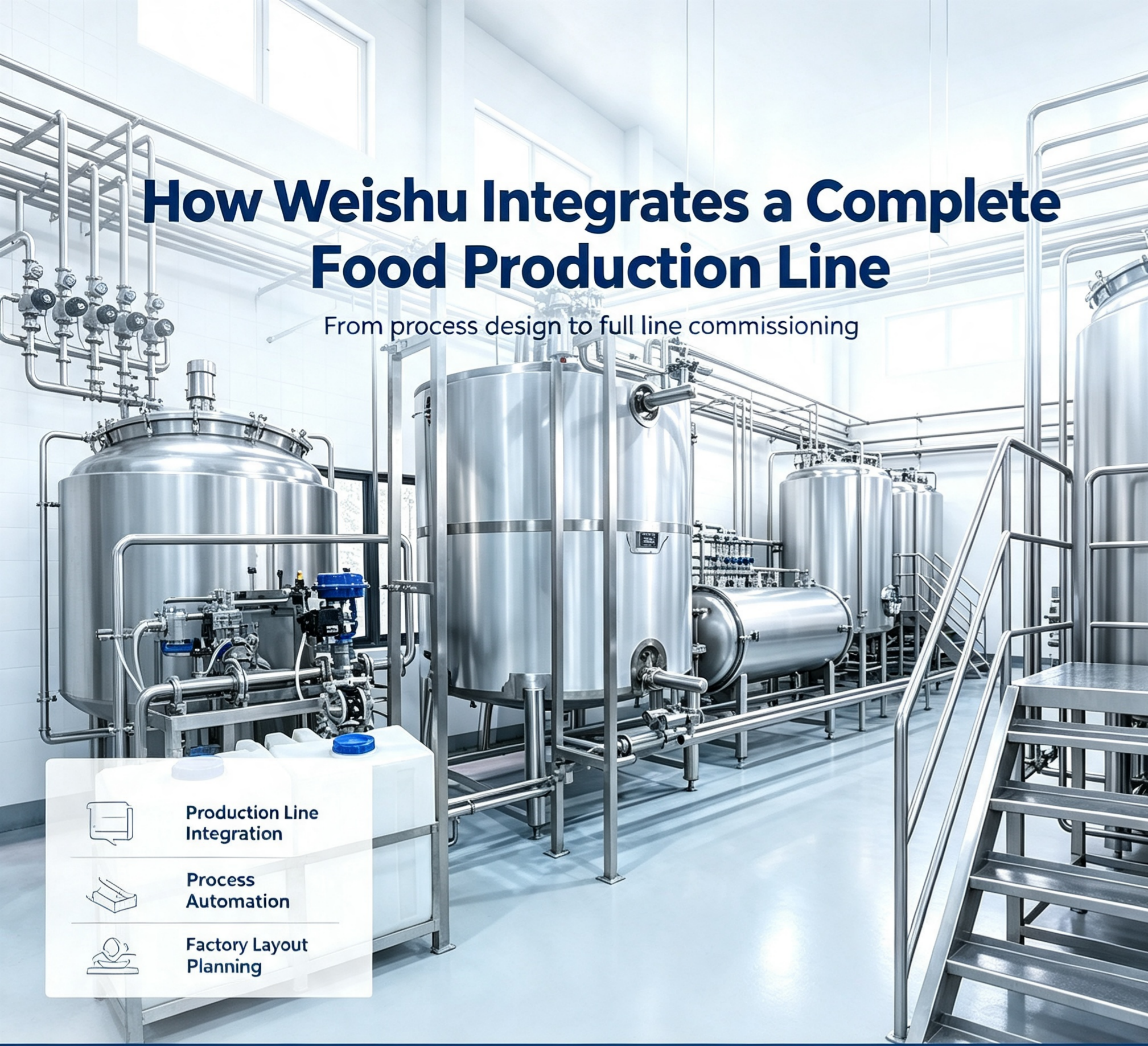
A complete production line is not simply a row of individual machines. Every tank, pump, pipe, heat exchanger, homogenizer, filler, control panel, and utility connection must operate on the same product and capacity basis.
At Weishu, we manufacture and configure equipment for dairy, juice, plant beverages, water, ice cream, cheese, milk powder, and other liquid-food applications. Our work on a complete line begins by defining the interfaces between the machines in our product range, not by selecting each machine independently.
This is how we coordinate the main parts of a processing line before manufacturing and installation.
1. We Define One Process Basis
The complete line needs one agreed design basis. We start with:
- raw material and incoming condition;
- finished product;
- formulation at a functional level;
- viscosity, particles, solids, and foaming behavior;
- hourly and daily output;
- batch size and operating schedule;
- packaging format and filler output;
- cleaning requirements;
- utility conditions;
- automation level;
- destination market and applicable project requirements.
This information is used across the entire line. If a mixing tank is selected for one viscosity while the pump and filler are selected for another, the system may not transfer or fill the product correctly. If the filler output is lower than the thermal-processing flow, the line will need a buffer or a different operating sequence.
2. We Match Batch Equipment With Continuous Equipment
Ingredient preparation and mixing are often batch operations. Homogenization, pasteurization, UHT processing, and filling may operate continuously.
We calculate whether the batch section can keep the continuous section supplied. This includes:
- ingredient-charging time;
- mixing or hydration time;
- heating or cooling time;
- quality-check time;
- transfer time;
- tank cleaning time;
- continuous process flow;
- filler output;
- product-change frequency.
Our stainless-steel mixing tanks can be configured for different production duties, but tank volume alone does not solve a timing problem. Depending on the schedule, we may propose alternating preparation tanks, a separate buffer tank, or longer production campaigns.
3. We Select Product-Transfer Equipment Around the Actual Liquid
Pumps, valves, and pipelines must match product characteristics and process duties.
Our engineering review considers:
- viscosity range;
- solids and particle size;
- shear sensitivity;
- required flow and pressure;
- suction conditions;
- temperature;
- hygienic requirements;
- drainability;
- cleaning flow;
- transfer distance and elevation.
The product pump that transfers water is not automatically suitable for yogurt, fruit pulp, or a foaming beverage. We also check whether the same pipe diameter can support both product transfer and the planned CIP flow.
4. We Coordinate Thermal Processing With Upstream Preparation
The thermal-processing system must receive product at a controlled flow, temperature, and composition. Variation in solids, viscosity, particles, or entrained air can affect heat transfer and operating stability.
For applicable shelf-stable liquid products, we may integrate a tubular UHT sterilizer with upstream blending, homogenization or deaeration, sterile buffering, and filling. For pasteurized products, we coordinate heating, holding, cooling, diversion, and downstream cold-chain handling according to the validated product process.
The exact thermal conditions are product-specific. We configure the equipment to support the agreed process, while the processor and its qualified food-safety team approve and validate the final process for the product and market.
5. We Balance Processing With Filling
Filling is often the most format-dependent part of the line. Output changes with package size, product viscosity, number of filling heads, closure method, material feeding, and changeovers.
Before we finalize the upstream flow, we confirm:
- product and viscosity range;
- package material;
- fill sizes;
- sustainable filler output;
- format-change requirements;
- hygienic or aseptic interface;
- start-up and shutdown sequence;
- coding and inspection;
- secondary packaging;
- conveying and finished-product handling.
If the filler pauses, the upstream section needs a defined response. Depending on the product and process, this may involve buffering, controlled recirculation, diversion, or stopping the upstream section. We define the intended operating sequence instead of leaving the connection between the sterilizer and filler unresolved.
6. We Integrate CIP Into the Equipment and Piping Design
CIP is not a separate machine placed beside the line after the process has been designed. Cleaning flow, return paths, tank spray devices, valve routing, pump capacity, heat-exchanger cleaning, drainability, and chemical handling affect the complete arrangement.
We divide the line into practical cleaning circuits and identify:
- which equipment is cleaned together;
- CIP supply and return points;
- required cleaning flow and pressure basis;
- product-recovery steps;
- drain paths;
- manually cleaned components;
- sequence control;
- interfaces with the filler;
- cleaning records and verification points.
The processor validates the final cleaning program for the actual product and site. Our responsibility is to configure the equipment and circuits so that the approved program can be implemented.
7. We Calculate Utility Interfaces
Every equipment item may have a utility table, but a complete line requires a coordinated utility plan.
We identify the users of:
- electrical power;
- steam or hot water;
- chilled water;
- cooling water;
- process water;
- compressed air;
- refrigeration;
- CIP chemicals;
- drainage and wastewater.
We also consider simultaneous demand. Production, tank heating, cooling, filling, and CIP may overlap. Adding the maximum value from every machine without a schedule can oversize utilities, while ignoring simultaneous users can leave the plant unable to run the intended process.
Our utility basis supports the equipment configuration. Final site generation, distribution, building services, and local approvals must be coordinated with qualified local engineers.
8. We Connect the Automation Across the Line
A collection of separate control panels does not automatically create an integrated production line.
We define how the main modules exchange operating signals and how the line responds to:
- low or high tank level;
- pump availability;
- valve position;
- temperature deviation;
- flow interruption;
- filler stop;
- CIP selection;
- emergency stop;
- recipe change;
- equipment fault.
Depending on project scope, the control concept may include recipe management, alarms, trends, user permissions, batch records, and remote-support functions. We state the control boundary, instrument scope, panel responsibility, and field-wiring responsibility in the project documents.
9. We Coordinate the Equipment With the Factory Layout
The shortest pipe route is useful only if the equipment remains accessible and the factory flow remains practical.
We arrange:
- process order;
- raw and treated product separation;
- tank and skid access;
- filler interface;
- operator movement;
- maintenance clearance;
- product and utility piping;
- drainage;
- electrical panels;
- equipment installation route;
- reserved expansion space.
For a fruit juice production line, raw-fruit preparation and by-product handling must be coordinated with the liquid-processing section. For a yogurt processing line, fermentation time and tank allocation affect the equipment count and floor space. Each product family changes the integration priorities.
10. We Define Scope Before Manufacturing
A complete line may include equipment, product piping, valves, instruments, controls, utilities, filling, installation, commissioning, and training. However, the exact commercial boundary differs by project.
Before manufacturing, we prepare or confirm the relevant:
- process flow;
- equipment list;
- layout;
- utility basis;
- product-piping boundary;
- control scope;
- filling interface;
- installation responsibility;
- commissioning plan;
- documentation requirements;
- exclusions and customer-supplied items.
This makes the interfaces visible and gives both teams a shared reference when site work begins.
11. We Test Modules and Then Commission the Connected Line
Equipment inspection at our factory verifies the quoted equipment within the agreed test scope. Site commissioning then checks the installed interfaces, utilities, controls, product routes, cleaning routes, and operating sequence.
A connected line must be checked step by step:
- installation and utility readiness;
- individual equipment operation;
- instruments and control signals;
- water testing where applicable;
- cleaning circuits;
- connected process sequence;
- product trial under agreed conditions;
- operator training and handover.
The final acceptance method is defined in the contract and must reflect the agreed raw materials, utilities, package, operating conditions, and responsibilities.
Information We Need for Line Integration
To prepare a coordinated configuration, send:
- product and raw-material information;
- hourly and daily output;
- batch sizes and production schedule;
- high-level process requirements;
- package type, size, and required output;
- building drawing;
- available utilities;
- automation and data requirements;
- cleaning requirements;
- target market and applicable standards;
- the equipment and service scope expected from Weishu.
The earlier these interfaces are defined, the easier it is to keep tanks, pumps, thermal processing, filling, utilities, controls, and layout on the same design basis.
Frequently Asked Questions
Can Weishu integrate equipment supplied by another company?
This must be reviewed case by case. We need technical data, interface drawings, control requirements, hygienic connections, and clear responsibility boundaries before confirming integration scope.
Can one processing line serve several products?
It may, but every product affects mixing, heat treatment, transfer, tank allocation, cleaning, filling, and changeover. We review the complete SKU matrix and production schedule before proposing shared equipment.
Why is filler information needed so early?
Filler output, package, hygienic interface, and stop/start behavior affect the upstream process flow, buffer strategy, controls, and layout. Selecting it late can force changes to the rest of the line.
Does Weishu supply utilities with the production line?
Utility equipment and distribution are project-specific. Tell us which generation systems and site connections should be included so we can define the commercial boundary.
When is the final line capacity confirmed?
Capacity is confirmed against the agreed product, process, package, operating schedule, utilities, and test conditions—not by one machine’s maximum rating alone.
Discuss Your Complete Line With Weishu
Contact Weishu with your product, process, capacity, package, utility, and building information. Our engineering team will use it to discuss a coordinated configuration covering process equipment, tanks, transfer, thermal treatment, cleaning, controls, filling interfaces, and layout.
Table of Contents
- 1. We Define One Process Basis
- 2. We Match Batch Equipment With Continuous Equipment
- 3. We Select Product-Transfer Equipment Around the Actual Liquid
- 4. We Coordinate Thermal Processing With Upstream Preparation
- 5. We Balance Processing With Filling
- 6. We Integrate CIP Into the Equipment and Piping Design
- 7. We Calculate Utility Interfaces
- 8. We Connect the Automation Across the Line
- 9. We Coordinate the Equipment With the Factory Layout
- 10. We Define Scope Before Manufacturing
- 11. We Test Modules and Then Commission the Connected Line
- Information We Need for Line Integration
- Frequently Asked Questions
- Discuss Your Complete Line With Weishu