
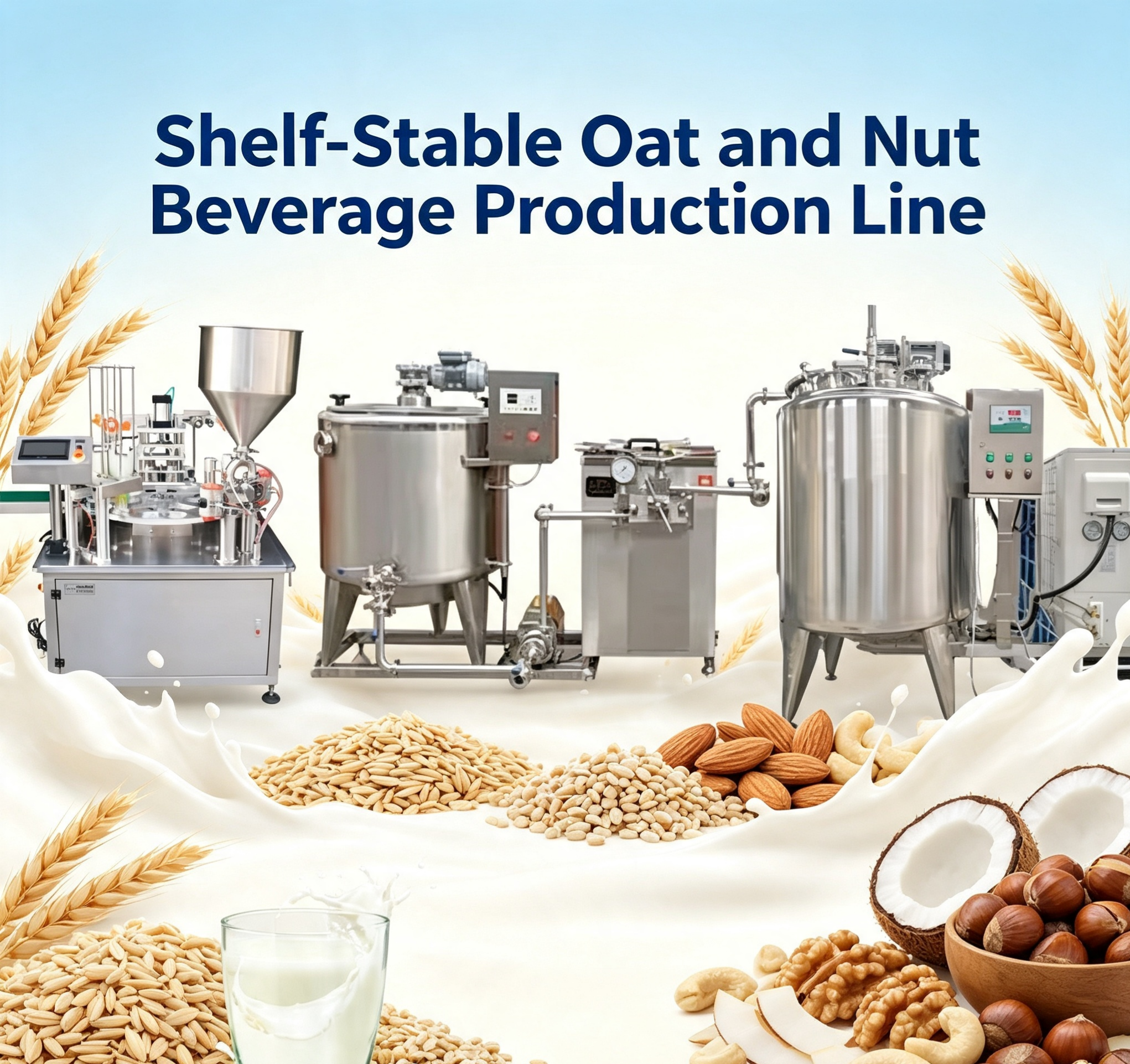
Producing a shelf-stable oat, almond, peanut, or walnut beverage requires more than placing a UHT sterilizer after a mixing tank. The complete line must manage raw-material preparation, suspended solids, recipe addition, product stability, thermal treatment, hygienic transfer, filling, and cleaning as one connected process.
At Weishu, we configure the equipment around the finished beverage rather than forcing every formula through one standard machine list. Our plant milk production line can combine raw-material preparation, extraction, blending, homogenization, thermal processing, filling, utilities, and cleaning according to the selected product route.
The right configuration depends first on the product you intend to sell. A smooth oat drink, a nut beverage with more body, and a blended cereal-and-nut drink may need different wet-processing, separation, homogenization, and heat-transfer arrangements. Package format and target shelf life also change the hygienic boundary of the project. This application explains how our engineering team approaches those decisions.
Define the commercial product before selecting equipment:
These answers determine whether the line needs soaking, blanching, grinding, pulping, filtration or centrifugation, powder induction, high-shear mixing, deaeration, homogenization, and an aseptic section.
The formulation also affects viscosity, settling behavior, fouling, heat transfer, and cleanability. Before we select pumps, valves, heat exchangers, tank agitation, and cleaning circuits, our engineering team reviews the recipe at a functional level and confirms the intended product route with the customer.
A shelf-stable plant-beverage project may include the following modules. The final sequence must be confirmed for the actual raw material and formula.
Whole oats or nuts may require inspection, cleaning, soaking, blanching, crushing, or wet grinding before extraction. Prepared powders or pastes use a different receiving and dosing arrangement.
At this stage, we first confirm:
Raw-material variability matters. Seasonal changes, supplier changes, and different particle sizes can affect extraction and downstream processing. The line should allow controlled adjustment without relying on uncontrolled manual additions.
Wet grinding or pulping releases the soluble and suspended components used in the beverage. Depending on the desired mouthfeel, the product may then pass through screens, filters, or another separation step.
Removing too little coarse material can increase sediment and create filling or heat-transfer problems. Removing too much may reduce body or change the intended product character. The correct balance is a product-development decision, not a universal machine setting.
Equipment selection should consider particle size, solids loading, flow consistency, ease of opening and inspection, and integration with the cleaning plan.
The extracted base is transferred to a blending system for controlled addition of water, sugar or syrup, oil, stabilizers, minerals, flavors, or other permitted ingredients.
A practical blending system should be specified around:
The tank should not be selected only by nominal volume. Allow for operating headspace, foam, agitation, minimum working level, transfer time, and the production schedule.
Vacuum deaeration may be considered where entrained air affects oxidation, foaming, filling stability, or heat transfer. Homogenization is commonly used to reduce particle or fat-droplet size and improve physical stability.
Pressure, temperature, number of stages, and homogenizer position depend on the formulation and process. They should be established through product trials or qualified process design. We use the product data as the design basis rather than presenting one setting as suitable for every oat and nut beverage. Where oxygen control is required, a vacuum deaerator can be integrated before downstream processing.
The thermal system must match product viscosity, particle characteristics, fouling tendency, target shelf life, packaging route, and the regulations of the destination market.
Shelf-stable products typically require a validated commercial-sterility process and protection from recontamination after final heat treatment. We can configure a tubular UHT sterilizer, sterile holding or buffering, and closed transfer to the selected filler. The exact time-temperature process must still be developed and validated for the actual product.
When we configure this section, we confirm:
Ambient distribution depends on the complete hygienic chain, including the filler and package. Selecting the package late can force major changes to the line.
Confirm:
The filler may become the production bottleneck, so upstream capacity should be balanced against realistic filling output rather than a theoretical headline speed.
Plant beverages can leave starch, protein, fat, fiber, mineral, and stabilizer residues. Cleaning circuits must cover tanks, pipelines, heat exchangers, homogenizers, and the interfaces to the filling section.
The cleaning program is product- and equipment-specific. In our line design, we define the cleaning circuits, supply and return paths, chemical and water requirements, sequence logic, and points that the customer will use for cleaning verification.
The project brief should also state available:
Hourly output is only one part of capacity planning. Build a daily schedule that includes raw-material preparation, blending, thermal processing, filling, changeovers, cleaning, maintenance, and product release.
For batch operations, calculate whether the preparation and blending tanks can feed the continuous section without starving it. For the continuous section, compare the sterilizer flow with the filler’s sustainable output. If several products share the line, include recipe changes and allergen-cleaning time.
A useful capacity brief includes:
This approach identifies the real bottleneck and prevents unnecessary oversizing.
This application is relevant when a processor wants to:
It may not be the correct approach when the product is sold only as a fresh, short-life drink, when processing is outsourced, or when the formula has not yet passed product-development and stability work. In those cases, pilot testing and formulation development should come before final equipment sizing.
To configure the line, our engineering team needs:
With these inputs, we can prepare a preliminary process sequence, major-equipment list, buffer strategy, utility basis, and project boundary. Customers can also review our existing oat, almond, peanut, and walnut beverage line before sending project details.
Potentially, but the line must be reviewed for different raw-material preparation, allergens, particle load, recipes, fouling behavior, and cleaning requirements. Shared equipment should be justified by the production schedule and validated cleaning plan.
No single heat exchanger is correct for every product. Selection depends on viscosity, particles, fouling, flow, pressure, required process, and filling arrangement. Share the product data and available test results with our team before we fix the thermal system.
It may be possible, but the process route, hygienic boundary, packaging, storage, and changeover plan must support both. The project should be designed around clearly defined SKUs rather than a general claim of flexibility.
Batch duration, continuous-line flow, ingredient-addition time, transfer time, cleaning time, recipe changes, and required production continuity all affect the number and size of tanks.
The processor should validate the formulation, thermal process, physical stability, cleaning procedures, packaging integrity, shelf life, food-safety controls, and compliance with target-market requirements.
Contact our team with your raw material, target product, hourly output, package, destination market, utility conditions, and plant drawing. We will use this information to prepare a preliminary process flow, equipment boundary, and configuration for further engineering review.







 EN
EN