
 EN
EN
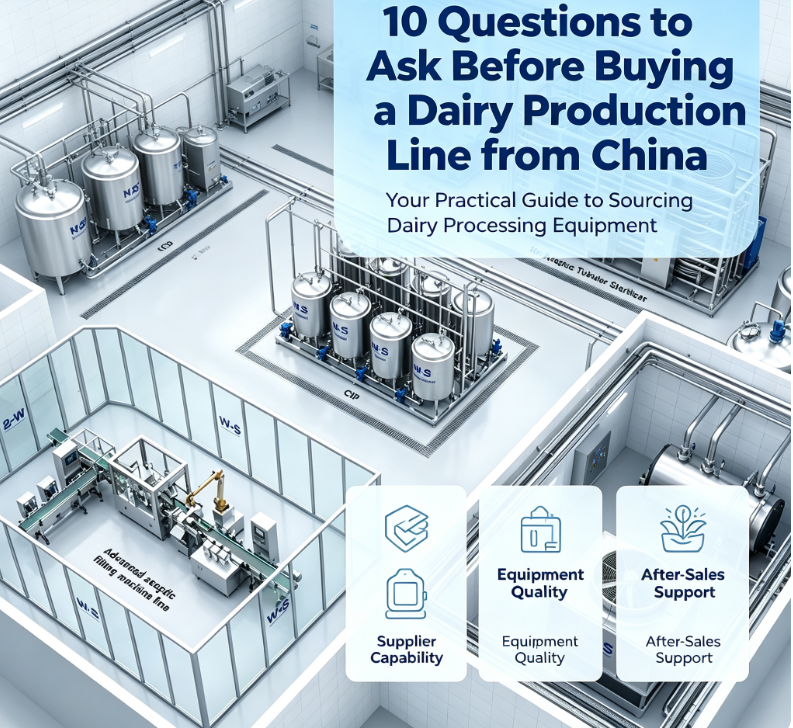
Buying a dairy production line is a system procurement decision. The machines must deliver the required product, integrate with the factory and remain supportable after shipment. A polished quotation is not enough; buyers need evidence, defined interfaces and measurable acceptance criteria.
The following ten questions provide a structured way to evaluate Weishu Machinery or any other dairy equipment supplier before placing an order.
1. Have You Completed Projects with Similar Products and Capacity?
Ask for references that match the planned product, process and scale. A supplier experienced in small batch tanks is not automatically qualified to integrate a continuous UHT and aseptic filling line.
Useful evidence includes process diagrams, equipment photographs, factory-test records and a clear description of the supplier's scope. Weishu Machinery presents selected configurations in its application section, but buyers should still request references relevant to their own project.
2. What Is Included and Excluded from the Quotation?
Confirm whether the offer includes:
- Product tanks and transfer pumps
- Interconnecting sanitary pipework and valves
- Instruments, PLC and electrical panels
- CIP system and cleaning connections
- Platforms and access structures
- Filling and packaging
- Utility equipment
- Installation, commissioning and training
- Freight, insurance and spare parts
Require a scope-of-supply matrix that assigns every interface to the supplier, buyer or local contractor.
3. What Output and Performance Are Guaranteed?
Nameplate capacity is not the same as guaranteed finished output. Define the test product, inlet conditions, operating pressure, treatment temperature, outlet temperature, filling format and test duration.
Performance criteria may cover:
- Sustainable liters per hour
- Temperature-control response
- Product loss during start-up and changeover
- Cleaning cycle completion
- Package integrity
- Utility conditions required to achieve the result
The acceptance method should be written before manufacture begins.
4. Which Materials and Components Will Be Used?
The specification should identify product-contact material, surface finish, welding requirements, gasket materials and insulation. It should also list proposed brands for pumps, valves, motors, PLCs, instruments and electrical components.
If SUS304 or SUS316L is required, include material certificates and inspection requirements. Do not rely on a general statement such as "food-grade stainless steel."
5. What Utilities Does the Line Require?
Ask for an equipment-specific schedule covering:
- Electrical voltage, frequency and connected load
- Steam pressure and peak consumption
- Chilled-water temperature and flow
- Process and cleaning water
- Compressed-air pressure and quality
- Drainage and wastewater load
These conditions should match the buyer's site. A line designed for stable steam and cooling may not reach capacity at a factory with lower pressure or higher ambient temperature.
6. How Will the Machines Be Integrated and Controlled?
Clarify whether the line uses individual panels or centralized control. Request a control description covering permissives, interlocks, alarms, recipe settings, temperature records, data access and CIP sequences.
For a line using a homogenizer, pasteurizer, tanks and filler, the supplier should explain how a downstream stop affects upstream equipment and how product is protected during the event.
7. How Will FAT and SAT Be Conducted?
Factory Acceptance Testing verifies equipment before shipment. Site Acceptance Testing verifies installation and operation at the customer's factory.
The protocol should define:
- Inspection and test items
- Test medium or product
- Measuring instruments
- Acceptance limits
- Test duration
- Responsibility for corrections
- Required records and signatures
For integrated projects, testing individual motors is not sufficient. The protocol should test sequences, alarms, flow, heating, cooling and communication between machines.
8. Who Is Responsible for Installation and Commissioning?
Confirm whether the supplier provides installation labor, supervision or remote guidance. Define responsibility for visas, travel, accommodation, local technicians, welding gas, lifting equipment, cable, pipe supports and commissioning materials.
Training should cover operation, CIP, routine inspection, preventive maintenance, fault response and spare-parts management. Weishu Machinery includes installation, commissioning and training among its available project services; the exact scope should be stated in the contract.
9. What Spare Parts, Warranty and Support Are Provided?
Request separate lists for commissioning spares, first-year operating spares and recommended long-term stock. The list should include manufacturer and part number where possible.
Clarify:
- When the warranty starts
- Which costs are covered
- Expected response time
- Remote diagnostic method
- Availability of English manuals and drawings
- Long-term supply of seals, valves, instruments and control components
- Conditions for sending a technician to site
10. How Will the Equipment Be Packed and Shipped?
International projects require packaging suitable for lifting, humidity, corrosion and inland transport. Ask for the packing method, container plan, gross dimensions and center-of-gravity information for large equipment.
Required documents may include packing list, commercial invoice, certificate of origin, bill of lading, conformity documents and material records. Labels should connect each component with the installation drawings.
Supplier Evaluation Scorecard
|
Evaluation area |
Suggested weight |
Evidence to request |
|
Process design |
20% |
Flow diagram, sizing basis and product understanding |
|
Technical compliance |
20% |
Data sheets, materials and performance guarantee |
|
Scope completeness |
15% |
Responsibility matrix and exclusions |
|
Similar references |
10% |
Comparable projects and test evidence |
|
Installation and commissioning |
10% |
Method, schedule and acceptance plan |
|
After-sales support |
10% |
Warranty, response and spare parts |
|
Delivery and logistics |
5% |
Manufacturing plan and packing method |
|
Commercial terms |
10% |
Price, payment, risk and contract clarity |
Adjust the weighting to the project, but do not allow price to replace technical compliance.
Warning Signs
- The supplier quotes before asking about product and packaging
- No process flow or equipment sizing basis is provided
- The offer does not define exclusions
- Only individual machine capacity is stated
- Utility requirements are missing
- FAT and SAT have no written acceptance criteria
- Spare parts and service response are undefined
- Claims are not supported by drawings, data sheets or references
Conclusion
A strong supplier evaluation converts sales statements into technical evidence and contractual responsibility. The best proposal is not the longest or the lowest priced; it is the one that clearly defines product performance, interfaces, site requirements and support.
To evaluate a new project with Weishu Machinery, send your product specification, capacity, packaging plan, factory drawing and utility information through the contact page. You can also review the company's manufacturing and project background before requesting a technical proposal.
Table of Contents
- 1. Have You Completed Projects with Similar Products and Capacity?
- 2. What Is Included and Excluded from the Quotation?
- 3. What Output and Performance Are Guaranteed?
- 4. Which Materials and Components Will Be Used?
- 5. What Utilities Does the Line Require?
- 6. How Will the Machines Be Integrated and Controlled?
- 7. How Will FAT and SAT Be Conducted?
- 8. Who Is Responsible for Installation and Commissioning?
- 9. What Spare Parts, Warranty and Support Are Provided?
- 10. How Will the Equipment Be Packed and Shipped?
- Supplier Evaluation Scorecard
- Warning Signs
- Conclusion