
 EN
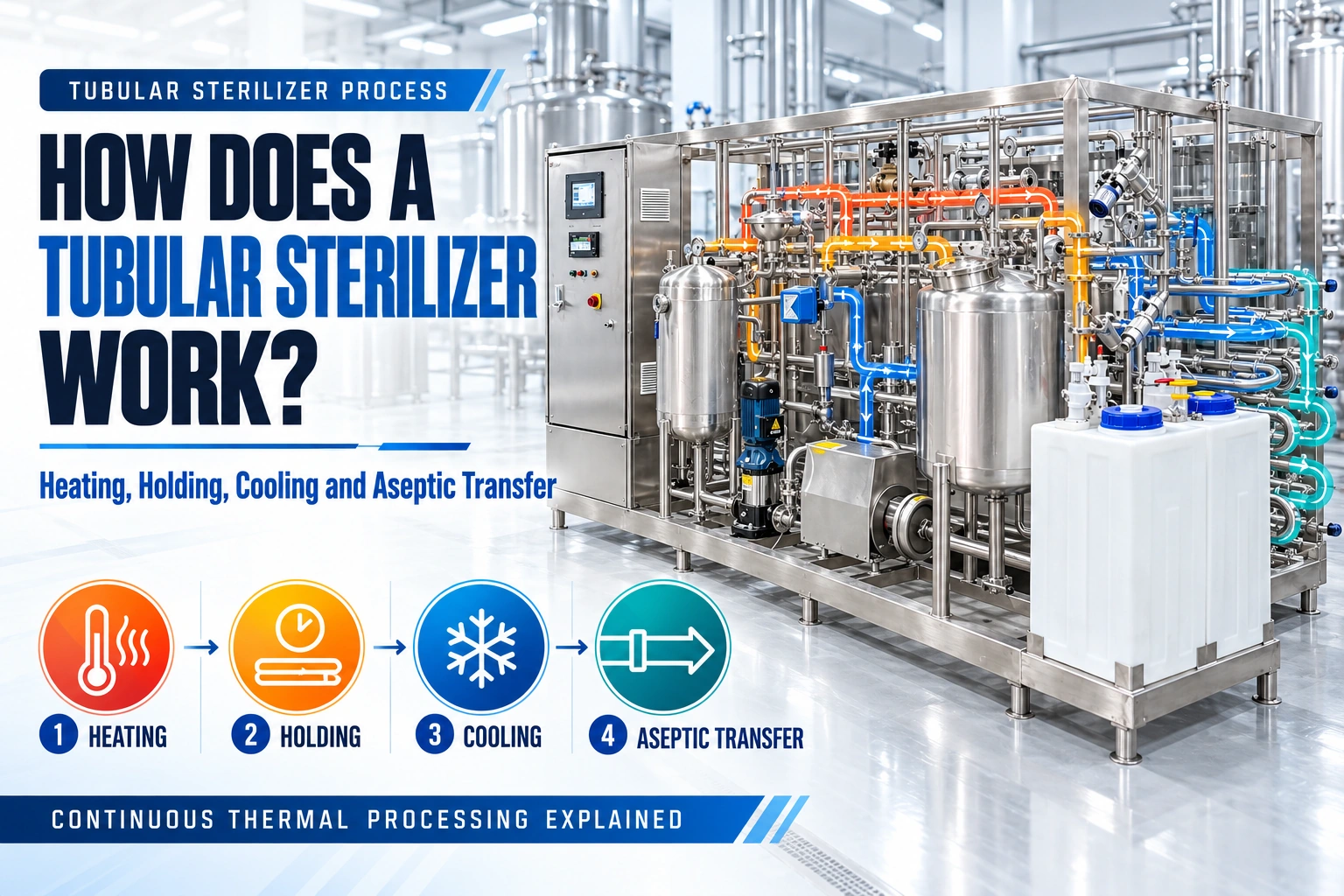
For food, beverage, and dairy processors, thermal processing is the critical milestone that guarantees commercial sterility and extends product shelf life without cold-chain dependence. When processing viscous liquids, heat-sensitive fluids, or products containing fibers and pulp, the tubular sterilizer (often configured as an Ultra-High Temperature or UHT system) is the industry standard.
Understanding how a tubular sterilizer works is essential for plant engineers and procurement managers aiming to optimize thermal efficiency, prevent fouling, and protect product quality. As a recognized manufacturer in food processing machinery, Weishu engineers custom tubular thermal processing systems designed to meet rigorous global hygienic standards.
What Is a Commercial Tubular Sterilizer and Where Is It Used?
A tubular sterilizer is an industrial continuous heat exchange system constructed from a series of concentric tubes or multi-tube bundles enclosed within an outer shell. Product flows through the inner tubes while the heating or cooling medium flows through the surrounding shell in a counter-current direction.
Unlike plate heat exchangers—which utilize narrow corrugated gaps—tubular configurations provide smooth, unobstructed flow channels. This structural advantage makes them exceptionally resistant to high operating pressures and product fouling.
Primary Industrial Applications:
-
High-Viscosity Products: Purees, tomato paste, jams, sauces, and baby food.
-
Fibrous & Pulpy Beverages: Orange juice with pulp, fruit nectars, and plant-based beverages (tubular sterilizer for juice with pulp).
-
Dairy & Dairy Alternatives: UHT milk, flavored milk, cream, soy milk, and oat milk.
How Does a Tubular Sterilizer Work Step-by-Step?
The working principle of a tubular UHT sterilizer relies on precise continuous thermal cycles divided into four integrated physical phases: pre-heating/heating, holding, cooling, and aseptic transfer.
How Do the Heating and Holding Stages Achieve Complete Sterilization?
-
Pre-Heating & UHT Heating: The raw product enters the system via a sanitary high-pressure pump (often a positive displacement or multi-stage centrifugal pump). It first passes through a heat recovery section where returning hot product pre-heats the incoming cold liquid. Next, it enters the primary heating section, where pressurized superheated water or indirect steam rapidly elevates the product temperature to ultra-high levels (typically 135°C to 142°C).
-
Precision Holding Tube: Once the target sterilization temperature is reached, the liquid enters a insulated, smooth-bore holding tube. The velocity of the fluid and the exact length of the pipe determine the retention time (typically 4 to 6 seconds for UHT milk, or 15 to 30 seconds for fruit purees). This precise thermal retention destroys resilient bacterial spores (such as Bacillus stearothermophilus) while minimizing thermal degradation of flavor, color, and nutrition.
How Do Cooling and Aseptic Transfer Prevent Recontamination?
-
Multi-Stage Cooling: Immediately after exiting the holding tube, the product enters the cooling section. Cold water or chilled glycol rapidly lowers the product temperature down to storage or aseptic filling temperatures (20°C to 25°C}$ for ambient aseptic packaging). Rapid cooling stops chemical reactions that cause cooked off-flavors and browning.
-
Aseptic Transfer & Steam Barrier Protection: To guarantee that sterilized product is not recontaminated before filling, the fluid flows through an aseptic valve block equipped with continuous steam barriers (steam tracing on valve stems and connections). The product pressure inside the sterilizer is maintained strictly higher than the cooling medium pressure. If a microscopic leak occurs, product leaks outward rather than unsterilized medium leaking inward.
Why Choose a Tubular Sterilizer Over a Plate Sterilizer for Viscous Products?
Choosing between plate and tubular heat exchangers depends heavily on fluid viscosity, particle content, and operating pressure.
| Performance Feature | Tubular Sterilizer | Plate Sterilizer |
| Viscosity Tolerance | High (Purees, concentrates, sauces) | Low to Medium (Milk, clear tea, clear juice) |
| Particle / Pulp Handling | Excellent (Smooth bore / Wide channels) | Poor (Prone to clogging at plate contact points) |
| Maximum Pressure | Up to 30+ bar (Ideal for high-viscosity pumping) | Typically limited to 10–15 bar |
| Fouling & Running Time | Low fouling rate; long continuous run times | Higher fouling rate with sticky/viscous media |
| CIP / SIP Efficiency | High-velocity CIP with low pressure drop | Requires careful chemical circulation |
Key Takeaway: While plate pasteurizers offer a compact footprint for low-viscosity fluids, a tubular sterilizer is essential for high-viscosity products, pulpy juices, or high-pressure UHT applications where operational continuity is critical.
What Key Factors Affect Tubular Sterilizer Efficiency and Operating Costs?
When evaluating aseptic tubular sterilizer system components, plant managers should consider features that lower operational expenditure (OpEx) and increase return on investment (ROI):
-
Corrugated Tube Technology: Incorporating inner corrugated profile tubes creates micro-turbulence within the fluid stream. This increases heat transfer efficiency by up to 30%, reduces total footprint, and minimizes boundary-layer product burning/fouling.
-
Thermal Regeneration Rate: Modern Weishu tubular sterilizers achieve energy recovery rates up to 85–90%, using hot outgoing product to pre-heat cold incoming product, which drastically reduces steam and chilled water costs.
-
Metallurgy & Sanitary Design: Wetted parts should be constructed from SUS316L stainless steel or specialized alloys to resist corrosion from acidic juices or aggressive CIP cleaning chemicals (caustic soda and nitric acid).
-
Automated PLC Controls: Fully automated PLC systems (Siemens/Allen-Bradley) monitor flow rates, pressure differentials, and temperatures in real-time, automatically activating divert valves if sterilization temperatures dip below critical thresholds.
Ready to Upgrade Your Processing Line with a Custom Weishu Tubular Sterilizer?
Don’t compromise on thermal efficiency or product safety. Contact the Weishu process engineering team today to share your capacity, fluid viscosity, and plant space requirements. We will deliver a tailored process flow design, equipment layout, and a transparent factory-direct quotation within 24 hours.
Get Your Custom Technical Proposal from Weishu
Send your technical specifications to Weishu engineers today to receive a complete proposal:
-
Target liquid product, viscosity, and pulp/particle size
-
Required processing capacity (L/h or GPH)
-
Target sterilization temperature & holding time
-
Available plant utilities (Steam, hot water, chilled water)
? Contact Weishu Engineering Team: Submit your technical specifications today to consult with our process engineers and request a customized equipment solution.
Table of Contents
- What Is a Commercial Tubular Sterilizer and Where Is It Used?
- How Does a Tubular Sterilizer Work Step-by-Step?
- Why Choose a Tubular Sterilizer Over a Plate Sterilizer for Viscous Products?
- What Key Factors Affect Tubular Sterilizer Efficiency and Operating Costs?
- Ready to Upgrade Your Processing Line with a Custom Weishu Tubular Sterilizer?