
 EN
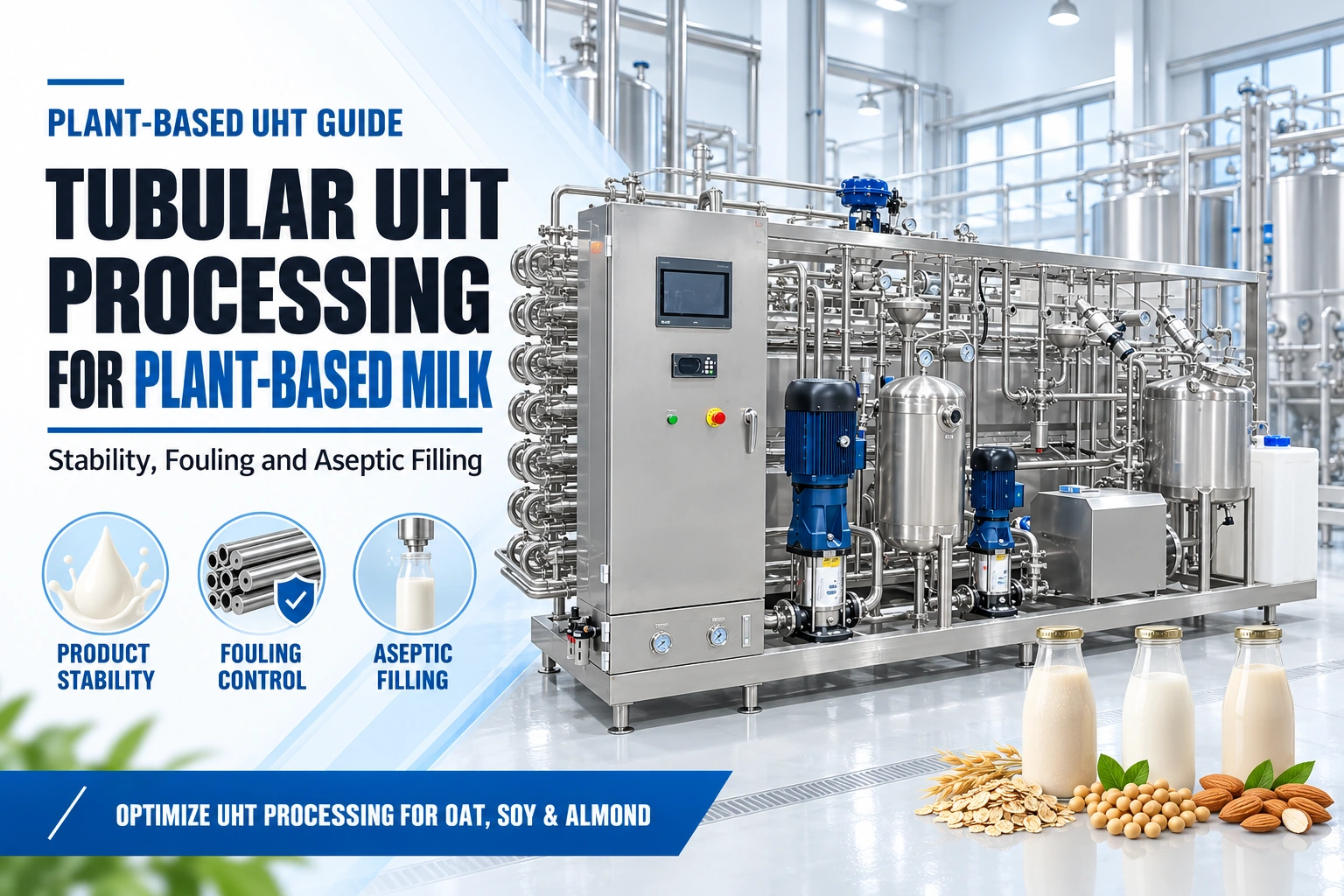
The global shift toward plant-based nutrition has driven rapid expansion in alternatives to traditional dairy, including oat milk, almond milk, soy milk, and coconut beverages. However, processing alternative dairy presents complex thermal engineering challenges. Unlike bovine milk, plant-based bases contain unique natural starches, insoluble fibers, and thermally sensitive plant proteins that behave unpredictably under high heat.
To achieve commercial sterility for ambient shelf-life (6–12 months) without destroying delicate natural flavors or causing product separation, plant manager and process engineers rely on a high-performance UHT sterilizer for plant based milk.
As a manufacturer of industrial thermal processing machinery, Weishu designs continuous tubular Ultra-High Temperature (UHT) systems specifically engineered to overcome the fouling, viscosity, and phase-separation hurdles inherent in plant-based milk processing.
Why Is a Tubular UHT Sterilizer Essential for Plant-Based Milk Processing?
Plant-based beverages are heterogeneous colloidal suspensions rather than simple true solutions. Raw bases derived from grains, nuts, or legumes exhibit distinct thermodynamic properties:
-
Free Starches: Oat and grain milks contain native or enzymatically hydrolyzed starches that gel abruptly when heated past their gelatinization threshold ($60^\circ\text{C}$ to $75^\circ\text{C}$).
-
Heat-Sensitive Plant Proteins: Soy and pea proteins denature rapidly at high temperatures, causing protein aggregation and precipitation.
-
Insoluble Fibers & Suspended Solids: Nut milks (like almond and cashew) contain insoluble particulate matter that can settle out or clog narrow heat exchanger channels.
Using standard heat exchangers often results in rapid surface fouling, extreme pressure spikes, and scorched off-flavors. A tubular sterilizer for oat and almond milk utilizes unobstructed, smooth-bore circular channels capable of handling high fluid viscosities and suspended solids, ensuring continuous thermal operation under high operating pressures.
How Does a Tubular UHT Sterilizer Overcome Thermal Fouling in Plant Milk?
Thermal fouling—the buildup of cooked product layers on internal tube walls—is the primary cause of unscheduled downtime in plant milk UHT operations. Weishu solves this issue through targeted fluid dynamics and multi-stage thermal engineering.
How Do Corrugated Tubes and High Velocity Prevent Product Burning?
In a smooth, straight tube, high-viscosity plant fluids tend to establish laminar flow. The fluid layer nearest the heated tube wall moves slowly, absorbing excess heat until it burns, forms a insulating burn-on layer (fouling), and reduces overall heat transfer rates.
To counteract this, Weishu tubular UHT systems incorporate corrugated tube technology:
The helical corrugations on the tube inner wall generate continuous micro-turbulence, even at lower fluid speeds. This turbulence constantly disrupts the fluid boundary layer, preventing product build-up on the wall, maximizing heat transfer rates, and allowing for longer continuous operational runs between CIP (Clean-in-Place) cycles.
Why Is Multi-Stage Temperature Control Critical for Starch Stabilization?
Preventing starch gelatinization and protein precipitation requires a carefully managed temperature profile coupled with inline mechanical homogenization:
-
Controlled Pre-Heating Stage: The plant base is gradually heated to an intermediate holding temperature ($60^\circ\text{C}$ to $70^\circ\text{C}$), allowing controlled viscosity changes without scorching.
-
Inline High-Pressure Homogenization: Before entering the final UHT section, the product passes through a two-stage high-pressure homogenizer (typically operating at 200–250 bar). This breaks down fat globules, reduces starch/protein agglomerates to sub-micron sizes, and creates a stable emulsion.
-
Flash UHT Heating: The homogenized product is rapidly brought to $138^\circ\text{C}$–$143^\circ\text{C}$ for 4 to 6 seconds using indirect hot water or steam loops, killing resilient bacterial spores without triggering protein aggregation.
How Does the Aseptic Transfer System Ensure Long Shelf Life for Plant Milk?
Achieving commercial sterility inside the holding tube is only half the challenge; maintaining sterility during cooling and transfer to packaging is equally critical.
Plant-based beverages are rich in nutrients, making them highly susceptible to secondary microbial contamination from opportunistic bacteria, yeasts, and molds.
Key Features of the Weishu Aseptic Transfer System:
-
Positive Differential Pressure Control: Automated sensors maintain higher product pressure inside the sterilizer tubes relative to the cooling water circuit, ensuring zero cross-contamination if a gasket pinhole develops.
-
Steam-Traced Valve Barriers (BTM): All sterile transfer lines, switchover valves, and dosing connections utilize continuous active steam tracing to maintain a bio-barrier against ambient air.
-
Sterile Surge Tank Integration: For plants operating high-speed aseptic carton or bag-in-box lines, an integrated sterile buffer tank allows continuous sterilizer operation during packaging roll changes or minor filler stops.
Tubular vs. Plate UHT Sterilizer: Which Is Better for Plant-Based Beverages?
Choosing between a plate heat exchanger and a tubular heat exchanger for plant milk is a major capital decision for processing plants.
| Operating Parameter | Tubular UHT Sterilizer | Plate UHT Sterilizer |
| Max Particle / Pulp Size | Up to 6.0 mm (Smooth / Corrugated) | $< 0.5\text{ mm}$ (Narrow chevron gap) |
| Starch / Viscosity Tolerance | Excellent (Handles shear-thinning & thick gels) | Low (Viscous fluids cause high pressure drops) |
| Continuous Operating Run Time | 8 to 12+ hours before CIP required | 2 to 4 hours (Fast fouling requiring frequent CIP) |
| Pressure Resistance | High pressure rating (Up to 30+ bar) | Medium pressure rating (Typically $< 12\text{ bar}$) |
| Maintenance & Gasket Costs | Low (Welded stainless construction, fewer gaskets) | High (Requires periodic replacement of dozens of plate gaskets) |
Key Takeaway: While plate systems have a lower initial capital cost for clear liquids, a UHT sterilizer for plant based milk built on a tubular architecture offers significantly longer production runs, reduced CIP chemical use, and lower total cost of ownership (TCO).
Ready to Scale Your Plant-Based Milk Production?
Upgrade your thermal processing line with Weishu advanced tubular UHT technology. Send us your product specs today (capacity, viscosity, and target holding temperatures) to receive a customized technical proposal and direct factory pricing.
Table of Contents
- Why Is a Tubular UHT Sterilizer Essential for Plant-Based Milk Processing?
- How Does a Tubular UHT Sterilizer Overcome Thermal Fouling in Plant Milk?
- How Does the Aseptic Transfer System Ensure Long Shelf Life for Plant Milk?
- Tubular vs. Plate UHT Sterilizer: Which Is Better for Plant-Based Beverages?
- Ready to Scale Your Plant-Based Milk Production?