
 EN
EN
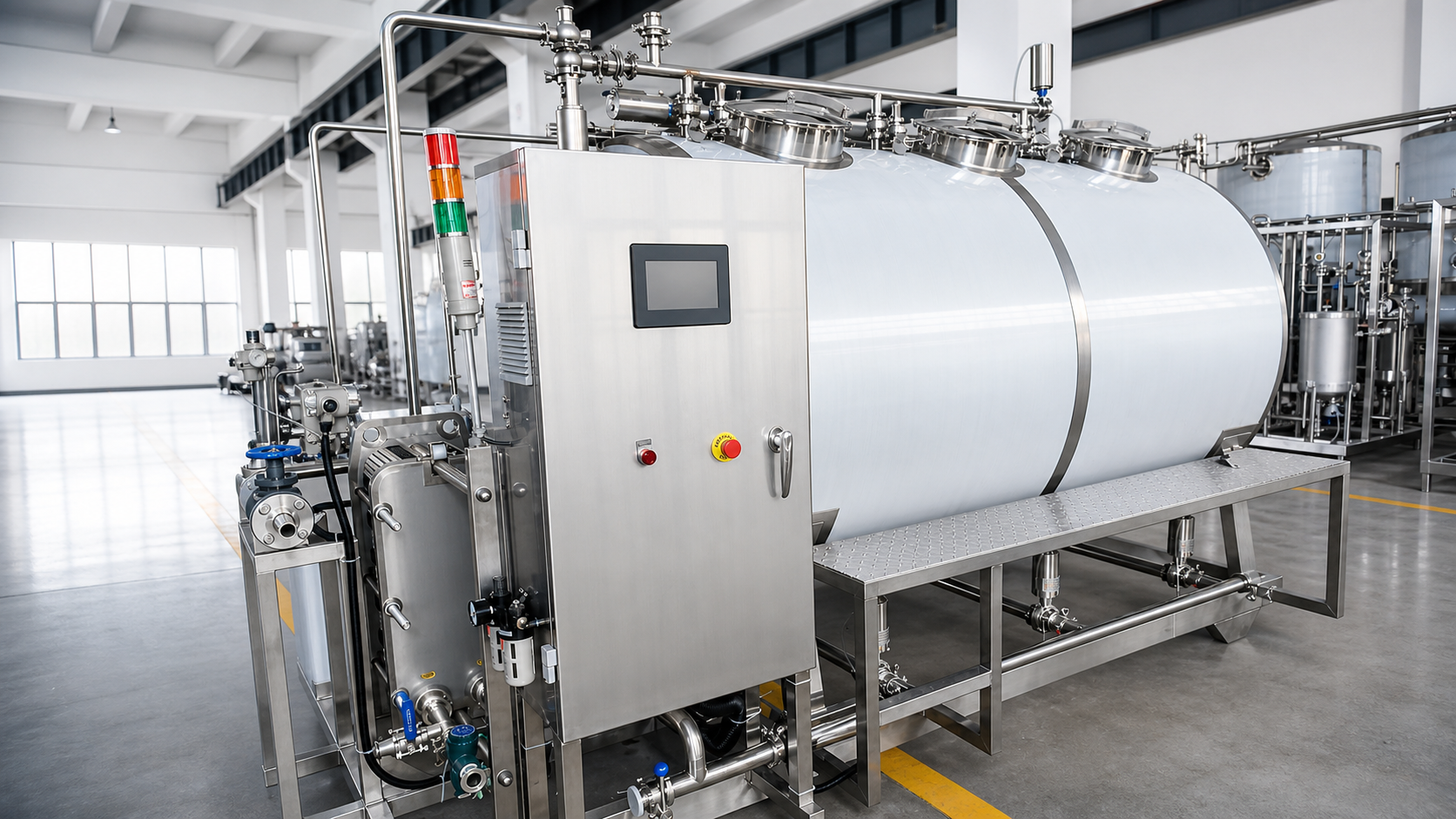
Introduction: Why Dairy CIP System Design Matters in Modern Milk Processing
In a modern dairy factory, cleaning is not just a routine maintenance task. It directly affects food safety, production efficiency, equipment lifespan, and operating costs. Milk contains proteins, fats, minerals, and other components that can quickly accumulate inside pipelines, tanks, heat exchangers, and processing equipment. Without an effective cleaning solution, these residues may reduce equipment performance and increase the risk of contamination.
A dairy CIP system (Cleaning-In-Place system) provides an automated solution for cleaning product-contact surfaces without dismantling equipment. By circulating water, alkaline solutions, acid solutions, and sanitizers through the production line, CIP technology allows dairy manufacturers to maintain consistent hygiene standards while reducing manual labor and production downtime.
For a new milk plant, CIP system planning should start during the factory design stage. The cleaning system must match the production process, equipment layout, pipeline design, and future expansion requirements. A well-designed clean in place system design helps dairy manufacturers achieve reliable cleaning performance while controlling water consumption, chemical usage, and energy costs.
This guide explains how a dairy CIP system works, how to design a CIP solution for a new milk processing plant, the main components required, sizing considerations, cleaning procedures, and how dairy companies can prepare for a successful CIP system project.
What Is a Dairy CIP System and How Does It Work?
A dairy CIP system is an automated cleaning solution that removes milk residues and microorganisms from processing equipment without requiring operators to manually disassemble the system.
During dairy production, different types of residues accumulate on equipment surfaces. Milk proteins can create sticky deposits, fats may attach to pipelines and tanks, and minerals can form hard deposits known as milkstone. These residues require different cleaning methods, which is why dairy CIP systems use multiple cleaning stages.
The basic CIP system working principle is based on circulating cleaning fluids through the same pipelines and equipment used for production. Instead of opening every machine for manual cleaning, the CIP system pumps cleaning solutions through the production line under controlled conditions.
A typical dairy CIP cleaning process includes:
- Pre-rinsing – Removes loose milk residues with water.
- Caustic cleaning – Uses alkaline solutions to remove fats and proteins.
- Acid cleaning – Removes mineral deposits and milkstone.
- Final rinsing – Eliminates chemical residues.
- Sanitization – Reduces microbial contamination before production.
The cleaning performance depends on four important factors:
|
Factor |
Function |
|
Time |
Controls cleaning contact duration |
|
Temperature |
Improves chemical cleaning performance |
|
Concentration |
Determines chemical strength |
|
Flow |
Creates mechanical cleaning action |
A successful CIP system balances these factors to achieve effective cleaning without unnecessary chemical, water, or energy consumption.
How Cleaning-in-Place Removes Milk Residues Without Dismantling Equipment
Traditional cleaning methods require operators to open equipment, remove components, and manually clean internal surfaces. While this method may work for small operations, it becomes inefficient for industrial dairy plants with complex pipelines and multiple processing machines.
Cleaning in place dairy technology solves this challenge by using controlled circulation. The cleaning liquid travels through tanks, pipes, valves, heat exchangers, and other product-contact areas, reaching surfaces that are difficult to access manually.
For example, alkaline cleaning breaks down organic residues such as milk fat and protein deposits. Acid cleaning targets mineral buildup that commonly occurs in heating equipment such as pasteurizers and UHT systems.
However, cleaning performance depends not only on the CIP station itself. The production line must also be designed correctly. Poor pipeline layouts, dead legs, insufficient drainage, or incorrect flow paths can reduce cleaning effectiveness.
This is why CIP system design and dairy plant engineering should be planned together. The goal is not simply to install powerful cleaning equipment but to create a complete cleaning network where every surface receives sufficient flow, temperature, and chemical action.
Which Dairy Processing Equipment Can Be Cleaned Through CIP?
A properly designed CIP for dairy processing equipment can serve most major machines in a commercial milk processing facility.
Common CIP-connected equipment includes:
- Milk storage tanks
- Mixing tanks
- Pasteurizers
- UHT sterilization systems
- Homogenizers
- Fermentation tanks
- Cheese vats
- Product pipelines
- Pumps and valves
- Filling machines
Different equipment requires different cleaning considerations.
For example, heat exchangers need effective CIP cleaning because milk deposits can reduce heat transfer efficiency and increase energy consumption. Fermentation tanks require controlled cleaning because remaining microorganisms may affect future production batches.
For cheese production, protein and fat residues can be more difficult to remove, requiring carefully designed cleaning programs for cheese vats, whey pipelines, and related equipment.
When designing a new milk plant, manufacturers should identify all equipment requiring CIP connection before installation. Early planning helps avoid costly modifications and ensures the final production line operates efficiently.
Clean-in-Place System Design for a New Milk Plant
A successful clean in place system design begins with understanding the entire production process. CIP should not be treated as an independent utility system because it directly interacts with every production stage.
Many dairy projects focus primarily on processing capacity, automation level, and equipment investment. However, cleaning efficiency has a direct impact on daily production performance. If cleaning cycles take too long or cannot completely remove residues, production availability will decrease.
A professional CIP design considers:
- Product characteristics
- Processing equipment type
- Production capacity
- Pipeline distance
- Cleaning frequency
- Future expansion plans
- Automation requirements
The objective is to create a cleaning system that provides reliable hygiene control while minimizing operating costs.
How to Divide a Milk Processing Line into CIP Cleaning Circuits
One of the most important decisions in CIP circuit design is dividing the production line into suitable cleaning circuits.
A cleaning circuit is a group of equipment that can be cleaned together using the same CIP recipe. Equipment within the same circuit should have similar cleaning requirements.
Typical dairy CIP circuits may include:
- Raw milk receiving circuit
- Storage tank circuit
- Pasteurization circuit
- UHT processing circuit
- Fermentation circuit
- Filling line circuit
Separating circuits provides better control because different equipment may require different cleaning temperatures, chemical concentrations, or cleaning times.
For example, a pasteurizer usually requires stronger cleaning conditions because milk deposits accumulate on heat-transfer surfaces. A storage tank may require a shorter cleaning cycle.
If too many machines are connected to one circuit, problems may occur:
- Reduced cleaning flow
- Longer cleaning time
- Higher chemical consumption
However, too many small circuits can increase equipment investment.
The best solution is a balanced CIP design based on production requirements.
Centralized vs. Decentralized CIP System Design
Dairy manufacturers usually choose between centralized and decentralized CIP configurations.
A centralized CIP system uses one main CIP station to supply multiple production areas. This approach is common in large dairy factories because cleaning preparation, chemical management, and automation can be controlled from one location.
Advantages include:
- Easier operation management
- Centralized monitoring
- Lower equipment duplication
A decentralized CIP system places smaller cleaning units near specific production areas. This design may be suitable for factories with multiple buildings or different product categories.
For example, a dairy company producing both milk beverages and cheese products may use separate CIP systems because these products create different cleaning challenges.
|
Feature |
Centralized CIP |
Decentralized CIP |
|
Management |
Central control |
Independent control |
|
Investment |
Efficient for large plants |
Higher for multiple units |
|
Flexibility |
Requires planning |
Easier local expansion |
|
Application |
Integrated dairy factories |
Separate production areas |
The right choice depends on factory size, product range, and future development plans.
How Future Production-Line Expansion Affects CIP Design
A dairy factory rarely remains unchanged for many years. Production capacity often increases as market demand grows.
For this reason, a new milk plant should consider future expansion during CIP planning.
A scalable CIP system may include:
- Additional valve capacity
- Expandable control systems
- Reserved pipeline connections
- Increased utility capacity
Without proper planning, adding new production lines may require major modifications to the existing cleaning system.
A well-designed CIP solution allows dairy manufacturers to expand production without rebuilding the entire cleaning infrastructure.
Milk Plant Cleaning Equipment: Main Components of a CIP Station
A complete CIP station includes multiple components working together to prepare, circulate, heat, monitor, and recover cleaning solutions.
The main milk plant cleaning equipment includes:
- CIP tanks
- CIP pumps
- Heat exchangers
- Chemical dosing systems
- Valves
- Return pipelines
- Sensors
- PLC control systems
CIP Tanks, Pumps, Heat Exchangers, and Chemical Dosing Units
CIP tanks store different cleaning solutions required during the cleaning cycle.
Typical tanks include:
- Water tank
- Caustic solution tank
- Acid solution tank
- Recovery tank
The caustic tank provides alkaline cleaning solutions for removing fats and proteins. The acid tank removes mineral deposits. Recovery tanks help reduce water and chemical consumption by allowing reuse where appropriate.
The CIP pump provides circulation power and must be selected according to pipeline size, equipment resistance, and required flow conditions.
Heat exchangers maintain cleaning temperature because temperature directly affects cleaning performance.
Chemical dosing systems automatically control solution concentration, improving consistency compared with manual chemical preparation.
CIP Control System and Monitoring Instruments
Modern dairy plants increasingly use an automatic CIP system with PLC-based control.
A CIP control system monitors:
- Flow rate
- Temperature
- Chemical concentration
- Cleaning time
- Valve sequence
These parameters help ensure every cleaning cycle follows the correct recipe.
Automated monitoring also improves traceability because cleaning records can be stored and reviewed when required.
For large dairy factories, automation reduces operator workload and provides more reliable cleaning performance.
How to Size a Dairy CIP System
Correct CIP system sizing ensures that the cleaning system matches actual production requirements.
The main factors affecting CIP sizing include:
Number of Cleaning Circuits
More circuits provide greater flexibility but increase investment costs. Engineers need to determine which equipment should be cleaned together and whether multiple cleaning operations are required.
CIP Tank Capacity
Tank size depends on the volume of the largest cleaning circuit, including pipelines and connected equipment.
CIP Pump Flow and Pressure
The pump must provide sufficient circulation to create effective mechanical cleaning action.
Heating Capacity
The heating system must provide enough energy to reach and maintain required cleaning temperatures.
Professional CIP suppliers calculate these requirements based on actual factory information rather than using standard sizes.
Dairy CIP Cleaning Cycle: Rinse, Wash, and Sanitization
A typical dairy CIP cleaning process follows several stages designed to remove different types of contamination.
Pre-Rinse and Milk Residue Recovery
The first stage uses water to remove loose product residues. This step reduces the amount of chemical required in later cleaning stages.
Caustic Cleaning for Fats and Proteins
Alkaline solutions are used to remove organic residues, especially milk fats and proteins.
This stage is usually one of the most important parts of the cleaning cycle because dairy products contain high levels of organic material.
Acid Cleaning for Mineral Deposits
Acid cleaning removes mineral deposits such as milkstone.
This step is especially important for equipment exposed to heating processes.
Final Rinse and Sanitization
The final rinse removes chemical residues before production begins again.
Sanitization reduces microbial risks and prepares the equipment for the next production cycle.
A successful CIP cleaning cycle depends on maintaining the correct balance between:
- Time
- Temperature
- Chemical concentration
- Flow rate
Single-Use vs. Recovery CIP Systems
Dairy factories can choose between single-use and recovery CIP systems depending on production scale and operating priorities.
|
|
Single-Use CIP |
Recovery CIP |
|
Investment |
Lower |
Higher |
|
Water consumption |
Higher |
Lower |
|
Chemical reuse |
Limited |
Possible |
|
Suitable for |
Smaller plants |
Large production facilities |
Single-use systems are simpler and may be suitable for smaller dairy operations.
Recovery CIP systems require higher initial investment but can reduce long-term operating costs through water and chemical recovery.
Large dairy plants often consider recovery systems because utility savings become significant over years of operation.
Dairy CIP Automation and Cleaning Validation
Automation has become an important feature of modern CIP system design.
A PLC-controlled CIP system can automatically manage:
- Cleaning recipes
- Valve sequencing
- Temperature control
- Chemical dosing
- Cleaning records
Cleaning validation ensures that the CIP cycle achieves the required hygiene performance.
Manufacturers can monitor cleaning parameters and verify that the process is completed correctly.
For dairy factories supplying international markets, cleaning records and traceability are increasingly important for quality management.
Dairy CIP System RFQ Checklist
Before requesting a CIP quotation, dairy manufacturers should prepare key project information.
A CIP supplier usually needs:
Product Information
- Milk type
- Dairy products produced
- Residue characteristics
Production Information
- Processing capacity
- Operating hours
- Production schedule
Equipment Information
- Processing equipment list
- Pipeline dimensions
- Tank volumes
Utility Information
- Steam supply
- Water availability
- Electricity
- Drainage conditions
Automation Requirements
- PLC system
- Data recording
- Remote monitoring requirements
Providing complete information allows suppliers to develop a more accurate CIP configuration.
Request a Dairy CIP System Proposal from Weishu Intelligent Machinery
A properly designed dairy CIP system helps milk manufacturers improve cleaning efficiency, reduce downtime, and maintain consistent product quality.
Weishu Intelligent Machinery provides customized CIP solutions based on dairy product type, production capacity, equipment layout, and automation requirements.
To receive a preliminary CIP configuration, please provide:
- Dairy product information
- Production capacity
- Processing equipment list
- Pipeline layout
- Utility conditions
- Automation requirements
Our engineering team can help design a CIP solution that matches your milk processing plant requirements and future expansion plans.
Table of Contents
- Introduction: Why Dairy CIP System Design Matters in Modern Milk Processing
- What Is a Dairy CIP System and How Does It Work?
- Clean-in-Place System Design for a New Milk Plant
- Milk Plant Cleaning Equipment: Main Components of a CIP Station
- How to Size a Dairy CIP System
- Dairy CIP Cleaning Cycle: Rinse, Wash, and Sanitization
- Single-Use vs. Recovery CIP Systems
- Dairy CIP Automation and Cleaning Validation
- Dairy CIP System RFQ Checklist
- Request a Dairy CIP System Proposal from Weishu Intelligent Machinery