
 EN
EN
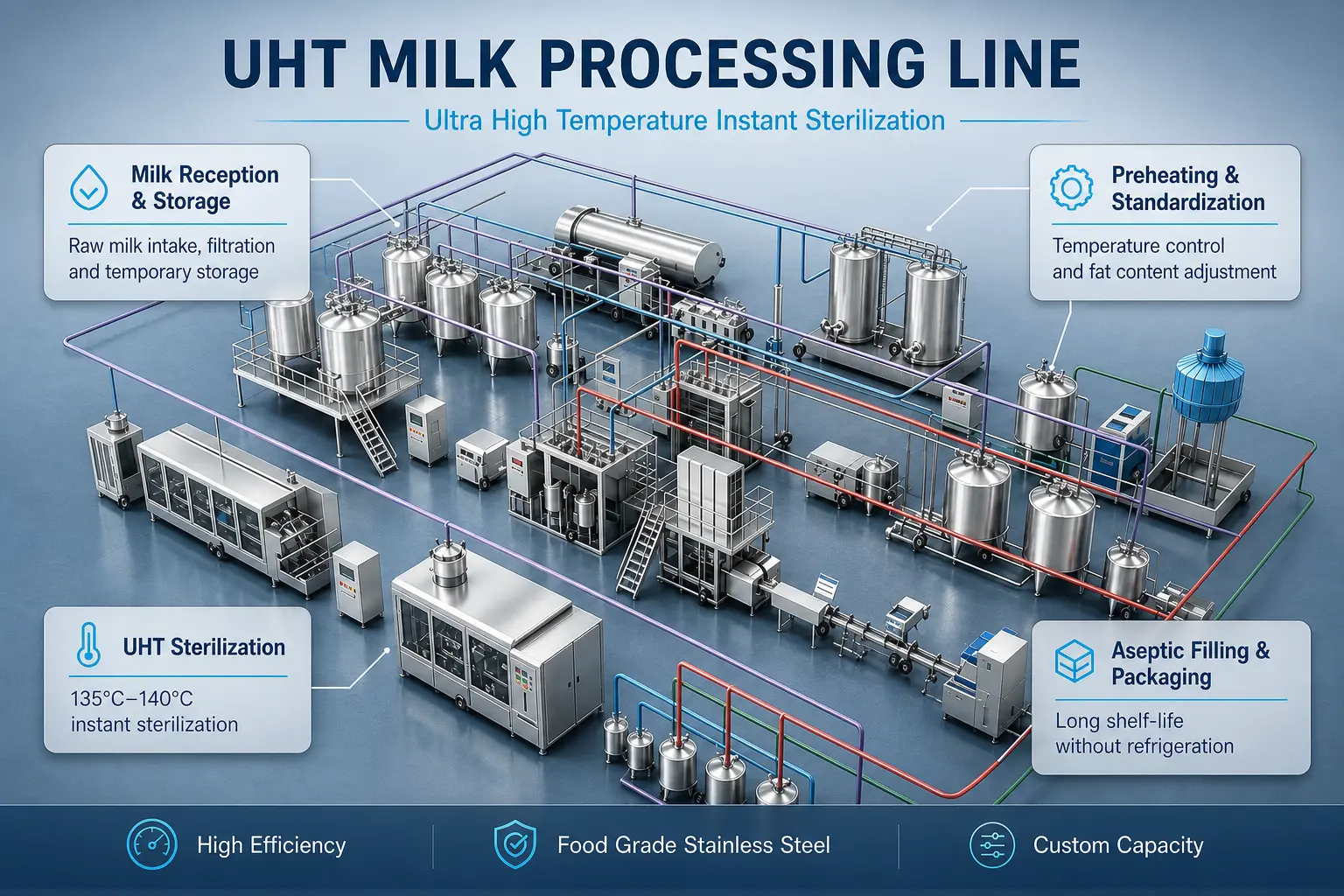
A UHT milk processing machine is the heart of a shelf-stable milk line, but it cannot work in isolation. Reliable long-life milk production depends on coordinated milk preparation, ultra-high-temperature treatment, aseptic storage and filling, CIP/SIP, utilities, and process controls.
Whether you are planning a greenfield dairy plant or upgrading an existing line, this guide will help you compare the process, equipment scope, operating risks, and cost drivers. It also explains what suppliers need from you before they can prepare a useful quotation.
What Is a UHT Milk Processing Machine, and What Does a Complete Plant Include?
A UHT milk processing machine—also called a UHT sterilizer or ultra-high-temperature processing unit—heats milk for a short, controlled holding period and then cools it in a closed system. A complete aseptic milk processing plant also prepares the milk, protects the sterile zone, fills the product into a compatible package, and cleans the line between production runs.
Put simply, buying a UHT unit is not the same as buying a production plant. Two proposals may show the same hourly capacity while covering very different equipment, services, and connection points.
Start by separating the project into three levels:
- UHT sterilization unit: Typically includes a balance tank, heating and cooling sections, holding tube, pumps, sanitary valves, instruments, and automatic process controls.
- UHT processing line: Adds upstream milk preparation and downstream aseptic handling, such as standardization, homogenization, sterile product piping, and an aseptic buffer tank.
- Turnkey dairy plant: May also include filling and packaging, CIP, water treatment, steam and chilled-water systems, electrical integration, layout design, installation, commissioning, and operator training.
Buyers comparing a complete UHT milk production line should ask for a clearly marked scope instead of relying on the phrase “turnkey solution.” That makes it much easier to compare suppliers on an equal basis.
What Equipment Does a UHT Milk Plant Need?
The final equipment list depends on the raw material, recipe, package, throughput, and destination market. Most commercial long-life milk lines still need to evaluate the same core systems:
- Raw milk reception and storage: Unloading, filtration or clarification, cooling, transfer pumps, and insulated storage tanks.
- Separation and standardization: Fat separation and controlled blending to meet the finished product specification.
- Product preparation: Mixing, preheating, deaeration, and homogenization for white, flavored, fortified, goat, camel, or recombined milk.
- Thermal processing: Plate, tubular, or direct UHT heating with controlled temperature, flow, holding time, cooling, and diversion logic.
- Aseptic handling: Sterile piping, valves, buffer storage, and filling equipment matched to cartons, pouches, or bottles.
- Cleaning and utilities: CIP/SIP, treated water, suitable steam, cooling water, compressed air, and electrical supply.
Ask the supplier to label every item as included, optional, supplied by others, or excluded. Battery limits, utility connections, filler interfaces, and site work should never be left to assumption.
How Does UHT Milk Processing Work Step by Step?
UHT milk processing is a controlled sequence, not a single burst of heat. The product must arrive at the sterilizer with a consistent composition, pass through the validated thermal process, remain protected from recontamination, and enter a sterile package.
In other words, every stage before and after the holding tube matters. Poor preparation can cause fouling or shelf-life defects, while weak aseptic handling can undo effective heat treatment.
How Is Milk Prepared Before UHT Treatment?
Upstream preparation usually covers:
- Reception and quality checks: Confirm that the raw milk meets the plant’s acceptance limits before processing.
- Clarification and separation: Remove physical impurities and separate cream when the recipe requires fat adjustment.
- Standardization: Set fat, protein, or total solids targets so the product behaves consistently from batch to batch.
- Preheating and deaeration: Prepare the milk for downstream processing and remove unwanted air.
- Homogenization: Reduce fat globule size to improve mouthfeel, appearance, and resistance to cream separation.
A properly selected high-pressure milk homogenizer must match the product, operating pressure, flow rate, and position in the process. Placing it before or after final heating changes both the process design and, in aseptic service, the hygienic requirements.
There is no single flow sheet for every dairy product. Plain white milk, chocolate milk, high-protein beverages, recombined milk, and fortified formulations can differ in mixing sequence, stabilization, homogenization, and heat treatment.
What Happens From UHT Heating to Aseptic Filling?
Once the milk is prepared, it moves through the shelf-stable section:
- Regenerative heating: Incoming milk recovers heat from outgoing product where the exchanger design allows it, reducing utility demand.
- Final heating and holding: The system maintains the required relationship between temperature, product flow, and holding time.
- Automatic diversion: Product that falls outside the scheduled process conditions follows the validated diversion or recovery route instead of moving to the filler.
- Closed-system cooling: The treated milk is cooled to the temperature required by the downstream aseptic equipment.
- Aseptic buffering and filling: Sterile product remains protected through tanks, valves, piping, filling equipment, and packaging material.
- CIP and SIP: Cleaning removes product deposits; sterilization prepares the defined sterile zone for the next production run.
When reviewing a proposal, request the process flow diagram, equipment list, control philosophy, and sterile-zone boundary. A machine list tells you what is being sold; it does not show how the complete system will produce repeatable, shelf-stable milk.
How Should You Choose Between Plate, Tubular, and Direct UHT Systems?
Select the heating system around the product and operating plan. Plate systems can be efficient for free-flowing products, tubular units offer open product passages, and direct systems heat through steam injection or infusion followed by flash cooling.
There is no universal best UHT process. The right answer depends on recipe sensitivity, viscosity, fouling tendency, flavor targets, planned run time, heat recovery, cleaning strategy, available utilities, and capital budget.
Which System Fits Your Milk Formula and Capacity?
Start with practical questions:
- What are you making? Sugar, cocoa, added protein, minerals, stabilizers, or higher total solids can change heat stability, viscosity, and deposit formation.
- How sensitive is the product to heat? Direct heating reduces the time spent at high temperature, while indirect heat exchange may offer a simpler utility arrangement and stronger heat recovery.
- How quickly does the formula foul? Fouling affects exchanger geometry, production hours between cleaning cycles, pressure drop, and CIP design.
- Where will homogenization occur? Downstream aseptic homogenization has different equipment and validation requirements from upstream homogenization.
- What output do you really need? Define hourly flow, net daily production, operating hours, SKU changes, and package speed—not just an annual sales forecast.
A plate heat exchanger can be compact and economical for appropriate low-viscosity products. A tubular UHT sterilizer may be a better fit where wider flow paths, higher pressure capability, or more demanding recipes are involved.
Direct steam injection or infusion can be attractive for heat-sensitive premium products. It also requires suitable culinary steam, flash-vacuum cooling, condensate balance control, and a clear plan for validating the process.
Why Must CAPEX and Operating Cost Be Compared Together?
A cheaper machine can become expensive if it shortens production runs, wastes milk, or consumes more steam, water, and cleaning chemicals. The useful number is cost per acceptable package, not the purchase price of the sterilizer alone.
Compare each proposal using the same assumptions:
- Expected hours of production between cleaning cycles.
- Heat recovery and utility consumption at the stated product and capacity.
- Product losses during startup, shutdown, diversion, and recipe changeover.
- CIP duration, water volume, chemicals, and wastewater load.
- Wear parts, service access, automation, and spare-parts availability.
- Capacity matching between the UHT unit, aseptic tank, and filling machine.
Ask suppliers to show the basis behind every performance estimate. That exposes real technical differences and stops a stripped-down quotation from looking cheaper than a properly integrated line.
What Determines UHT Milk Processing Plant Cost and Production Risk?
UHT milk processing plant cost depends on much more than liters per hour. Recipe complexity, heating technology, automation, aseptic packaging, utilities, building conditions, documentation, installation, and destination-market requirements all affect the final budget.
So, how much does a UHT milk plant cost? The honest answer starts with scope: a standalone dairy sterilization machine, a processing line with aseptic filling, and a commissioned factory ready for production are three different investments.
What Should a Supplier Quote Include?
Ask for a structured commercial offer that separates:
- Processing equipment: Reception, storage, separation, standardization, mixing, homogenization, UHT treatment, and product transfer.
- Aseptic section: Sterile valves and piping, buffer tank, filler interface, and packaging equipment where included.
- Cleaning and utilities: CIP/SIP, water treatment, steam generation or connection, chilled water, compressed air, and wastewater requirements.
- Controls and documentation: PLC/HMI or supervisory control, instruments, production records, manuals, drawings, and software scope.
- Project services: Layout, installation supervision, commissioning, operator training, performance tests, and validation support.
- Logistics and lifecycle items: Export packing, freight, site handling, initial spares, consumables, and after-startup support.
Clear battery limits are just as important as the equipment price. Confirm who supplies interconnecting pipework, electrical cabling, insulation, platforms, laboratory equipment, filler integration, civil work, and local permits.
For more planning context, the technical guide to an efficient UHT milk processing plant explains how heating method, the sterile zone, CIP, utilities, and filling affect the complete installation rather than just the sterilizer.
What Production Problems Increase Total Cost?
Many expensive problems only become visible after startup:
- Heat-exchanger fouling: Deposits reduce heat transfer, increase pressure drop, shorten runs, and lengthen cleaning.
- Cooked flavor or instability: Excessive heat load, inconsistent standardization, or unsuitable homogenization can contribute to off-notes, sediment, or fat separation.
- Aseptic deviations: A failed critical condition can stop production and lead to product hold, evaluation, reprocessing, or disposal.
- Line imbalance: Mismatched sterilizer, buffer-tank, and filler capacities create recirculation, waiting time, and avoidable product loss.
- Weak CIP performance: Poor flow, temperature, chemical concentration, or hygienic design increases downtime and contamination risk.
- Limited service readiness: Missing spares, weak diagnostics, or insufficient operator training delays recovery.
Ask how each risk will be controlled and measured during acceptance. Strong answers define instruments, alarms, diversion logic, cleaning sequences, sampling points, test methods, and responsibility boundaries—not just “fully automatic.”
What Should You Confirm Before Requesting a UHT Milk Processing Plant Quote?
An accurate quotation starts with accurate project data. Before contacting a dairy equipment manufacturer, define the product, required output, package, utilities, site conditions, destination market, and expected project services.
Put simply, vague inputs produce vague prices. A focused RFQ helps suppliers size the equipment correctly and gives your team a fair basis for comparing proposals.
What Should U.S. Buyers Check for Aseptic Validation?
For a U.S. shelf-stable dairy project, bring a qualified process authority and the relevant regulatory stakeholders into the project early. Commercial sterility covers the scheduled product process, downstream sterile zone, filling equipment, packaging material, monitoring records, and deviation procedures—not just the peak UHT temperature.
Confirm how the project will address:
- The scheduled process and critical factors for each recipe and package.
- The boundary of the sterile zone and how sterility will be established and maintained.
- Temperature, flow, pressure, timing, diversion, alarm, and production records.
- Cleaning, pre-sterilization, restart, and process-deviation procedures.
- Packaging-material sterilization and filler integration.
- FAT, SAT, commissioning, performance testing, and validation responsibilities.
These points are a procurement checklist, not regulatory advice. The exact requirements must be confirmed for the product, facility, package, state, and intended sales market.
What Information Should You Put in the RFQ?
Send every shortlisted supplier the same data package:
- Product: Recipe, fat, protein, total solids, viscosity, particles, additives, inlet temperature, and known heat or fouling concerns.
- Production: Hourly capacity, daily operating hours, batch size, SKU count, changeovers, seasonal demand, and expansion plans.
- Packaging: Format, fill volume, target shelf life, required pack speed, and preferred filling method.
- Utilities: Available steam, water, cooling, compressed air, electrical supply, and wastewater limits.
- Site: Country, altitude where relevant, available floor space, hygiene zoning, existing equipment, and connection points.
- Deliverables: Automation, documentation, installation, commissioning, training, spare parts, and acceptance tests.
Weishu can use these inputs to develop a project-specific process flow, equipment scope, layout basis, and commissioning plan for discussion. That is far more useful than forcing a standard machine into a product and factory it was never designed around.
Planning a new line or capacity upgrade? Share your formula, throughput, packaging, utility, and site details with Weishu to receive a proposed UHT process and equipment scope.
Table of Contents
- What Is a UHT Milk Processing Machine, and What Does a Complete Plant Include?
- How Does UHT Milk Processing Work Step by Step?
- How Should You Choose Between Plate, Tubular, and Direct UHT Systems?
- What Determines UHT Milk Processing Plant Cost and Production Risk?
- What Should You Confirm Before Requesting a UHT Milk Processing Plant Quote?