
 EN
EN
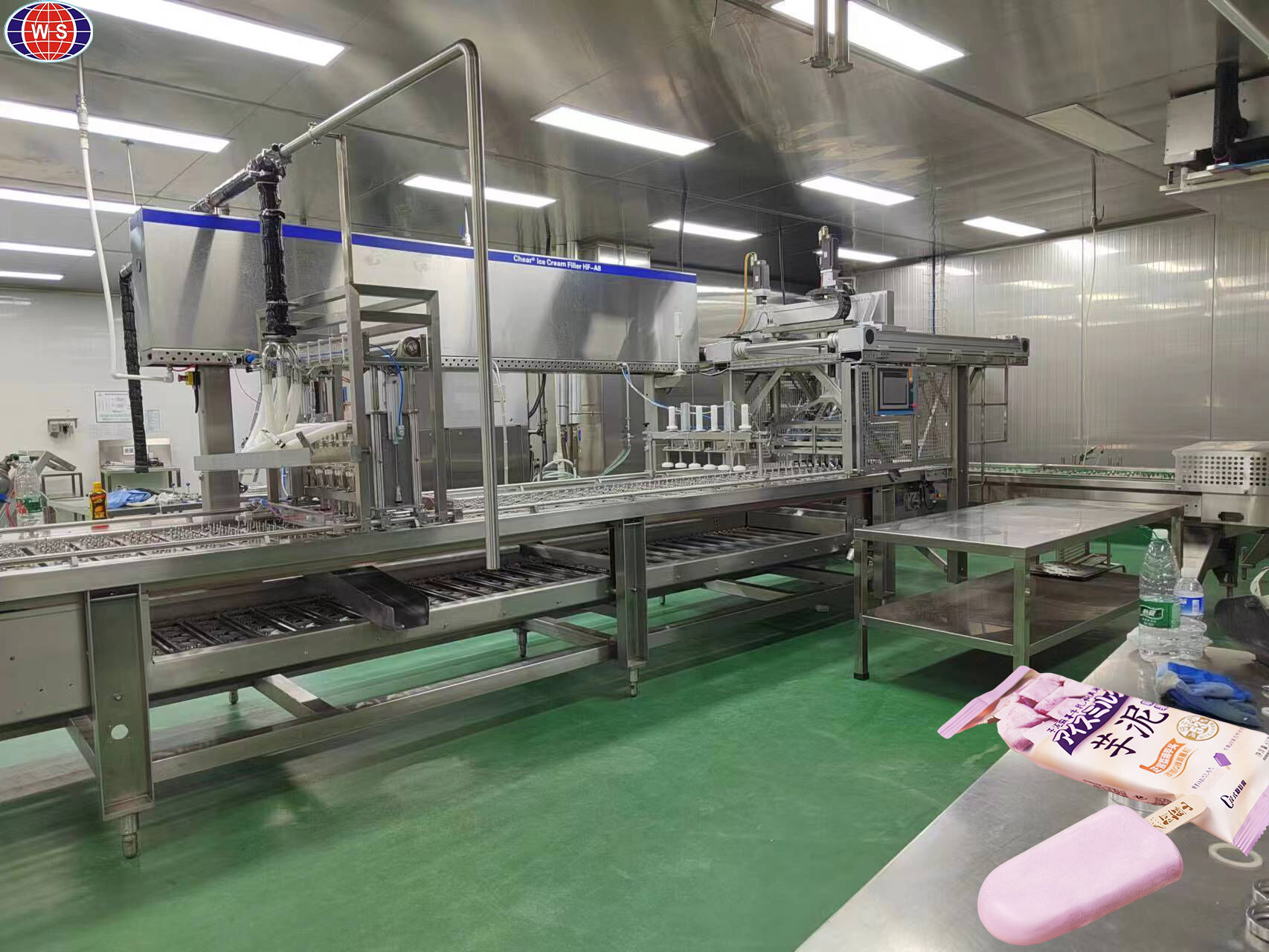
If you are evaluating an ice cream production line for your factory, you have probably already seen a lot of spec sheets. But do you know what actually happens inside the line — from the moment raw ingredients enter to the moment a finished product rolls out sealed and frozen?
Understanding the production process is not just about satisfying curiosity. It directly affects which equipment you need, how you plan your layout, where quality risks sit, and what your total cost of ownership will look like.
This guide walks through the complete ice cream production line process — step by step — with a focus on what matters to buyers and factory managers.
The 6 Core Stages of an Ice Cream Production Line
A standard industrial ice cream production line moves through six key stages. Each stage has its own equipment, critical parameters, and potential impact on final product quality.
Stage 1: Ingredients Mixing & Blending
The process begins in the mixing tank, where dairy ingredients (milk, cream, skim milk powder), sweeteners (sugar, glucose syrup), stabilizers, and emulsifiers are combined into a uniform mix.
Key considerations at this stage:
- Temperature control: Most ingredients dissolve best at 40–60°C. The mixing tank must maintain precise temperature.
- Agitation speed: Too slow causes poor dispersion; too fast introduces excessive air too early.
- Dry powder handling: Some lines integrate powder dissolving units to prevent clumping.
For buyers: If your recipe includes high-viscosity ingredients or heat-sensitive flavors (like chocolate), verify that the mixing system supports variable speed agitation and temperature zoning.
Stage 2: Homogenization
After mixing, the blend passes through a homogenizer — typically a two-stage high-pressure homogenizer in ice cream production lines. This is one of the most technically critical steps.
What it does:
- First stage (high pressure, typically 150–200 bar): Breaks fat globules down to 1–2 μm.
- Second stage (low pressure, typically 30–50 bar): Disperses broken fat globules to prevent re-agglomeration.
Why it matters: Proper homogenization directly determines texture. Under-homogenized mix produces greasy, grainy ice cream. Over-homogenized mix can destabilize certain emulsifier systems. The quality of your homogenizer is one of the most important variables in product consistency.
For buyers: Always request homogenizer pressure specifications and ask whether the equipment supports CIP (Clean-in-Place). A homogenizer that is hard to clean is a food safety liability.
Stage 3: Pasteurization
The homogenized mix must be pasteurized to eliminate pathogens and extend shelf life. Most ice cream production lines use either batch pasteurization or HTST (High-Temperature Short-Time) pasteurization via a plate heat exchanger (PHE).
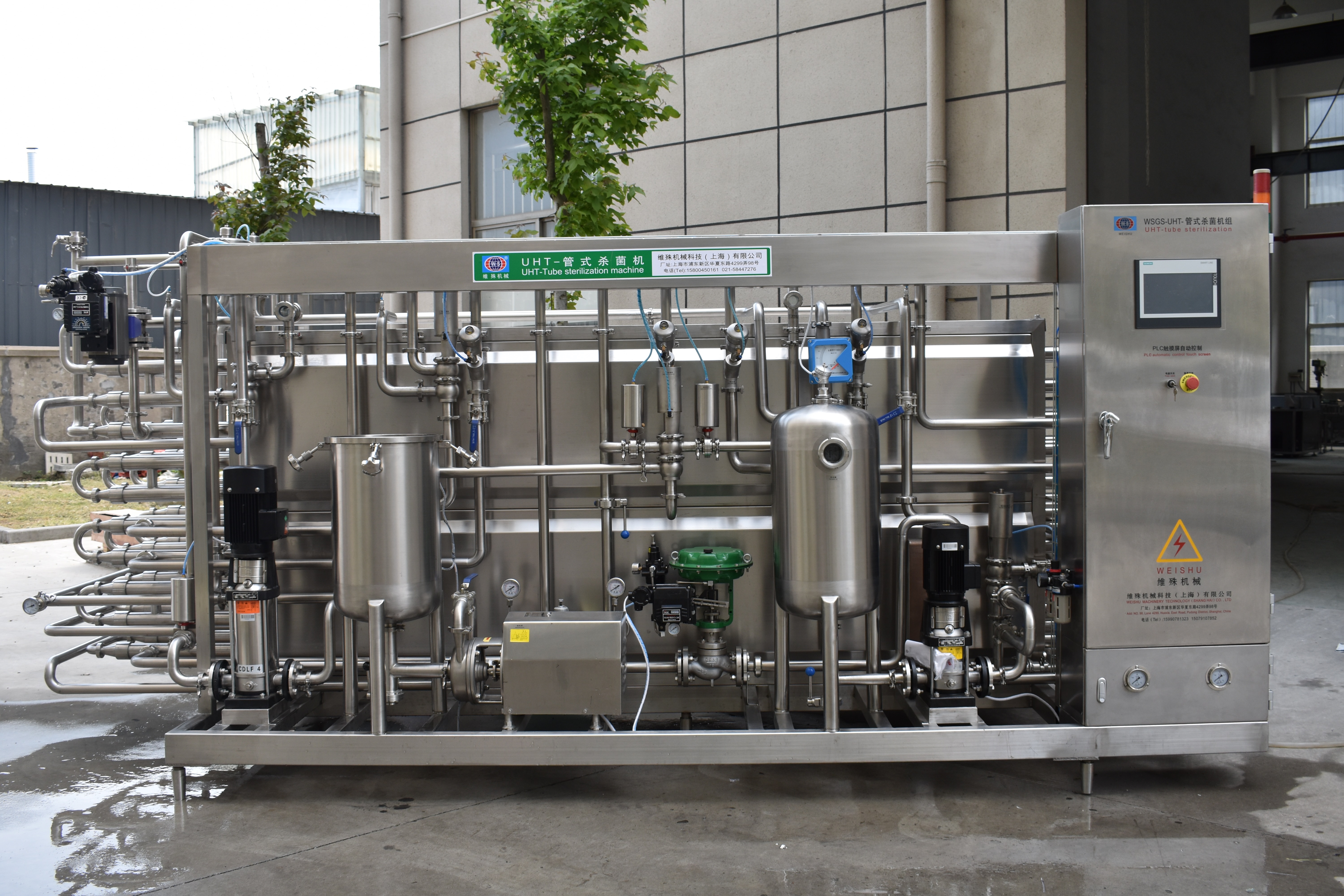
For buyers: HTST with a plate heat exchanger is the industry standard for commercial lines above 500L/h capacity. Confirm the PHE is designed for viscous ice cream mix, not just standard milk.
Stage 4: Aging (Maturation)
After pasteurization and cooling (to 2–4°C), the mix is transferred to an aging tank where it rests for a minimum of 4 hours — often overnight in industrial settings.
During aging:
- Fat globules partially crystallize, which improves overrun stability during freezing.
- Proteins hydrate fully, contributing to body and texture.
- Stabilizers activate and reach their maximum viscosity-building potential.
Skipping or shortening aging is one of the most common causes of poor texture and low overrun in ice cream. The aging tank must maintain 2–4°C consistently, with gentle agitation to prevent fat separation.
For buyers: Size your aging tank capacity based on your daily output target, not just your hourly throughput. Many operations underestimate tank size and create bottlenecks at this stage.
Stage 5: Continuous Freezing (Freezer / Dasher)
The continuous freezer — also called a continuous freezer barrel or dasher — is the heart of the production line. This is where the aged mix is simultaneously frozen and whipped to incorporate air (overrun).
Inside the freezer barrel:
- Mix enters the barrel at 2–4°C and exits as semi-frozen ice cream at approximately -5 to -7°C.
- Rotating dashers scrape the barrel wall continuously, preventing large ice crystal formation.
- Air injection is controlled to achieve target overrun (typically 80–120% for soft-serve; 20–50% for premium hard pack).
The exiting product (called "soft ice cream" at this stage) is still pumpable and goes directly to the filling station — it must be handled quickly to preserve texture.
For buyers: Dasher blade material (stainless steel grade), scraping speed, and refrigerant type all affect output quality. Request the dasher's overrun control range and ask whether it has automated back-pressure regulation.
Stage 6: Filling, Hardening & Packaging
The final stage depends heavily on your product format. Industrial lines support three main categories:
Direct-Fill Products (Stick / Cup / Cone)
The soft ice cream from the freezer barrel is filled directly into molds or cups, then immediately transferred to a hardening tunnel. A well-configured filling line can achieve outputs of 80,000–110,000 pieces/day on a single lane.
- Cup filling machines: Servo-driven piston fillers for volumetric accuracy (±1–2%)
- Linear filling machines: High-speed multi-lane lines with integrated lid sealing
- Cone filling: Requires specialized dispensing heads and product flow control to prevent spillage
Sliced / Portioned Products
These lines combine extrusion and in-line slicing. Ice cream is extruded into a continuous ribbon, sliced to weight, and packed — often used for ice cream sandwiches, novelty bars, and bulk blocks. Multi-format tunnel lines can run multiple SKUs simultaneously, with daily capacities around 100,000 pieces.
Cone Products
Cone-type filling requires synchronized cone feeding, product dispensing, and optional coating (chocolate dipping, nut topping). Flow-through production design reduces downtime between format changes.
Hardening tunnel: After filling, all product formats pass through a hardening tunnel (typically -35 to -40°C) to bring the core temperature to -18°C or below. Tunnel length and airflow directly affect throughput — this is a common bottleneck in undersized configurations.
Where Quality Problems Most Often Occur
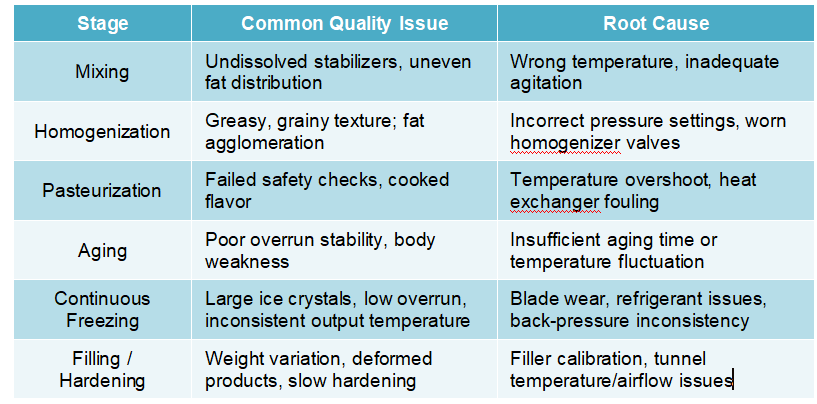
Knowing the process helps you anticipate where quality risks concentrate. Here is a quick reference:
5 Process-Related Questions to Ask Any Equipment Supplier
With a clear picture of the process, you are now equipped to ask sharper questions when evaluating production line suppliers:
- What is the maximum operating pressure of your two-stage homogenizer, and how often do the homogenizing valves need replacement?
- Is the pasteurization unit designed specifically for ice cream mix viscosity, or is it a standard dairy PHE?
- What is the overrun control range on the continuous freezer, and how is back-pressure regulated?
- What is the CIP (Clean-in-Place) configuration across the full line? Which stages are CIP-capable?
- Can the filling and packaging equipment handle the product formats I need — and what is the changeover time between formats?
How Weishu Designs Ice Cream Production Lines
At Weishu Intelligent Machinery, we supply complete turnkey ice cream production lines — covering every stage described in this guide, from mixing and homogenization through pasteurization, aging, continuous freezing, and filling.
Our approach is built around three principles:
- Process-first design: We start with your recipe and output requirements, then engineer the line to match — not the other way around.
- Full line accountability: One supplier, one point of contact, full system integration. No gaps between equipment from different vendors.
- Global deployment: Our lines operate in over 100 countries. We provide installation, commissioning, operator training, and after-sales support wherever your factory is.
Whether you are building a new factory, upgrading an existing line, or scaling capacity, we work with you from process design to production — and beyond.
Conclusion
Ice cream production is more process-intensive than it looks from the outside. Every stage — mixing, homogenization, pasteurization, aging, freezing, and filling — has specific technical requirements that directly affect your product quality, yield, and operational cost.
Understanding the process gives you a real advantage when comparing suppliers, evaluating quotes, and designing your factory layout. The best production line is not the one with the most impressive brochure — it is the one that is engineered correctly for your specific process.
Ready to discuss your ice cream production line project? Contact our engineering team for a process consultation and customized line proposal — no commitment required.
Contact us | Request a quote | Talk to our team about your project
Table of Contents
- The 6 Core Stages of an Ice Cream Production Line
- Stage 1: Ingredients Mixing & Blending
- Stage 2: Homogenization
- Stage 3: Pasteurization
- Stage 4: Aging (Maturation)
- Stage 5: Continuous Freezing (Freezer / Dasher)
- Stage 6: Filling, Hardening & Packaging
- Where Quality Problems Most Often Occur
- 5 Process-Related Questions to Ask Any Equipment Supplier
- How Weishu Designs Ice Cream Production Lines
- Conclusion