
 EN
EN
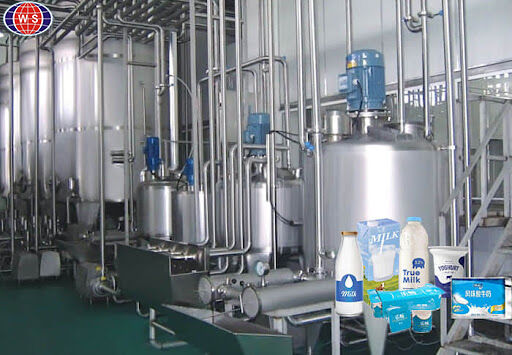
If you're sourcing a UHT milk production line, you already know the basics: ultra-high temperature processing extends shelf life, enables ambient distribution, and opens up markets that refrigerated dairy simply can't reach. What's harder to figure out is how to compare equipment, what specs actually matter, and where most buyers go wrong during procurement.
This guide cuts through the noise. Whether you're building a greenfield plant or upgrading an existing line, here's what to evaluate before you sign a contract.
1. Start With Your Output Target — Not the Machine Specs
Most suppliers lead with equipment capacity. Don't let that be your starting point.
Before comparing any machines, nail down:
- Daily or annual output volume (liters/day or tons/year)
- Product mix: Whole milk only? Flavored milk? Cream? Plant-based blends?
- Packaging format: Tetra Pak-style carton, HDPE bottle, sachet, or pouch?
- Planned SKUs and fill volumes: 200ml, 500ml, 1L — each affects line configuration
A line rated at 5,000 L/hour means nothing if your packaging machine creates a bottleneck at 3,000 L/hour, or if your raw milk supply only allows 6 hours of daily operation.
Buyer tip: Define your target throughput at the packaging output stage, then size the upstream process equipment to match — not the other way around.
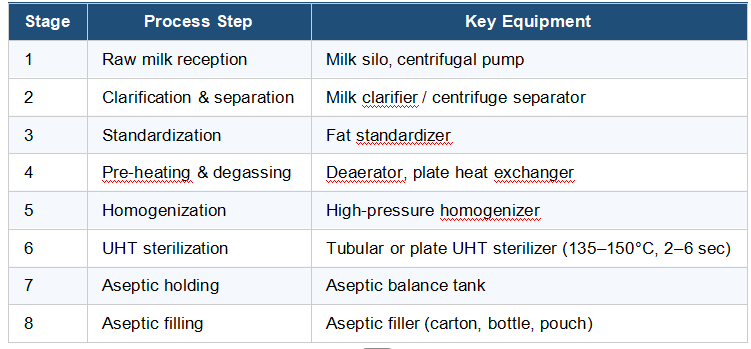
2. Understand the Full Process Flow
A UHT milk production line is not a single machine — it's a system. When comparing suppliers, you need to evaluate whether the complete flow is designed coherently, not just individual components.
Ask every supplier: who supplies each stage? Some integrators assemble lines from mixed brands with poor compatibility. Others manufacture the full flow in-house, which simplifies commissioning, spare parts, and after-sales support.
3. Direct Steam Injection vs. Indirect UHT: Know the Difference
This is one of the most consequential technical choices in a UHT line — and buyers frequently overlook it.
Indirect UHT (plate or tubular heat exchanger):
- Product never contacts steam directly
- Better suited for standard whole milk, skim milk, flavored milk
- Lower operating cost
- Easier to clean (CIP-compatible)
- Most common choice for dairy plants
Direct steam injection (DSI) / infusion:
- Steam contacts product instantly — very short hold time at high temperature
- Better for heat-sensitive products: protein-enriched milk, cream, whey-based drinks
- Higher equipment cost and steam consumption
- Can reduce cooked flavor in premium products
Which to choose? For most standard UHT milk applications, indirect heating (tubular or plate) is the right call. If you're producing high-protein products or premium lines where flavor profile matters, consider direct injection — and budget accordingly.
4. Capacity: Think in Realistic Operating Hours, Not Peak Ratings
Equipment capacity is typically rated at peak, continuous operation. Real-world output depends on:
- CIP (clean-in-place) cycles: typically 60–90 min per shift
- Pre-sterilization of the aseptic system before production starts
- Changeovers between SKUs or flavors
- Planned downtime and maintenance windows
A rule of thumb: assume 70–80% effective utilization of rated capacity for planning purposes. If your demand requires 8,000 L/hour of net output, don't spec a line rated at 8,000 L/hour — you'll need closer to 10,000–12,000 L/hour rated capacity.
5. Aseptic Filling: The Bottleneck Everyone Underestimates
The UHT sterilizer rarely limits your line. The aseptic filler almost always does.
Key questions for the filling stage:
- Is the filler truly aseptic? Not just 'clean room' — it must maintain sterile conditions after pre-sterilization with H₂O₂ or steam, and hold that sterility throughout the production run.
- What is the filler's actual speed (fills/hour) at your target pack size?
- Does it support your packaging format? Not all fillers are format-agnostic. Carton, pouch, and bottle lines use fundamentally different machines.
- Changeover time between SKUs? If you're running 3–4 SKUs, changeover frequency directly impacts effective capacity.
If your supplier is quoting the sterilizer capacity without matching filler specs, push for both — and make sure they align.
6. Automation Level: Match It to Your Workforce and Budget
Modern UHT lines range from semi-automatic to fully automated with PLC/SCADA control. The right level depends on:
- Local labor cost and availability — high automation reduces headcount but increases CapEx
- Operator skill level — fully automated systems require trained technicians for fault diagnosis
- Regulatory requirements — some markets require audit trails, batch records, and traceability that only automated systems provide
Most mid-to-large dairy plants today opt for PLC-controlled lines with HMI touchscreen interfaces, automatic CIP programs, and real-time process monitoring. This is the sweet spot between cost and reliability.
Don't underestimate the value of automatic CIP: consistent, validated cleaning cycles reduce contamination risk far more reliably than manual washing, and they're essential for FDA, EU, or Codex Alimentarius compliance.
7. Hygienic Design Standards: Non-Negotiable for Export Markets
If you're producing for export — or planning to in the future — the line must be built to recognized hygienic engineering standards:
- 3-A Sanitary Standards (USA)
- EHEDG guidelines (EU)
- FDA/cGMP compliance
- CE marking for electrical and mechanical components (EU)
Practically, this means:
- All product-contact surfaces in 304 or 316L stainless steel
- Smooth, crevice-free welds (Ra ≤ 0.8 µm internal finish for aseptic lines)
- Gaskets in food-grade EPDM or silicone
- No dead legs in pipework where bacteria can accumulate
- Full drainability of all product-contact zones
Ask for material certifications (EN 10204 3.1 or equivalent) and weld quality documentation. Reputable suppliers provide these as standard.
8. After-Sales Support: The Factor That Determines Your Real Total Cost
A UHT line at competitive CapEx means nothing if it sits idle for 3 weeks waiting for a spare part, or if commissioning overruns because of poor technical support.
Evaluate:
- Commissioning and startup support: Is it included, or extra cost? How long?
- Operator and technician training: On-site at your facility, or only at the factory?
- Spare parts availability: Critical consumables (seals, gaskets, homogenizer valves) should be stocked locally or available within 48–72 hours.
- Remote diagnostics: Does the control system support remote access for troubleshooting?
- Reference customers in your region: Can the supplier connect you with an existing customer running a similar line?
The best suppliers offer turnkey project delivery — process design, manufacturing, FAT (factory acceptance test), shipping, installation, commissioning, and training under one contract. This reduces coordination risk and gives you a single point of accountability.
9. Common Mistakes to Avoid
- Selecting on price alone. A line that costs 15% less but has poor hygienic design, incompatible components, or no local service network will cost far more over its lifecycle.
- Not clarifying what's included. Confirm: Does the quoted price include CIP system? Utilities connections? Control panels? Aseptic tank? Installation? These items are often quoted separately and can add 20–30% to the base price.
- Ignoring utility requirements. UHT lines consume significant steam, cooling water, compressed air, and power. Ensure your facility can supply them at the required specs — and factor infrastructure upgrades into your budget.
- Skipping FAT (Factory Acceptance Test). Always require a full FAT at the supplier's facility before shipment. This is your opportunity to verify performance, CIP cycle validation, and control system behavior before the line arrives at your plant.
- Underspecifying for future expansion. If you plan to add a second filling head or a new SKU in 3 years, discuss modular expansion options now — it's far cheaper to design for it upfront than to retrofit later.
10. Questions to Ask Every Supplier
Use these to separate serious suppliers from those just quoting to win the order:
- What is the effective throughput at the aseptic filler, not just the sterilizer?
- What hygienic design standard does the line comply with — 3-A, EHEDG, or equivalent?
- What is the material certification for all product-contact components?
- Who manufactures each major sub-system — in-house or third-party?
- What is the CIP cycle time, and how is it validated?
- Can you provide reference customers running a similar line — preferably in my country or region?
- What is included in commissioning, and what is the expected timeline from delivery to commercial production?
- How are critical spare parts supplied, and what is your average response time for technical support?
Final Thoughts
Choosing a UHT milk production line is a long-term investment that affects your product quality, regulatory compliance, and competitive position in the market. The right line isn't necessarily the cheapest or the one with the most impressive rated capacity — it's the one that fits your actual output requirements, meets the food safety standards of your target markets, and comes with the technical support to keep it running reliably.
At Weishu Intelligent Machinery, we design and manufacture complete UHT milk production lines — from raw milk reception to aseptic filling — with full project support from process design to commissioning and operator training. Our lines are trusted in over 100 countries, and we're experienced in meeting the regulatory and hygienic standards of diverse export markets.
Table of Contents
- 1. Start With Your Output Target — Not the Machine Specs
- 2. Understand the Full Process Flow
- 3. Direct Steam Injection vs. Indirect UHT: Know the Difference
- Indirect UHT (plate or tubular heat exchanger):
- Direct steam injection (DSI) / infusion:
- 4. Capacity: Think in Realistic Operating Hours, Not Peak Ratings
- 5. Aseptic Filling: The Bottleneck Everyone Underestimates
- 6. Automation Level: Match It to Your Workforce and Budget
- 7. Hygienic Design Standards: Non-Negotiable for Export Markets
- 8. After-Sales Support: The Factor That Determines Your Real Total Cost
- 9. Common Mistakes to Avoid
- 10. Questions to Ask Every Supplier
- Final Thoughts