
 EN
EN
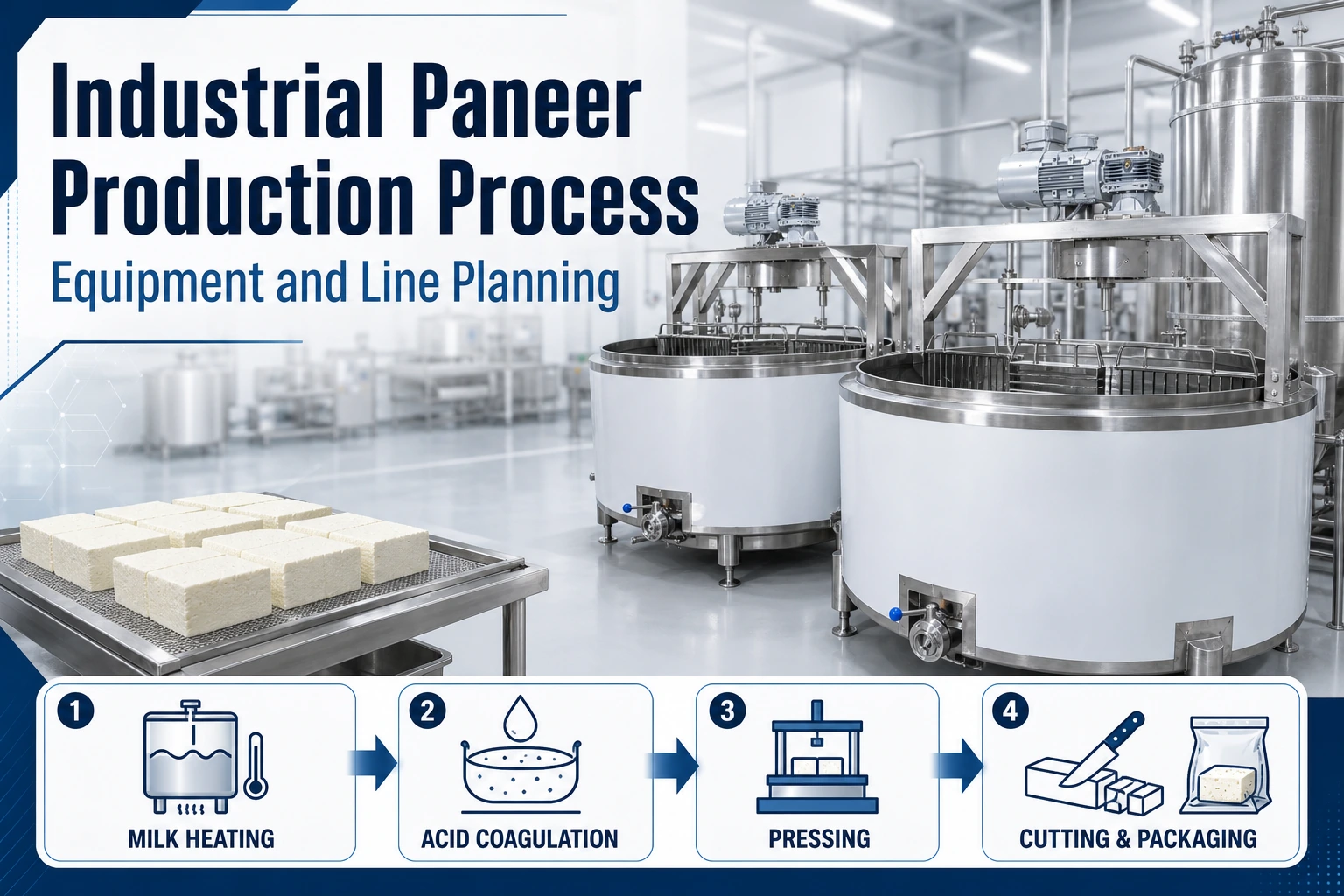
An industrial paneer production process converts milk into a fresh, acid-coagulated dairy product through controlled milk preparation, heating, coagulation, whey separation, pressing, cooling, cutting, and packaging. The basic sequence is straightforward, but achieving consistent commercial output requires more than increasing batch volume. Every stage must be sized around the same batch schedule, product specification, hygiene plan, and packaging output.
The most common project mistake is to begin with a list of machines. A paneer plant should instead begin with the required product: milk source, fat and solids level, target moisture and texture, block dimensions, package size, daily output, and intended storage conditions. These decisions determine the equipment, utilities, automation, labor, and factory space required.
In this guide, Weishu explains how a complete paneer line works and how to plan each section as part of one coordinated production system. The objective is to help dairy processors define a workable process and equipment scope without treating the cheese vat, press, chiller, and packaging machine as isolated purchases. When discussing a paneer project with Weishu, buyers can use the planning points below to organize their product, capacity, packaging, utility, and factory requirements before equipment selection begins.
What Is an Industrial Paneer Production Line?
Paneer is commonly described as a fresh, unripened dairy product made by heating milk and precipitating its proteins with an acid such as citric or lactic acid. Every producer must confirm the product definition and composition rules that apply in its own market. Unlike many ripened cheeses, conventional paneer production does not depend on rennet coagulation, starter-culture development, or an aging room. The curd is separated from whey, pressed into a compact mass, conditioned or cooled, cut, packaged, and kept under the storage conditions established for the product.
An industrial paneer production line coordinates this process at a repeatable commercial scale. A complete line may include:
- milk reception, filtration, cooling, and storage;
- milk standardization and ingredient preparation;
- a batch or continuous heating system;
- an acid preparation and dosing system;
- a coagulation or cheese vat;
- curd and whey separation equipment;
- paneer hoops, molds, and a manual, hydraulic, or pneumatic press;
- chilled-water conditioning or another validated cooling system;
- block cutting, portioning, weighing, and packaging;
- cold storage;
- clean-in-place equipment for compatible closed circuits;
- manual cleaning provisions for open equipment and removable parts;
- whey collection and wastewater handling.
The line is therefore a production system rather than one paneer making machine. The equipment configuration changes with milk composition, output, batch size, desired texture, degree of automation, package format, and local food regulations.
Industrial Paneer Production Process Step by Step
1. Receive and Test the Milk
Production begins with raw-material control. Milk is received, measured, sampled, filtered, and transferred to chilled storage or directly to processing. The acceptance plan may examine temperature, appearance, odor, acidity, fat, solids-not-fat, density, microbial quality, and possible antibiotic or cleaning-chemical residues. The exact tests and limits should follow the plant’s quality plan and applicable regulations.
Paneer yield and texture depend strongly on the incoming milk. Variation in fat, protein, acidity, and heat stability can change curd formation, whey clarity, moisture retention, and pressing behavior. Reception equipment must also match the peak delivery pattern, not only average hourly production.
2. Standardize the Milk
Standardization adjusts milk composition to the paneer specification and the producer’s yield, texture, and labeling objectives. Depending on the milk source and recipe, the plant may separate cream, blend milk streams, or add permitted milk solids. Cow milk, buffalo milk, and mixed milk do not necessarily behave the same way during coagulation and pressing.
The target should be defined by product trials and regulatory requirements, not copied from another factory. Increasing solids may improve recovery, but it can also change curd firmness, heat transfer, acid demand, and whey handling. The fat-to-protein relationship affects both economic yield and the eating properties of the finished paneer.
3. Heat the Milk
The standardized milk is heated before acid coagulation. Heat treatment supports microbial control and changes the behavior of milk proteins in ways that influence curd recovery and texture. Paneer manufacturing often uses a stronger heat treatment than ordinary drinking-milk pasteurization, but the actual temperature, holding time, and cooling point before coagulation must be established for the milk and product specification.
Small or flexible plants may heat milk in a jacketed cheese vat. Larger operations may use a plate pasteurizer or tubular heat exchanger for faster, more controlled heating before transferring milk to coagulation vats. The choice affects batch time, energy recovery, cleaning, floor space, and automation.
Heating capacity must match the real production schedule. If a vat holds 1,000 liters but the heating system needs too long to reach the process temperature, the plant will not achieve the assumed number of batches per shift. The calculation should include filling, heating, holding, transfer, coagulation, draining, cleaning, and operator handling—not only nominal vat volume.
4. Prepare and Dose the Coagulant
Paneer curd is produced by adding a food-grade acid solution to heated milk under controlled conditions. Citric acid and lactic acid are common options, but the permitted material, concentration, preparation water, dosage, and addition method should follow the approved recipe and local rules.
Uniform dosing is important. Acid added too quickly or unevenly can create local over-acidification, fragmented curd, excessive fines, and inconsistent moisture. Acid added too slowly may lengthen the batch and expose different parts of the milk to different conditions. The vat’s agitation should distribute the coagulant without breaking the forming curd unnecessarily.
5. Coagulate and Rest the Curd
After acid addition, milk proteins aggregate and separate into curd and whey. A properly configured cheese vat must distribute heat and coagulant without subjecting the forming curd to unnecessary mechanical damage. Operators normally assess the endpoint through a defined combination of process conditions and visual or analytical checks. Clearer whey and cohesive curd may indicate appropriate separation, but an industrial quality plan should not rely on appearance alone.
The curd may be allowed to settle briefly before whey removal. Excessive agitation at this stage can shatter the curd and increase solids loss into the whey. Insufficient distribution of acid, however, can leave uneven coagulation within the vat. Vat geometry, agitator type, speed, acid-entry location, temperature uniformity, and operator timing all affect the result.
6. Separate the Curd From the Whey
The curd and whey are transferred or discharged to a draining system. Depending on plant scale, this may be a cloth-lined hoop, perforated vat, draining table, curd trolley, screen, or more automated separation arrangement.
The separation method must retain the curd while allowing whey to leave at a controlled rate. A screen that is too coarse can lose curd fines; one that blocks easily can slow production and retain excess moisture. High transfer forces or unsuitable pumps can damage fragile curd. Gravity transfer is simple, but the floor level and equipment elevation must be planned early.
7. Fill the Hoops and Press the Paneer
The drained curd is placed in cloth-lined or otherwise suitable hoops and pressed into blocks. Pressing removes additional whey, consolidates the curd, and helps establish moisture, density, shape, and slicing behavior.
Press selection depends on batch size, block dimensions, required pressure control, labor, changeover, cleaning, and throughput. Small plants may use manual presses. Higher-output lines often use a hydraulic or pneumatic cheese pressing machine with multiple molds or stations. Automation can improve repeatability, but only if curd loading is also consistent.
Pressure should not be treated as a single universal setting. The result depends on curd temperature, particle condition, milk composition, hoop size, cloth, fill weight, pressing time, and whether pressure is applied in stages. Excessive or rapid pressing can trap moisture unevenly or produce an overly firm block. Insufficient pressing can leave a weak structure and excessive free whey.
8. Cool and Condition the Blocks
Pressed paneer is commonly cooled or conditioned to firm the block and remove process heat. One traditional industrial approach uses chilled water or chilled brine under controlled conditions. The exact time, temperature, water quality, and sanitation program must be validated for the product and market.
Cooling is a capacity-limiting stage that is often underestimated. A cooling tank must hold the output from the press while maintaining the required water temperature. As warm blocks enter, they add a significant heat load. The chiller should therefore be sized from product mass, inlet and target temperatures, batch frequency, tank volume, ambient conditions, and recovery time—not from a generic refrigeration rule.
9. Cut, Weigh, and Package the Paneer
After conditioning, blocks may be drained, surface-dried, cut into retail or food-service portions, checked for weight, and packaged. Cutting equipment ranges from manual wire frames to pneumatic or automated block cutters. The correct system depends on block firmness, dimensions, portion tolerance, output, and the number of formats.
The package should be selected before the line is finalized. Vacuum pouches, thermoformed packs, trays, and other formats have different requirements for product dimensions, headspace, sealing surfaces, hygiene, leak testing, labeling, and secondary packaging. The packaging machine’s sustainable output must match the upstream batch release rate.
10. Move the Product to Cold Storage
Shelf life cannot be promised from one processing temperature or packaging material. It depends on the complete system: raw milk, heat treatment, post-process hygiene, water quality, handling, package integrity, storage, transport, and the validated microbiological and sensory program. Producers should establish shelf life for the actual product and market rather than borrowing a number from another factory.
Equipment Required for Paneer Manufacturing
The following table provides a practical starting point for an industrial paneer equipment list.
| Equipment | Main function | Key selection inputs |
|---|---|---|
| Milk reception and storage system | Receives, filters, chills, and holds milk | Delivery pattern, milk volume, holding time, cooling duty |
| Cream separator or standardization system | Adjusts milk composition | Milk source, fat/protein target, other dairy products |
| Pasteurizer or heating system | Delivers the defined heating program | Batch size, flow rate, temperature program, heat recovery |
| Cheese or coagulation vat | Heats or receives milk, doses acid, forms curd | Batch volume, agitation, discharge, temperature uniformity |
| Acid preparation and dosing system | Prepares and distributes coagulant | Acid type, concentration, dose accuracy, automation |
| Curd-whey separation equipment | Retains curd and removes whey | Curd fragility, screen size, drainage rate, cleaning |
| Hoops and molds | Forms repeatable blocks | Block size, fill weight, cloth or liner, handling method |
| Paneer press | Consolidates curd and controls moisture/shape | Blocks per batch, pressure program, cycle time, labor |
| Cooling or conditioning tank | Firms and cools pressed paneer | Product heat load, batch interval, water hygiene, chiller duty |
| Block cutter and checkweigher | Produces consistent saleable portions | Product firmness, dimensions, portion tolerance, formats |
| Packaging system | Seals and protects the product | Pack type, size, output, hygiene level, leak testing |
| CIP station | Cleans compatible tanks, pipes, and heat exchangers | Circuits, return volume, flow, temperature, chemical program |
| Whey collection system | Separates whey from drains and product areas | Whey volume, destination, storage, transfer, treatment |
Not every open paneer-processing step can be cleaned completely by CIP. Hoops, cloths, screens, cutters, open tables, press contact parts, and other removable components may require clean-out-of-place or validated manual cleaning. The quotation should clearly state which equipment is connected to CIP and which is not.
How to Match Capacity Across a Paneer Production Line
Paneer projects often quote capacity in liters of milk per day, kilograms of paneer per day, or vat volume. These are related, but they are not interchangeable.
A reliable capacity calculation begins with the milk available per shift and an expected yield range derived from actual milk and trials. Yield varies with milk composition, standardization, heat treatment, coagulation, fines loss, moisture target, and pressing. It should not be guaranteed from milk volume alone.
Next, calculate the complete batch cycle:
- fill the vat;
- heat and hold the milk;
- prepare and add coagulant;
- allow coagulation and settling;
- drain and transfer curd;
- load, press, and unload molds;
- cool or condition blocks;
- cut and package the batch;
- clean the equipment for the next run.
The slowest recurring stage defines practical line output. Two vats may feed one press, but only if the press cycle and mold inventory can accept both batches. A large press may still wait for a small heating system. A fast cutter adds little value if cooling requires several hours and the tank has no room for the next batch.
For each proposal, request a batch schedule showing equipment occupancy over a full shift. Include product changeovers, CIP, breaks, quality release, packaging-film changes, and realistic handling time. This is more useful than comparing nominal machine capacities.
Factors That Affect Paneer Yield and Quality
Yield is an economic result, but it must be evaluated together with composition and saleable quality. A high apparent yield caused by uncontrolled moisture may create weak texture, liquid release, inconsistent weight, shorter usable life, or noncompliance with the product standard.
Important variables include:
- Milk composition: Protein, fat, minerals, acidity, and total solids affect curd recovery and structure.
- Heat treatment: The heating program influences microbial control and protein behavior.
- Coagulation conditions: Acid type, concentration, dose, addition rate, temperature, mixing, and endpoint affect curd formation.
- Curd handling: Rough pumping, agitation, or transfer can create fines and increase solids loss in whey.
- Drainage and pressing: Screen condition, cloth, fill distribution, pressure, time, and curd temperature affect moisture and density.
- Cooling: Cooling rate and final condition influence firmness, cutting behavior, and downstream handling.
- Hygiene: Contamination after heating can undermine product quality even when the curd formation is satisfactory.
A useful plant dashboard can track milk fat and protein, milk quantity, acid consumption, coagulation time, whey appearance or solids, wet curd weight, pressed block weight, moisture, rejected packs, and recovered saleable output. Trends across batches are more informative than an isolated yield number.
CIP, Manual Cleaning, and Hygienic Design
Paneer production combines closed milk circuits with open curd handling. The cleaning strategy must address both.
Closed equipment such as storage tanks, pipelines, compatible heating systems, pumps, and certain vats may be connected to a CIP station. A validated cycle controls the interaction of time, temperature, chemical concentration, and mechanical action. Flow paths, return detection, drainage, spray-device coverage, valve routing, and instrument placement all matter. These decisions should be addressed during dairy CIP system design, not added after the paneer line layout is frozen.
Open equipment requires a separate cleaning plan. Hoops, liners, draining screens, tables, press plates, cutters, conveyors, and cooling tanks must be accessible and designed to avoid cracks, hollow sections, trapped water, and difficult-to-reach product residues. Operators need defined disassembly, washing, inspection, sanitation, drying, and storage procedures.
Factory zoning should separate raw milk and dirty-return routes from post-heating curd, cooling, cutting, and packaging. Personnel, tools, crates, packaging materials, and waste should follow controlled paths. Good equipment cannot compensate for a layout that repeatedly moves contamination into the finished-product area.
Utilities and Factory Layout
A paneer line requires more than electrical power. The project utility schedule may include steam or hot water, chilled water or glycol, refrigeration, potable or process water, compressed air, electricity, ventilation, drainage, and wastewater treatment.
The layout should provide one-direction product flow wherever practical:
milk reception → preparation and heating → coagulation → whey drainage → pressing → cooling → cutting → packaging → cold storage
Allow space for operators to load and remove hoops, clean equipment, service valves and motors, move curd trolleys, handle packaging materials, and access the chiller and utility systems. Drain slopes, floor loading, ceiling height, doorway dimensions, and installation access should be confirmed before equipment is manufactured.
Future expansion also deserves space. Adding another vat is useful only if the press, cooling, packaging, refrigeration, CIP, and wastewater systems can accept the extra production.
Information to Send Before Requesting a Paneer Line Quotation
A useful quotation requires more than “500 kg per day” or “one paneer machine.” Prepare the following information:
- milk type, source, typical fat, protein, total solids, and daily availability;
- target paneer composition, moisture, texture, block dimensions, and portion sizes;
- required kilograms per hour, shift, and day;
- number and length of production shifts;
- current recipe or trial process, if available;
- package type, pack weight, dimensions, and required packs per hour;
- desired automation and batch-record requirements;
- available steam or hot water, cooling, power, compressed air, and process water;
- factory dimensions, hygiene zones, drainage, and installation access;
- whey use or disposal plan;
- destination market and applicable regulatory or documentation requirements;
- other dairy products that must share the same reception, heating, CIP, or packaging systems.
With these inputs, a supplier can discuss the process flow, mass balance, batch schedule, equipment list, utility loads, layout, cleaning boundary, and project exclusions on a common basis.
Frequently Asked Questions
What is the basic industrial paneer production process?
The typical sequence is milk reception and testing, standardization, heating, acid coagulation, curd-whey separation, molding and pressing, cooling or conditioning, cutting, packaging, and cold storage. The actual settings must be validated for the milk, product specification, and local requirements.
What equipment is essential for a paneer plant?
Core equipment usually includes milk storage and preparation, a heating system, coagulation vat, acid dosing, curd drainage, hoops or molds, a paneer press, cooling, cutting, packaging, refrigeration, cleaning equipment, and whey handling. The exact scope depends on which utilities and dairy systems already exist.
Can one machine produce finished paneer automatically?
Some operations can be integrated or automated, but commercial paneer production still involves several different duties: heating, coagulation, separation, pressing, cooling, cutting, packaging, and cleaning. Buyers should evaluate the complete production line and batch schedule rather than a single machine label.
How should paneer production capacity be calculated?
Capacity should be calculated from milk supply, trial-based yield, complete batch time, number of vats and molds, press cycles, cooling residence time, packaging output, cleaning time, and shift schedule. Nominal vat volume alone is not sufficient.
Is CIP enough to clean the complete paneer line?
No. CIP can clean properly designed closed tanks, pipes, pumps, and heat exchangers. Open curd-contact equipment, hoops, cloths, screens, presses, and cutters generally require clean-out-of-place or validated manual cleaning as well.
What determines paneer yield?
Milk composition, standardization, heat treatment, coagulation conditions, curd losses, pressing, and final moisture all affect yield. The relevant commercial measure is compliant, saleable paneer—not wet curd weight alone.
Plan Your Industrial Paneer Production Line
The right paneer line is built around a defined product and a balanced production schedule. Milk preparation, heating, coagulation, drainage, pressing, cooling, packaging, CIP, refrigeration, and whey handling must all support the same output.
Weishu can discuss a preliminary paneer process and equipment configuration based on your project requirements. Send your milk type and composition, target paneer output and specification, package format, operating schedule, available utilities, factory dimensions, and destination country. These details provide a practical basis for discussing the process flow, equipment scope, utility requirements, and layout.
Table of Contents
- What Is an Industrial Paneer Production Line?
-
Industrial Paneer Production Process Step by Step
- 1. Receive and Test the Milk
- 2. Standardize the Milk
- 3. Heat the Milk
- 4. Prepare and Dose the Coagulant
- 5. Coagulate and Rest the Curd
- 6. Separate the Curd From the Whey
- 7. Fill the Hoops and Press the Paneer
- 8. Cool and Condition the Blocks
- 9. Cut, Weigh, and Package the Paneer
- 10. Move the Product to Cold Storage
- Equipment Required for Paneer Manufacturing
- How to Match Capacity Across a Paneer Production Line
- Factors That Affect Paneer Yield and Quality
- CIP, Manual Cleaning, and Hygienic Design
- Utilities and Factory Layout
- Information to Send Before Requesting a Paneer Line Quotation
- Frequently Asked Questions
- Plan Your Industrial Paneer Production Line