
 EN
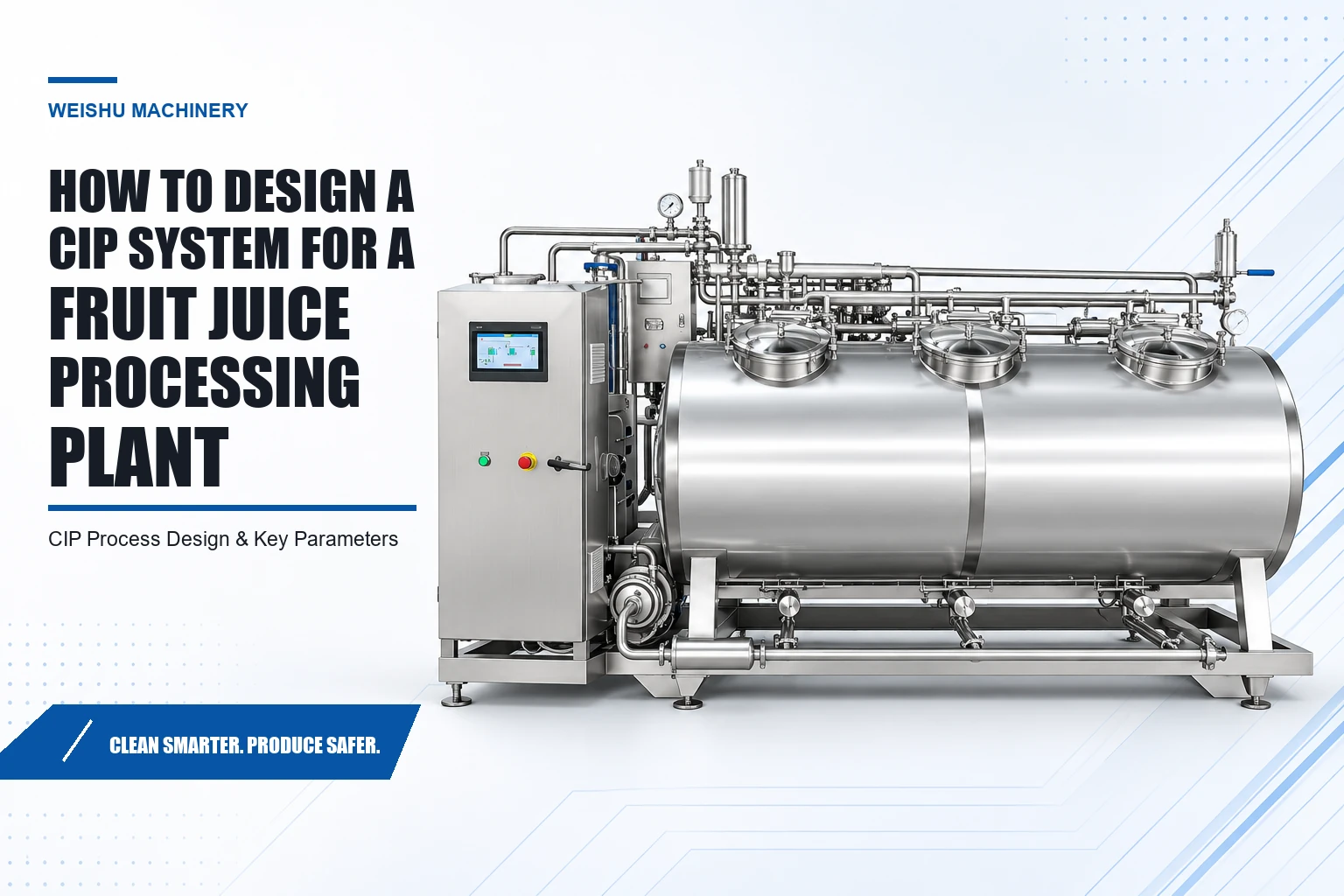
In the fruit juice processing industry, maintaining impeccable hygiene standards is not just a regulatory mandate—it directly dictates product shelf life and brand reputation. Designing an efficient fruit juice plant CIP system requires a deep understanding of fluid dynamics, as fruit processing introduces unique complications like high-viscosity concentrates, fibrous pulp residues, and caramelized sugars from thermal treatment. Standard, off-the-shelf washing setups often fail to clean these stubborn soils, leading to extended downtime or, worse, safety hazards.
At Weishu , we engineer highly optimized, automated CIP system for beverage plant applications that ensure maximum uptime and zero sanitary blind spots. By precisely calibrating the interaction of mechanical force, chemical concentration, and temperature, our compact, integrated systems deliver repeatable, validated cleaning cycles. Whether you are running a high-capacity concentrate line or a delicate, multi-flavor juice blend facility, this technical guide breaks down the essential engineering design parameters needed to maximize your plant's cleaning efficiency and ensure complete safety.
What Are the Critical Cleaning Challenges in Fruit Juice Processing?
Fruit juice processing involves distinct product characteristics that make cleaning significantly more complex than standard beverage lines. Implementing a generic wash cycle without understanding these product behaviors will inevitably lead to compromised food safety or catastrophic component wear.
H3: Mastering the Juice Pasteurizer CIP Cleaning Procedure
The thermal treatment zone—specifically the plate or tubular juice pasteurizer—is the most difficult area to clean in a fruit juice plant CIP system. When fruit juice containing natural fructose and sucrose is exposed to pasteurization temperatures (75°C to 95°C), sugar caramelization and protein denaturation occur rapidly on the heat exchanger surfaces. This creates a resilient, baked-on organic scale.
To break this down, the juice pasteurizer CIP cleaning procedure must be engineered with precise thermal and chemical sequencing. A static wash is insufficient; the system must initiate a pre-rinse using recovered water at 50°C to flush out loose sugars without shocking the thermal plates, followed by a targeted hot caustic (1.5% - 2.0% NaOH) wash maintained strictly at 80°C - 85°C to hydrolyze the caramelized matrix.
H3: Preventing Clogging and Dead Legs from High-Fibre Pulp
Unlike clear beverages, fruit juices often retain heavy pulp, cellular tissues, and fibrous solids. When the production run ends, these fibers settle out of suspension and accumulate in low-velocity zones, pipe elbows, and valve manifolds, forming dense, compact plugs. If the CIP system's structural design allows for "dead legs" (unstirred pockets of piping), these fibers will decompose, creating dangerous bio-films that contaminate subsequent batches.
Weishu eliminates this risk by optimizing the layout to ensure the ratio of dead-leg length to pipe diameter (L/D) is strictly below 1.5, in compliance with EHEDG standards. Furthermore, we integrate high-capacity, inline duplex strainers prior to the return loop to intercept and trap freed fibers, preventing recirculated pulp from clogging the spray balls or contaminating the fresh chemical solution.
How to Calculate Fluid Velocity for Efficient Juice CIP Cleaning?
The core performance of an automated CIP system for beverage plant depends on a precise balance between chemical action and mechanical force. In juice lines, relying solely on chemical concentration to dissolve pulp accumulation is incredibly wasteful; mechanical scrubbing via turbulent flow is mandatory to physically dislodge organic soils.
H3: Achieving Turbulent Flow for Total Mechanical Scrubbing
To achieve a thorough physical scrubbing action on the inner walls of the process piping, the cleaning fluid must transition out of laminar flow and achieve high turbulence. Fluid mechanics dictates that this requires a minimum Reynolds Number (Re) of 4,000, though food safety engineering demands a safer threshold of Re > 10,000.
In practical plant engineering, this translates to a mandatory linear fluid velocity of 1.5 m/s to 2.0 m/s. Weishu designs its CIP modules by calculating the exact pipe diameters of your filler lines and pasteurizers, matching them with high-head centrifugal supply pumps. This guarantees the fluid exerts the necessary kinetic shear stress to strip away stubborn pectin layers and pulp sediments from every millimeter of the pipe wall.
H3: Optimizing Chemical Action and Wash Cycle Times
Once turbulent flow is established, the chemical phase must be tightly regulated to conserve water and expensive detergents. For fruit juice plants, a standard three-phase wash cycle is optimized as follows:
- Pre-Rinse: 5 - 10 minutes using ambient or warm water to evacuate 90% of loose product debris directly to the drain.
- Caustic Detergent Wash: 20 - 30 minutes of circulating 1.5% Sodium Hydroxide (NaOH) at 80°C to dissolve organic matter.
- Acid Neutralization Wash: 10 - 15 minutes of circulating 0.5% - 1.0% Nitric Acid (HNO₃) at ambient temperature to remove inorganic mineral scales and neutralize residual caustic.
- Final Post-Rinse: A rapid flush with fresh RO/DI water until the inline conductivity meter registers neutral water parameters, signaling a completely clean system.
How to Ensure Rigorous Cross-Contamination Prevention in Juice CIP?
In modern multi-flavor juice facilities, a single cross-contamination event can compromise a whole product batch or trigger severe allergen recalls. Ensuring total cross-contamination prevention in juice CIP requires removing human error from the equation and establishing fail-safe boundaries between product lines and active chemical headers.
Deploying Smart PLC Controls to Eliminate Human Error
Manual valve positioning during cleaning operations introduces unacceptable risk. Weishu configures its CIP systems with fully integrated PLC control architecture (utilizing premium Siemens or Omron processors) paired with precise touchscreen HMIs.
The entire wash routine—including temperature ramp-ups, precise chemical dosing via proportional valves, pneumatic valve routing, and loop-return validation—is completely automated. Operators select the pre-validated recipe for the specific process line, and the system executes it identically every single time, logging conductivity and temperature data for mandatory food-safety compliance audits.
H3: Utilizing Mixproof Valves to Isolate Chemicals from Juice
The physical interface where the CIP pipelines meet the juice production lines is a critical control point. To safely clean one section of the plant while product is running in another, standard single-seat valves are inadequate.
Our engineering team utilizes double-seat mixproof valve matrices. These valves feature two independent seals separating the juice line from the CIP chemical line, with an open atmospheric drain cavity situated between them. If a seal ever wears out or fails, the leaking fluid safely exits through the drain port onto the floor rather than mixing with your product, providing an absolute, physical guarantee against cross-contamination.
Why Opt for Weishu Skid-Mounted CIP Modules for Your Factory?
For existing juice processing plants, installing a new CIP system often brings a major concern: extended operational downtime during a messy, drawn-out onsite installation. Weishu resolves this operational bottleneck by offering fully integrated, skid-mounted CIP modules.
Our engineering approach centers on modularity and pre-validation. Every Weishu CIP unit is completely assembled, piped, wired, and structurally supported on a heavy-duty, compact stainless steel frame right inside our factory. We conduct comprehensive hydrostatic pressure tests and full PLC dry-runs before the equipment ever leaves our floor.
When the skid arrives at your fruit juice plant, it functions as a literal "plug-and-play" asset. Your local team simply needs to anchor the skid, connect the utility lines (steam, fresh water, electricity), and link the main CIP supply and return headers. This engineering strategy compresses onsite installation timelines from weeks down to a matter of days, preserving your production schedules and significantly minimizing factory downtime.
Let’s Right-Size Your Juice Plant’s CIP Efficiency Together
We get it. No production manager wants to deal with a messy, weeks-long installation that paralyzes the factory floor, or a complex system that operators struggle to run. You need a CIP setup that works quietly in the background, cleans thoroughly on the first run, and passes every regulatory audit with flying colors.
That is why we don't believe in "one-size-fits-all" machinery. A truly efficient system is calculated down to the exact flow velocity and valve timing your specific juice line requires.
Let’s take the guesswork out of your plant hygiene. Tell us a little bit about your daily output and your floor constraints by clicking below. Our engineers at Weishu will build a tailor-made 3D skid design and a clear process diagram for you—completely free of charge. Let’s find the perfect balance between your cleaning standards and your operational budget today.
Table of Contents
- What Are the Critical Cleaning Challenges in Fruit Juice Processing?
- How to Calculate Fluid Velocity for Efficient Juice CIP Cleaning?
- How to Ensure Rigorous Cross-Contamination Prevention in Juice CIP?
- Why Opt for Weishu Skid-Mounted CIP Modules for Your Factory?
- Let’s Right-Size Your Juice Plant’s CIP Efficiency Together