
 EN
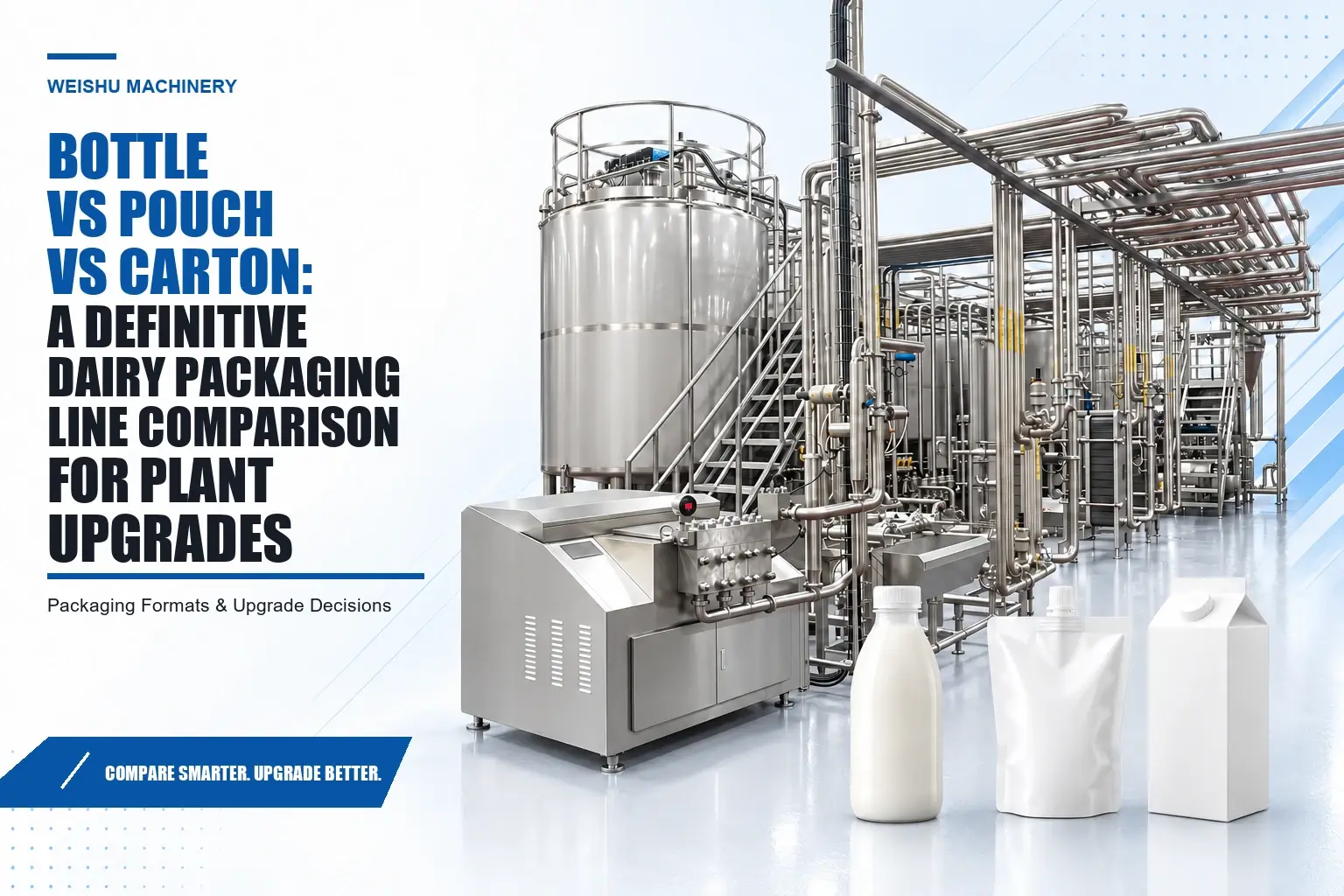
What is the Core Impact of Packaging Choices on a Dairy Production Line?
The final packaging format exerts a reverse-engineering effect on the entire upstream processing hall. A mistake in matching your filling technology with your thermal pasteurization curve will result in either compromised shelf-life or catastrophic product flavor degradation.
Non-Aseptic vs. Aseptic Processing Requirements
- Fresh Pasteurized Milk: Requires a low-temperature long-time or High-Temperature Short-Time (HTST) pasteurization curve (typically 72°C–75°C for 15 seconds) through a standard Plate Heat Exchanger (PHE). Since pasteurized milk is non-sterile, it is typically routed to ultra-clean or clean-fill bottling or gable-top carton machines, maintaining a strict cold chain to deliver a 7-to-21-day shelf life.
- UHT Milk and Juices: Demand complete commercial sterility. The liquid must undergo ultra-high temperature treatment (137°C–142°C for 2–4 seconds). To maintain this sterility, the downstream filling machine must be fully aseptic. Tetra Pak carton packaging lines use sterilizing agents (such as vaporized hydrogen peroxide or UV-C arrays) to sterilize the continuous packaging material web right before forming and filling. This creates an absolute microbial barrier, achieving a 6-to-12-month ambient shelf life for UHT milk and juices.
Production Layout and Shop Floor Constraints
- Bottling Lines: Require extensive linear layouts. Empty bottles must move through single-file air conveyors, massive rotary rinsing-filling-capping blocks, accumulation tables, and lengthy linear labeling tunnels. This demands significant floor space.
- Pouch Lines: Utilize multiple parallel filling lanes or rotary pouch feeders. They have moderate footprints but require elaborate secondary packaging cartoning equipment because flexible pouches cannot be palletized directly.
- Aseptic Brick Carton Lines: Provide the most compact footprint per unit of output. A carton filling machine processes paperboard rolls directly, forming, filling, and sealing the bricks vertically within a single enclosed sterile chamber. This drastically reduces the cleanroom square footage required and optimizes shop floor utilization.
Dairy Packaging Line Comparison: Bottles vs. Pouches vs. Tetra Pak Cartons
To guide capital expenditure (CAPEX) evaluation, the table below compares the mechanical and technical specifications of the three packaging lines operating at a standard capacity of 10,000 units/hour:
| Engineering Parameter | Bottling Line (HDPE/PET) | Flexible Pouch Line | Tetra Pak Brick Carton Line |
|---|---|---|---|
| Primary Core Application | Fresh Milk, ESL Milk, Juices | Low-Cost Fresh Milk, Yogurt | UHT Long-Life Milk, Juices, ESL Milk |
| Filling Mechanical Style | Rotary Gravity / Low-Vacuum | Linear Multi-Lane / Rotary Piston | Vertical Continuous Web Forming & Sealing |
| Aseptic Integrity Level | Clean / Ultra-Clean (High-Risk) | Clean / Limited Aseptic | Strict Aseptic (Class 100 / ISO 5 Zone) |
| Floor Footprint Required | Large (due to linear accumulation) | Medium (requires secondary cartoners) | Highly Compact (Integrated vertical footprint) |
| Material Sourcing Waste | Moderate (Scrap caps, bottle rejection) | Low (Roll stock film trimming) | Extremely Low (Precision continuous cutting) |
| Palletization Efficiency | Moderate (Lost volume between cylinders) | Poor (Requires rigid outer secondary crates) | Maximum (Rectangular bricks optimize volume) |
Filling Speeds and Mechanical Performance at 10,000 Units/Hour
- Rotary Bottlers: Rely on centrifugal force and high-speed starwheels to smoothly transfer rigid bottles under filling nozzles. Liquid splashing at 10,000 bph requires precise liquid level control and neck-clamping mechanisms to prevent product loss.
- Pouch Fillers: At this velocity, pouches must be filled via multi-lane indexing linear systems or high-speed rotary grippers. The primary challenge is pouch stability; flexible film moves inconsistently under high acceleration, creating a higher risk of seal contamination if liquid splashes onto the top heat-seal zone.
- Aseptic Carton Fillers: The continuous paperboard web moves vertically, and filling occurs below the liquid level inside a closed tube of packaging material. This eliminates splashing entirely, allowing the system to easily maintain a steady 10,000 cartons/hour output with minimal mechanical strain or product rejection.
CIP Cleaning and Aseptic Integrity Standards
- Bottling Equipment: Utilizes a standard Clean-In-Place (CIP) loop for the filling bowl and product valves, supplemented by a Clean-Out-of-Place (COP) or localized chemical spray system to sanitize the massive rotary open-air turret areas.
- Aseptic Carton Fillers: Feature a completely enclosed product path. The machine undergoes a fully automated, intensive CIP and Sterilization-In-Place (SIP) cycle using superheated water or pressurized steam (121°C) before production begins. During operation, the filling zone is isolated by a constant positive pressure of sterile air (Class 100 sterile chamber), eliminating any risk of environmental contamination.
How Does the Plate Heat Exchanger Connect to Different Dairy Fillers?
Connecting the front-end Plate Heat Exchanger (PHE) pasteurizer/UHT system to the back-end packaging fillers is one of the most complex integration challenges in dairy plant design. The PHE must maintain a constant flow rate and pressure to ensure proper pasteurization thermal cycles, whereas filling lines experience frequent short stoppages (e.g., during roll changes or conveyor jams).
What is the ROI and Capital Cost Comparison for Each Packaging Line?
Evaluating a packaging upgrade requires balancing initial capital expenditure (CAPEX) against ongoing operating expenses (OPEX).
- Flexible Pouch Lines: Offer the lowest initial CAPEX. The filling machinery is mechanically straightforward, and raw plastic film rolls are inexpensive to purchase and store. However, pouches require rigid secondary plastic crates or corrugated boxes for transport. This adds ongoing labor and secondary packaging costs, making the long-term OPEX higher for industrial-scale operations.
- Bottling Lines: Fall in the middle for CAPEX. However, they carry the highest logistical OPEX. Empty pre-formed plastic or glass bottles require massive warehouse storage space. Transporting rigid bottles—both empty into the plant and full out to retail—means paying to transport empty space, which increases fuel and transport costs.
- Tetra Pak Brick Carton Lines: Represent the highest initial CAPEX due to the precision engineering required for aseptic vertical web forming systems. However, they deliver the highest long-term ROI. Cartons are shipped to the plant as flat, compact paperboard rolls, minimizing storage costs. Once filled, their rectangular shape eliminates wasted space on shipping pallets, reducing logistical costs by 20% to 35% compared to bottles. Combined with an extended ambient shelf life that cuts cold-chain refrigeration electricity costs, an automated carton line often achieves a full capital payback within 18 to 24 months.
Why Choose Weishu for Your Turnkey Pasteurization and Carton Packaging Line?
At Weishu, we build fully integrated processing and packaging systems designed to maximize efficiency and maintain strict hygienic control. Our comprehensive turnkey processing lines seamlessly bridge front-end pasteurization with back-end automated filling, optimized specifically for 10,000 units/hour capacities.
- Native Siemens Automation Ecosystem: Every Weishu production line is integrated using a unified Siemens S7-1500 PLC control network and WinCC HMI system. This centralized control synchronizes the flow rate of the plate heat exchanger, the pressure in the aseptic buffer tank, and the filling speed of your carton lines. If downstream packaging speeds change, the upstream pasteurization parameters self-adjust automatically, preventing thermal stress on the product and eliminating operator error.
- End-to-End Mechanical Integration: We eliminate the headaches of dealing with multiple distinct equipment suppliers. Weishu designs and manufactures the entire line—from raw milk storage tank CIP spray balls and product valve matrices to the core PHE sterilizer and downstream fillers—guaranteeing perfect compatibility and zero system bottlenecks.
- Advanced Aseptic Integrity: Our systems are engineered to meet strict international hygienic standards. We feature mixproof valve arrays, orbital-welded AISI 316L stainless steel lines, and automatic chemical dosing loops to ensure your UHT milk and juices stay safe throughout production.
- Global EPC Project Delivery: Weishu manages the entire project lifecycle. We handle everything from 3D factory layout engineering and utility integration (steam, water, air) to international shipping, on-site installation, and final plant commissioning.
Ready to Optimize Your Dairy Production Line?
Whether you are planning a greenfield processing facility or upgrading your existing filling throughput to 10,000 units/hour, our engineering team is here to design the optimal system architecture tailored to your specific product parameters and factory layout. Contact Weishu Today to submit your material specifications and receive a free technical line design and capital cost quotation.
Frequently Asked Questions
Q1: Can a single Weishu pasteurization line switch between processing fresh milk and fruit juice?
A: Yes. Our plate heat exchangers (PHE) and multi-stage pasteurizers can be custom-engineered with multi-section plates and flexible thermal curves managed via the Siemens PLC. By selecting different pre-set recipes on the HMI panel, the system can automatically adjust temperatures and holding times to accommodate low-acid liquid milk or high-acid fruit juices.
Q2: What is the typical shelf life of milk packed in a Weishu aseptic brick carton versus a PET bottle?
A: Milk processed through our UHT system and filled on our aseptic brick carton line achieves a commercial shelf life of 6 to 12 months at ambient temperatures without refrigeration. In contrast, standard PET or HDPE bottles used for fresh pasteurized milk typically deliver a 7-to-21-day shelf life and strictly require an unbroken cold chain.
Q3: What are the cleanroom air quality standards required for a 10,000 cph aseptic carton filling line?
A: The filling zone of a Weishu aseptic carton machine is isolated inside an enclosed Class 100 (ISO 5) sterile chamber with continuous HEPA-filtered positive pressure and vaporized hydrogen peroxide (H₂O₂) sterilization. This localized barrier allows the surrounding factory floor to operate under standard cleanroom guidelines, significantly lowering your overall facility HVAC construction costs.
Table of Contents
- What is the Core Impact of Packaging Choices on a Dairy Production Line?
-
Dairy Packaging Line Comparison: Bottles vs. Pouches vs. Tetra Pak Cartons
- To guide capital expenditure (CAPEX) evaluation, the table below compares the mechanical and technical specifications of the three packaging lines operating at a standard capacity of 10,000 units/hour:
- Filling Speeds and Mechanical Performance at 10,000 Units/Hour
- CIP Cleaning and Aseptic Integrity Standards
- How Does the Plate Heat Exchanger Connect to Different Dairy Fillers?
- What is the ROI and Capital Cost Comparison for Each Packaging Line?
- Why Choose Weishu for Your Turnkey Pasteurization and Carton Packaging Line?
- Ready to Optimize Your Dairy Production Line?
- Frequently Asked Questions