
 EN
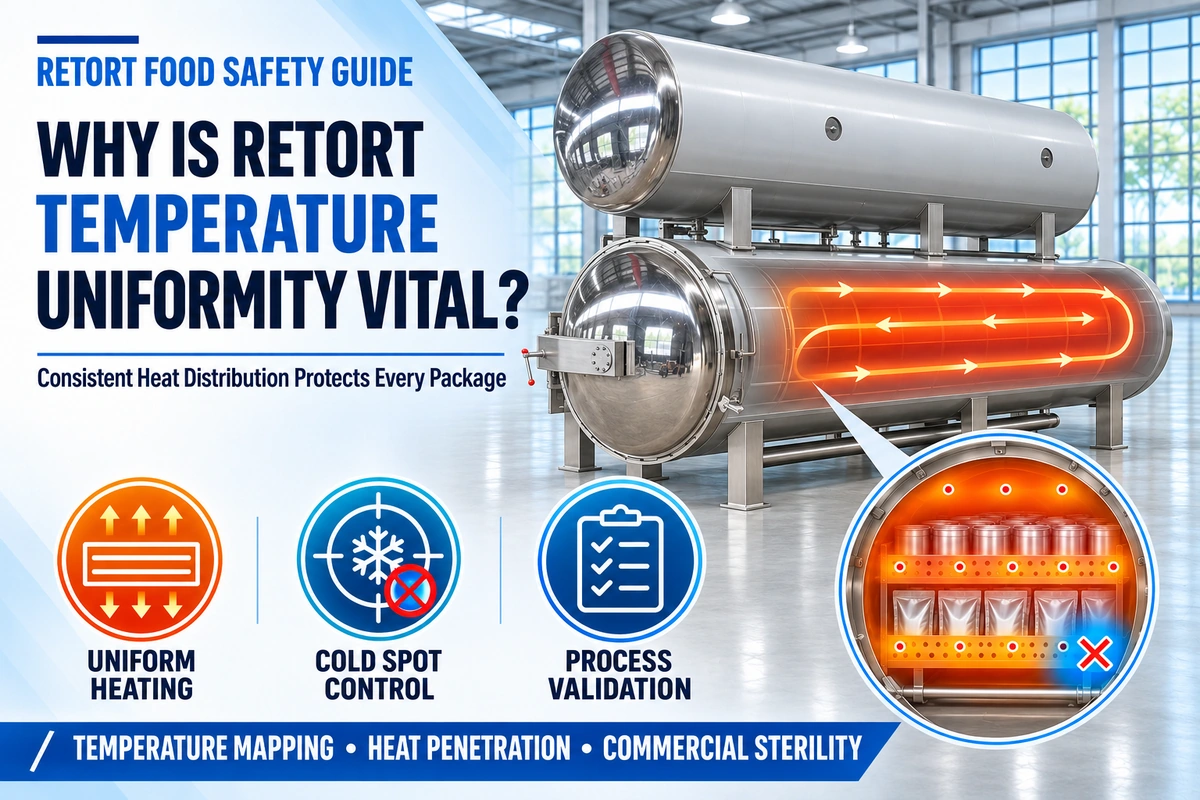
In industrial food processing, achieving the required sterilization temperature is only part of the challenge. What matters just as much is whether heat is distributed consistently throughout the retort chamber, allowing every packaged product to receive the thermal treatment established for its production process.
At Weishu, we believe that retort temperature uniformity is one of the most important factors influencing sterilization reliability, product quality, and production efficiency. A retort sterilizer must do more than heat packaged food. It must maintain controlled processing conditions across different basket positions, packaging formats, and production batches.
Uneven temperature distribution can create serious operational problems. Containers located in slower-heating areas may receive less thermal treatment than intended, while products exposed to excessive heat may experience changes in flavor, color, texture, or packaging integrity.
These challenges are particularly relevant when processing canned foods, bottled dairy beverages, ready-to-eat meals, and flexible retort pouches.
This article explains why temperature uniformity matters, what causes uneven heating, how different retort systems distribute thermal energy, and how food manufacturers can improve sterilization consistency through equipment design, operating procedures, and temperature distribution testing.
What Is Retort Temperature Uniformity?
Retort temperature uniformity refers to how consistently the heating medium maintains the required temperature throughout the processing chamber under defined operating conditions.
During sterilization, hot water, steam, or a steam-air mixture transfers heat to the outside surfaces of packaged food products. Heat then travels through the packaging material and into the food.
For a reliable process, the heating environment must provide the conditions assumed when the sterilization schedule was established.
Temperature differences can occur between different locations inside the chamber because of circulation patterns, basket loading, equipment geometry, or heating-medium distribution.
A properly designed retort system aims to control these variations so that the validated thermal process can be delivered consistently.
However, temperature uniformity does not mean that every point inside the chamber must display exactly the same temperature at every moment. Actual performance is evaluated through appropriate heat distribution studies and operating requirements.
Why Does Uniform Heating Matter for Commercial Sterility?
Commercial sterility is a fundamental objective of retort processing for many shelf-stable packaged foods.
For low-acid foods, the thermal process must provide sufficient microbial inactivation to control relevant hazards, including heat-resistant bacterial spores.
The effectiveness of thermal treatment depends on the temperature experienced by the product over time.
This relationship is commonly evaluated using thermal lethality concepts such as the F₀ value, where appropriate to the product and process.
If one area of the retort consistently heats more slowly than another, containers in that location may experience different heating conditions.
Even relatively small temperature differences can affect accumulated thermal lethality. Whether this creates an unacceptable process deviation depends on the validated sterilization schedule and the actual heat penetration behavior of the food.
For this reason, retort heat distribution must be evaluated before relying on a sterilization process for routine commercial production.
Temperature uniformity supports process reliability, but it does not independently prove that every product has achieved commercial sterility. Product-specific heat penetration testing and process validation are also necessary.
How Do Temperature Differences Affect Product Quality?
Temperature differences inside a retort can influence more than microbial safety.
Food products exposed to excessive thermal treatment may undergo undesirable changes in appearance, flavor, texture, or nutritional characteristics.
For example, dairy beverages may develop stronger cooked flavors or changes in protein stability when exposed to unnecessary heating.
Canned vegetables may lose firmness, while certain sauces and prepared meals may experience color changes or texture deterioration.
When operators encounter uneven heating, increasing the overall sterilization time may appear to be a simple solution.
However, extending the process without appropriate technical evaluation can expose already adequately heated products to additional thermal stress.
The better approach is to identify the cause of uneven heating and determine whether equipment adjustments, loading changes, or process modifications are required.
Maintaining consistent retort temperatures helps manufacturers reduce unnecessary thermal variation while supporting repeatable product quality.
What Causes Uneven Heating in Retort Sterilization?
Uneven heating can result from several interacting factors. In industrial retorts, temperature distribution depends on how the heating medium moves through the chamber, how products are arranged, and how accurately the equipment controls the process.
Understanding these causes is essential before attempting to improve sterilization performance.
Insufficient Water Circulation and Steam Distribution
The heating medium must reach the relevant areas of the product load effectively.
In a water spray retort, heated water is circulated through a distribution system that directs it toward packaged products.
If circulation flow is inadequate or certain spray passages become obstructed, water may not reach all container surfaces under the intended conditions.
This can create differences in heating-medium exposure between basket positions.
Water immersion retorts also depend on effective circulation. Although the containers are submerged, the water temperature may not remain sufficiently consistent throughout the chamber if circulation or heating performance is inadequate.
Steam-based systems face different challenges. In saturated steam retorts, incomplete air removal can interfere with steam contact and heat transfer.
The common engineering requirement is clear: the heating medium must be distributed effectively throughout the loaded vessel.
Improper Basket Loading and Packaging Arrangement
Basket loading has a direct influence on retort temperature distribution.
Food manufacturers often focus on maximizing the number of containers processed per batch. However, excessive loading or unsuitable container arrangements may restrict the movement of the heating medium.
For example, tightly packed containers can reduce the available flow paths for circulating water.
Divider plates, trays, and other loading accessories may also affect water or steam distribution.
The impact depends on the retort design and the loading pattern used during process validation.
A loading arrangement that performs adequately with one packaging format may not be suitable for another.
This is particularly important when manufacturers change container dimensions, packaging materials, or the number of layers inside a basket.
Rather than assuming that all loading configurations are interchangeable, factories should evaluate how changes affect heat distribution and product heating.
Equipment Design and Temperature-Control Problems
Temperature uniformity also depends on the mechanical and control-system design of the retort sterilizer.
Important equipment factors include circulation pump performance, heating-medium distribution, piping arrangements, temperature sensors, control valves, and chamber geometry.
Poorly positioned distribution components may create areas with different heating conditions.
Similarly, unstable temperature control can introduce unnecessary fluctuations during processing.
Sensor calibration and measurement location are also important. A temperature reading from one point inside the vessel does not necessarily represent conditions throughout the entire product load.
For reliable operation, the control system should maintain the required processing conditions while the equipment's heat distribution performance is demonstrated through appropriate testing.
What Is the Difference Between Retort Heat Distribution and Heat Penetration?
Heat distribution and heat penetration are closely related, but they describe different aspects of retort sterilization.
Heat distribution concerns the heating conditions inside the retort chamber.
Heat penetration concerns how heat travels through the packaging and into the food itself.
Understanding this distinction is essential because a retort can maintain consistent heating-medium temperatures while different products still heat at different rates.
|
Comparison Factor |
Retort Heat Distribution |
Product Heat Penetration |
|---|---|---|
|
Main focus |
Heating conditions throughout the retort chamber |
Heating behavior inside the packaged food |
|
Primary objective |
Demonstrate suitable heating-medium distribution |
Determine product heating characteristics |
|
Influencing factors |
Circulation, loading, distribution design, venting |
Viscosity, packaging, particle size, agitation |
|
Measurement |
Temperature sensors at selected chamber locations |
Temperature measurements within representative products |
|
Main purpose |
Support consistent retort operating conditions |
Support development and validation of the thermal process |
For example, two containers positioned in a retort may experience similar surrounding water temperatures.
However, one container may hold a low-viscosity beverage while another contains a thick sauce.
The beverage may transfer heat internally through natural convection, while the sauce may rely more heavily on conduction.
As a result, their internal heating rates can differ significantly even when the external heating conditions are similar.
This is why food manufacturers must evaluate both vessel heat distribution and product heat penetration.
How Do Water Spray and Water Immersion Retorts Maintain Temperature Uniformity?
Water spray and water immersion retorts use different methods to transfer thermal energy to packaged products.
Both can provide effective sterilization conditions when properly designed, operated, and validated.
For manufacturers comparing Weishu's rotary water spray and rotary water immersion configurations, understanding their circulation characteristics is particularly useful.
Water Spray Retort: Circulation and Nozzle Distribution
A water spray retort sterilizer distributes circulating hot water across the surfaces of packaged food products.
The heating medium moves through a circulation system and reaches the product load through a designed spray or water-distribution arrangement.
Temperature uniformity depends on several factors, including water flow, distribution coverage, chamber geometry, and basket loading.
If spray passages are blocked or circulation becomes insufficient, some containers may receive different heating conditions from others.
For this reason, the distribution system must be designed to provide effective water contact across the intended loading arrangement.
Routine inspection and maintenance of circulation components can help preserve the equipment's established operating performance.
Water spray systems are worth evaluating for applications requiring controlled heating and pressure management, including suitable flexible pouches, plastic containers, glass packaging, and metal cans.
However, the heating method alone does not guarantee uniform processing. The complete system must be assessed under actual operating conditions.
Water Immersion Retort: Water Circulation and Thermal Stability
A water immersion retort sterilizer heats packaged products by surrounding them with hot water inside a pressurized chamber.
Because the product load is submerged, the heating medium contacts the exposed packaging surfaces throughout the immersion process.
This arrangement can provide effective heat transfer, but temperature uniformity still depends on water circulation and equipment design.
If water movement is inadequate, different areas of the chamber may experience different heating conditions.
The thermal mass of the water may help moderate certain temperature fluctuations, although it also influences heating requirements and utility consumption.
Manufacturers should therefore evaluate water circulation performance, loading patterns, heating arrangements, and temperature-control behavior when considering an immersion retort.
The objective is not simply to maintain a large quantity of hot water. It is to ensure that the water provides the conditions required by the validated process throughout the product load.
What Role Does Rotary Agitation Play in Product Heating?
Rotary agitation is an additional mechanical function that can be combined with water spray or water immersion heating.
During operation, the retort rotates the product baskets or loading assembly according to the equipment's mechanical design.
For suitable liquid and semi-liquid foods, this movement may encourage internal convection and improve heat penetration.
For example, certain packaged beverages may heat more efficiently when controlled rotation promotes movement inside the container.
However, rotary agitation primarily influences the product's internal heating behavior. It should not be confused with the circulation system responsible for distributing heat throughout the retort chamber.
The effectiveness of rotation depends on product viscosity, headspace, container geometry, rotational speed, and sensitivity to mechanical movement.
Some products may benefit significantly, while others may show limited improvement or experience undesirable changes in texture.
Therefore, rotary operation should be selected based on product-specific testing rather than assumed to be universally superior.
Water Spray vs. Water Immersion: Temperature Uniformity Comparison
|
Technical Factor |
Water Spray Retort |
Water Immersion Retort |
|---|---|---|
|
Heating medium |
Circulating sprayed hot water |
Circulating immersion water |
|
Heat distribution |
Depends on spray coverage and circulation |
Depends on immersion circulation |
|
Main potential issue |
Inadequate distribution or blocked spray passages |
Insufficient circulation or temperature differences |
|
Loading influence |
Can obstruct spray coverage and water flow |
Can restrict circulation around containers |
|
Rotary compatibility |
Available in suitable configurations |
Available in suitable configurations |
|
Validation requirement |
Heat distribution and product heat penetration |
Heat distribution and product heat penetration |
Neither method should be considered automatically more uniform.
The appropriate choice depends on the equipment design, packaging format, loading arrangement, and actual processing requirements.
How Can Manufacturers Test Retort Temperature Uniformity?
Temperature distribution testing helps manufacturers evaluate whether a retort provides sufficiently consistent heating conditions under defined operating conditions.
These studies are particularly important when commissioning equipment, establishing processing conditions, or evaluating significant changes to the system.
Heat Distribution Testing
Heat distribution studies use calibrated temperature-measurement equipment to monitor conditions at selected locations inside the retort.
Sensors may be positioned throughout the chamber or product load according to a testing protocol developed for the specific equipment and heating method.
The purpose is to identify areas that heat more slowly, evaluate temperature differences, and determine whether the retort provides suitable conditions for the intended process.
A typical evaluation considers the following stages:
-
Preparation: Confirm the equipment configuration, sensor calibration, and loading arrangement.
-
Sensor Placement: Position temperature sensors at representative and potentially challenging locations.
-
Heating Evaluation: Record temperature behavior during the heating phase.
-
Processing Evaluation: Assess temperature conditions during the relevant sterilization period.
-
Data Analysis: Identify heating differences and determine whether the results meet the established acceptance criteria.
The number and placement of sensors should be determined by the testing protocol rather than a universal fixed requirement.
Identifying Cold Spots and Heating Differences
A cold spot in the retort chamber refers to an area that experiences comparatively slower heating or lower heating-medium temperatures under the conditions being evaluated.
This should not be confused with the slowest-heating location inside an individual food container.
During heat distribution testing, engineers analyze temperature records to identify locations that may represent challenging heating conditions.
If significant differences are observed, the cause may involve circulation performance, loading arrangements, heating-medium distribution, or control-system behavior.
Corrective actions should address the underlying problem.
Simply increasing the processing time without evaluating the cause may increase product heat exposure without resolving the equipment issue.
How to Improve Temperature Uniformity in Industrial Retorts
Improving retort temperature uniformity requires a combination of appropriate equipment design, operating practices, and preventive maintenance.
Rather than relying on a single adjustment, manufacturers should evaluate the complete heating system.
Optimize Heating-Medium Circulation
Circulation systems should provide sufficient flow to distribute the heating medium throughout the intended product load.
For water spray retorts, this includes evaluating pump performance, distribution components, and potential flow restrictions.
For immersion systems, water circulation should be assessed to determine whether temperature differences occur within the loaded chamber.
Increasing pump capacity is not always the correct solution. Excessive flow may increase energy consumption without resolving problems caused by poor distribution design.
The objective is to establish an effective circulation arrangement for the specific retort configuration.
Maintain Consistent Loading Patterns
Factories should use loading arrangements that are compatible with the validated thermal process.
Container spacing, basket configuration, divider design, and product orientation can influence heat transfer.
When packaging dimensions or loading patterns change, the effect on processing conditions should be evaluated.
Consistent loading practices also help reduce unnecessary batch-to-batch variation.
Maintain Temperature Sensors and Control Components
Accurate measurement is essential for reliable temperature control.
Temperature sensors, control valves, circulation pumps, and related components should be inspected and maintained according to the equipment's operating requirements.
Calibration procedures help ensure that recorded temperatures remain reliable.
Control-system performance should also be reviewed when abnormal temperature fluctuations occur.
Evaluate Changes Through Appropriate Testing
Significant changes to equipment configuration, circulation arrangements, loading patterns, or processing conditions may affect previously established thermal performance.
Manufacturers should assess whether additional heat distribution or heat penetration testing is necessary before implementing such changes in commercial production.
This approach helps ensure that improvements to production efficiency do not compromise the validated sterilization process.
How Does Weishu Support Consistent Retort Sterilization?
At Weishu, retort equipment selection begins with understanding the customer's product characteristics, packaging requirements, and production objectives.
For food manufacturers, maintaining consistent thermal processing conditions is essential to achieving reliable production performance.
Weishu's rotary water spray and rotary water immersion retort configurations provide different heating arrangements that can be evaluated according to the intended application.
Equipment Configuration Based on Product Requirements
Different food products require different heating and handling conditions.
For example, a manufacturer processing bottled dairy beverages may need to evaluate whether controlled rotary movement improves heat penetration without negatively affecting product quality.
A canned-food producer may place greater emphasis on basket loading, heating-medium circulation, and batch capacity.
Weishu can discuss suitable equipment configurations based on product type, packaging material, container dimensions, and expected production output.
Temperature Control and Circulation Considerations
An effective retort system requires appropriate heating-medium circulation, temperature monitoring, and pressure management.
These functions work together to support repeatable processing conditions.
When comparing equipment configurations, manufacturers should request relevant technical specifications and determine what testing or validation documentation is available for the proposed system.
Performance claims should be evaluated against the actual equipment configuration and operating conditions rather than general descriptions alone.
Supporting Reliable Industrial Production
Temperature uniformity is closely connected to broader factory performance.
Consistent heating conditions can help reduce process variation, support product quality, and improve confidence in routine production.
For manufacturers planning a new sterilization line or upgrading existing equipment, Weishu recommends evaluating the complete process before finalizing a retort configuration.
This includes product characteristics, packaging compatibility, production capacity, heating method, and the required thermal process.
Contact Weishu to discuss rotary water spray and rotary water immersion retort configurations for your packaged-food production requirements.
Conclusion
Retort temperature uniformity is an essential factor in reliable industrial food sterilization.
Uneven heating conditions can affect thermal process delivery, product quality, and production consistency. Common contributing factors include inadequate circulation, unsuitable loading arrangements, heating-medium distribution problems, and temperature-control issues.
Water spray and water immersion retorts use different heating arrangements, but both require effective circulation and appropriate heat distribution testing.
Rotary agitation may improve heat penetration for suitable products, although it does not replace the need for consistent heating conditions throughout the chamber.
For food manufacturers, the most reliable approach combines appropriate equipment selection, validated thermal processing, consistent operating procedures, and preventive maintenance.
Weishu supports manufacturers in evaluating retort sterilization configurations that match their products, packaging formats, and production requirements.
Frequently Asked Questions
1. What is retort temperature uniformity?
Retort temperature uniformity describes how consistently the heating medium maintains the required temperature throughout the sterilization chamber. It is evaluated through heat distribution studies conducted under defined operating conditions.
2. What causes uneven heating in a retort sterilizer?
Common causes include insufficient water circulation, obstructed distribution components, improper basket loading, unsuitable container spacing, incomplete air removal in relevant steam systems, and temperature-control problems.
3. Does a rotary retort improve temperature uniformity?
Rotary agitation can improve internal heat transfer for certain packaged foods by promoting product movement. However, it does not automatically improve heating-medium distribution throughout the retort chamber. Both functions must be evaluated separately.
4. Which provides better temperature uniformity: water spray or water immersion?
Neither method is universally superior. Water spray systems depend on effective spray distribution and circulation, while immersion systems depend on suitable water circulation throughout the submerged product load. Actual performance must be evaluated through testing.
5. How often should retort temperature distribution be tested?
Testing should be conducted as appropriate for equipment commissioning, process establishment, and significant changes that may affect heat distribution. Additional evaluations may be necessary based on operating experience, equipment modifications, and the facility's validation procedures.
Table of Contents
- What Is Retort Temperature Uniformity?
- What Causes Uneven Heating in Retort Sterilization?
- What Is the Difference Between Retort Heat Distribution and Heat Penetration?
- How Do Water Spray and Water Immersion Retorts Maintain Temperature Uniformity?
- How Can Manufacturers Test Retort Temperature Uniformity?
- How to Improve Temperature Uniformity in Industrial Retorts
- How Does Weishu Support Consistent Retort Sterilization?
- Conclusion
- Frequently Asked Questions