
 EN
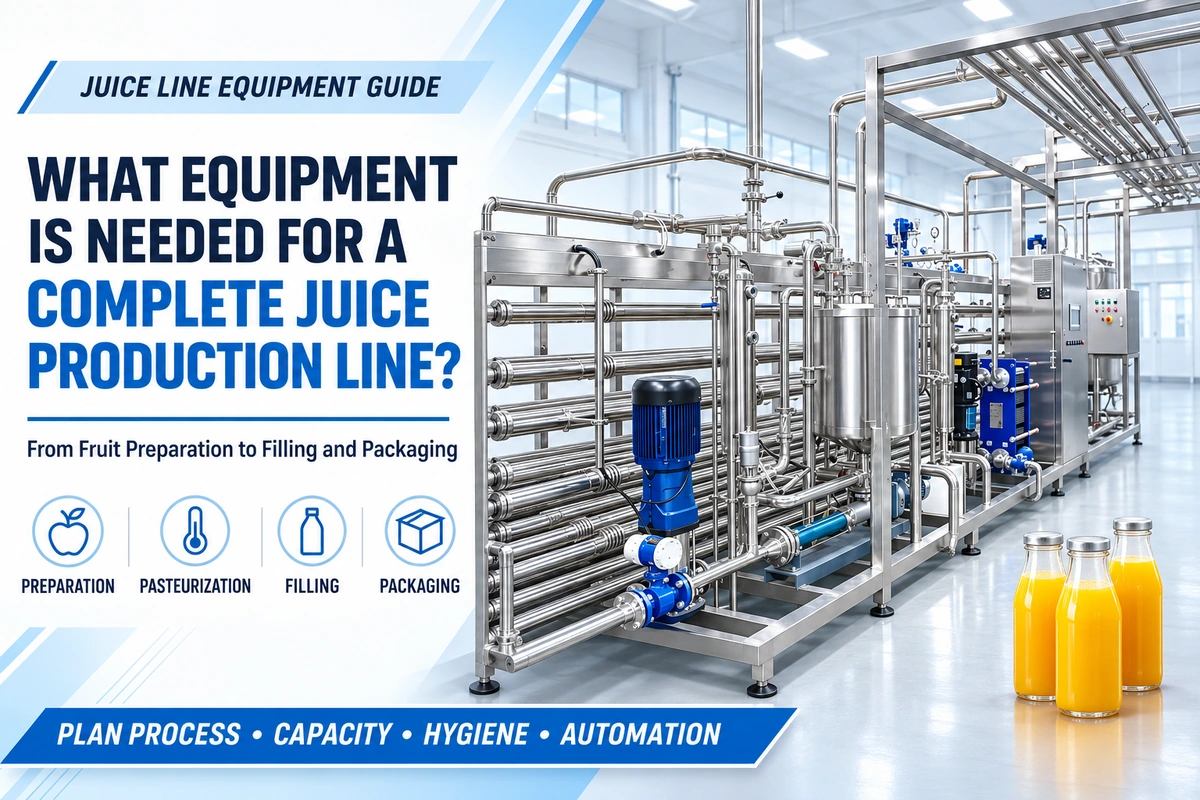
Building a commercial juice factory involves more than purchasing a juicer, a pasteurizer, and a filling machine. Every processing stage must work together to achieve consistent product quality, reliable production capacity, and efficient operating costs. Choosing the wrong equipment—or investing in unnecessary machinery—can increase capital expenditure without improving production performance.
At Weishu, we believe that a successful juice production line begins with the product itself, not a fixed equipment list. A factory producing clarified apple juice has different processing requirements from one manufacturing mango nectar or concentrate-based orange juice drinks. Raw materials, pulp content, packaging formats, and target shelf life all influence equipment selection.
A complete industrial juice production line typically includes raw material preparation, blending, filtration, product-specific homogenization, thermal processing, filling, packaging, and cleaning infrastructure. However, not every product requires every processing module.
Weishu specializes in manufacturing four important processing systems: water treatment systems, homogenization systems, sterilization systems, and automatic CIP cleaning systems. These systems can be integrated with other processing and packaging equipment to create a production line tailored to the customer's requirements.
This guide explains the equipment needed at each stage, which machines are product-dependent, and how beverage manufacturers can select a practical configuration without unnecessary investment.
How Does an Industrial Juice Production Line Work?
An industrial juice production line converts fresh fruit, fruit pulp, or concentrated juice into a finished beverage through a series of controlled processing stages.
The exact process depends on whether the manufacturer uses fresh agricultural materials or purchased concentrates. For example, an NFC juice factory requires extraction equipment, while a factory producing juice drinks from concentrate can begin with ingredient preparation and blending.
Raw Material Preparation and Juice Extraction
For factories processing fresh fruit, production begins with washing, sorting, and extraction. This stage removes unwanted materials and prepares the fruit for subsequent processing.
Typical equipment includes fruit washing machines, sorting conveyors, crushers, pulpers, and juice extractors.
The equipment configuration depends on the fruit variety. Apples may require crushing and pressing, while citrus fruits generally need specialized extraction equipment to separate juice from peel and other unwanted materials. Mango and similar fruits often require pulping equipment rather than conventional juice presses.
Efficient raw material preparation helps improve extraction yield and reduces unnecessary product losses. However, equipment capacity must match the downstream processing system. A high-capacity extractor provides little benefit if the pasteurizer or filling machine cannot handle the resulting juice flow.
Factories using purchased juice concentrate or fruit puree can often eliminate much of this upstream equipment, significantly simplifying the production line.
Blending, Filtration, and Product Formulation
After extraction or ingredient receiving, the juice enters the formulation stage.
Blending tanks combine juice, water, sugar solutions, and other permitted ingredients according to the beverage recipe. Temperature-controlled mixing may be necessary when ingredients require heating or dissolution.
Filtration equipment removes unwanted particles, but filtration requirements vary significantly between products.
For clarified apple juice, fine filtration or additional clarification may be necessary to achieve the desired appearance. For cloudy orange juice or mango nectar, excessive filtration could remove desirable pulp and change the product's characteristics.
A typical concentrate-based beverage formulation system may include mixing tanks, sugar-dissolving equipment, dosing equipment, filters, and transfer pumps.
Manufacturers should select these components according to the required formulation accuracy, batch size, and product characteristics rather than purchasing every available processing module.
Homogenization, Sterilization, and Filling
After formulation, certain juice beverages require homogenization to improve particle dispersion and physical stability.
The product then undergoes an appropriate thermal treatment to control microorganisms and achieve the required product safety and shelf-life objectives.
Depending on the beverage, the production line may use a plate pasteurizer, tubular pasteurizer, or a suitably designed UHT sterilization system.
The treated juice subsequently moves to the filling system under conditions compatible with the validated process.
Hot filling, hygienic chilled filling, and aseptic filling have different equipment and process requirements. The selected sterilization system must therefore be considered together with the packaging material, filling method, and intended distribution conditions.
Packaging and Finished Product Handling
The final production stage prepares filled beverages for storage, transportation, and distribution.
Depending on the packaging format, equipment may include bottle rinsers, filling and capping machines, cooling tunnels, labeling machines, date coders, shrink-wrapping machines, and carton-packing equipment.
PET bottles, glass bottles, cans, and cartons may require different filling technologies.
For smaller factories, certain secondary packaging operations can initially be performed with semi-automatic equipment or suitable manual assistance. As production volume increases, automated packaging equipment can help reduce labor requirements and improve consistency.
The key is ensuring that packaging capacity matches the output of the upstream processing equipment.
What Are the Essential Equipment Systems in a Juice Production Line?
A complete juice production line combines several processing systems, but their importance depends on the beverage formulation and production objectives.
The following equipment categories form the foundation of most commercial juice processing projects.
Water Treatment Systems for Juice Beverage Production
Water quality plays an important role in concentrate-based juice beverage production because water can represent a substantial proportion of the finished formulation.
Variations in water hardness, dissolved minerals, odor, or other characteristics may affect beverage consistency and processing equipment performance.
A properly designed water treatment system helps manufacturers obtain water that meets their specific processing requirements.
Depending on the source-water analysis and intended use, the system may include:
-
Multimedia or sand filtration for suspended particles
-
Activated carbon filtration for suitable odor and organic contaminant reduction
-
Cartridge filtration for finer particle removal
-
Reverse osmosis for dissolved-solids reduction where required
-
Appropriate disinfection and hygienic water storage
Not every juice factory requires the same water treatment configuration. Facilities using municipal water may have different requirements from factories relying on groundwater.
Reverse osmosis should therefore be selected based on source-water quality, desired treated-water specifications, production demand, and operating cost.
Weishu manufactures industrial water treatment systems that can be configured to support beverage preparation and associated processing requirements.
When planning a juice factory, water treatment capacity should account for ingredient water, relevant process-water demand, and any necessary reserve capacity.
Mixing and Blending Equipment
Mixing and blending equipment combines ingredients into a consistent beverage formulation.
Common components include stainless steel mixing tanks, agitators, ingredient dosing systems, sugar-dissolving equipment, and sanitary transfer pumps.
For concentrate-based juice beverages, the blending system is particularly important because ingredient proportions directly influence soluble solids, acidity, flavor, and product consistency.
A mixing system must provide sufficient agitation without creating unnecessary aeration or damaging sensitive product characteristics.
Tank capacity should also be coordinated with downstream processing. If a production line operates at 2,000 liters per hour, the manufacturer must consider batch preparation time, tank turnover, transfer losses, and whether continuous production requires additional holding capacity.
Blending equipment should be selected according to the formulation and production schedule. High-shear mixing may be useful for certain ingredients, but conventional agitation may be sufficient for simpler juice formulations.
Homogenization Systems for Pulp-Containing Juices
Homogenization is particularly useful for beverages containing suspended pulp, fine fruit particles, or other dispersed ingredients.
Without adequate particle dispersion and formulation stability, some juice beverages may experience sedimentation or phase separation during storage.
A high-pressure homogenizer forces the product through a specially designed homogenizing valve, creating intense mechanical forces that reduce particle size and modify particle distribution.
Depending on the formulation, homogenization can help improve mouthfeel, reduce visible separation, and create a more consistent product appearance.
However, not every juice production line requires a homogenizer.
Clarified juice products may not benefit from high-pressure homogenization, while pulp-containing beverages may require careful homogenization trials to determine suitable processing conditions.
For industrial applications, equipment selection should consider production capacity, operating pressure, product viscosity, pulp characteristics, temperature, and cleaning requirements.
Weishu manufactures high-pressure homogenization systems for beverage processing applications. The appropriate configuration should be determined through product evaluation rather than selecting the highest available pressure.
Plate and Tubular Pasteurization Systems
Thermal processing is one of the most important stages in a commercial juice production line.
The purpose of pasteurization is to apply a validated heat treatment that controls relevant microorganisms and supports the intended product safety and shelf-life requirements.
Industrial juice processing commonly uses plate or tubular heat exchanger systems.
Plate pasteurizers are often suitable for relatively low-viscosity juices with limited suspended solids. Their compact heat transfer surfaces can provide efficient heating and cooling, including opportunities for heat recovery.
Tubular pasteurizers may be preferable for products with higher viscosity or certain pulp characteristics, particularly where product flow behavior and fouling make plate systems less suitable.
The choice depends on the actual product, not simply whether it is labeled as juice.
|
Selection factor |
Plate pasteurizer |
Tubular pasteurizer |
|---|---|---|
|
Typical product |
Clarified and low-viscosity juice |
Higher-viscosity or suitable pulp-containing juice |
|
Heat transfer |
Efficient for compatible low-viscosity products |
Depends on tube design and product flow |
|
Suspended solids |
Generally less tolerant of larger particles |
Can accommodate certain particulate products |
|
Fouling |
Depends on formulation and plate design |
Depends on formulation and tube design |
|
Heat recovery |
Available in suitable configurations |
Available in suitable configurations |
|
Main selection consideration |
Viscosity, particles, pressure drop |
Viscosity, particles, flow behavior |
Weishu manufactures plate and tubular thermal processing systems for liquid food applications.
For products requiring UHT treatment, the equipment must be selected as part of a complete validated process. Thermal treatment alone does not guarantee an ambient-stable product if downstream handling or packaging introduces contamination.
Automatic CIP Cleaning Systems
Cleaning is a fundamental part of industrial beverage production.
Juice residues, sugars, pulp particles, and other deposits can accumulate inside processing tanks, pipes, heat exchangers, and homogenization equipment.
If these residues are not adequately removed, they may contribute to contamination risks, processing inefficiency, and inconsistent production conditions.
An automatic Clean-in-Place (CIP) system circulates cleaning solutions through compatible equipment without requiring routine dismantling of the entire processing circuit.
Depending on the application, a CIP sequence may include pre-rinsing, alkaline cleaning, intermediate rinsing, acid cleaning where necessary, and final rinsing or sanitization.
Important operating parameters include cleaning solution concentration, temperature, flow conditions, contact time, and cleaning verification.
Weishu manufactures automatic CIP cleaning systems that can be integrated with beverage processing equipment.
A properly engineered CIP system can improve cleaning repeatability, reduce manual intervention, and support more predictable production scheduling.
However, cleaning programs must be developed for the actual equipment and product residues. Automation does not eliminate the need for inspection, maintenance, and cleaning validation.
Filling and Packaging Equipment
Filling and packaging equipment completes the production process and protects the beverage after treatment.
Common packaging formats include PET bottles, glass bottles, cans, and cartons.
The filling method must match the beverage's thermal processing conditions and intended storage requirements.
For example, hot-fill systems require packaging materials and equipment compatible with the validated filling temperature and cooling process. Aseptic filling systems require suitable product sterilization, packaging sterilization, and controlled filling conditions.
Factories should not select filling machinery based only on purchase price or advertised bottles-per-hour capacity.
The filling system must be compatible with upstream processing capacity, product characteristics, packaging materials, and the required hygiene level.
When integrating a complete juice production line, Weishu can coordinate the processing equipment interfaces with the selected filling and packaging machinery according to project requirements.
Which Additional Equipment Depends on the Juice Product?
Different juice products require different equipment configurations.
Understanding these differences helps manufacturers avoid purchasing unnecessary machinery while ensuring that essential processing operations are not omitted.
Equipment for NFC Juice Production
NFC, or Not-From-Concentrate, juice is produced without a concentration and subsequent reconstitution step.
Factories processing fresh fruit typically require washing, sorting, extraction, and appropriate separation equipment.
Depending on the fruit and finished product, additional equipment may include deaerators, clarification systems, filtration equipment, and thermal processing systems.
For products where fresh flavor and color are important, oxygen management and carefully selected processing conditions may help reduce unwanted quality changes.
NFC production does not automatically mean that every juice must be clarified or homogenized. These decisions depend on the desired product characteristics.
The production line should be designed around the raw fruit, extraction method, processing requirements, packaging, and intended shelf life.
Equipment for Concentrate-Based Juice Beverages
Concentrate-based juice production often has a simpler upstream process because the manufacturer purchases prepared juice concentrate rather than extracting juice from fresh fruit.
A typical process may follow this sequence:
Water treatment → Ingredient preparation → Blending → Filtration → Optional homogenization → Thermal treatment → Filling → Packaging
This configuration can reduce the need for fruit washing, crushing, and extraction equipment.
For manufacturers operating with limited budgets, concentrate-based production may offer a practical starting point because the processing line can focus on formulation, stabilization, thermal treatment, and packaging.
Water treatment is particularly relevant when treated water is used for reconstitution or beverage formulation.
The exact configuration must still account for ingredient characteristics, product stability, target shelf life, and packaging requirements.
Equipment for Pulp-Containing Juice Beverages
Pulp-containing beverages introduce additional processing challenges.
Mango nectar, certain orange juice products, and mixed-fruit beverages may contain suspended solids that affect viscosity, pumping, heat transfer, and filling performance.
Depending on the formulation, the production line may require pulping equipment, suitable filtration or screening, homogenization, and a thermal processing system designed for the product's physical characteristics.
Homogenization may help improve dispersion and mouthfeel, but it cannot independently guarantee long-term stability.
Formulation, particle-size distribution, viscosity, and storage conditions also influence the final product.
For beverages containing larger fruit pieces, the manufacturer must evaluate whether the selected homogenizer, heat exchanger, pumps, and filler can accommodate the particles without damage or blockage.
How to Match Juice Production Equipment to Factory Capacity
Production capacity affects almost every equipment selection decision.
A juice factory should not size its equipment based only on the maximum advertised output of a single machine. The complete processing line must operate as a coordinated system.
Small-Scale Juice Production Lines
For a small commercial project, a production capacity of approximately 1,000–2,000 liters per hour may provide a useful planning scenario.
A concentrate-based beverage line at this capacity could include a suitably sized water treatment system, blending tanks, product-dependent homogenization, continuous pasteurization, CIP cleaning, and compatible filling equipment.
However, the nominal processing capacity does not equal the guaranteed volume of saleable finished product.
Actual daily production depends on operating hours, batch preparation, cleaning time, changeovers, equipment availability, and packaging performance.
For example, a line operating at a nominal capacity of 2,000 L/H for eight hours has a theoretical processing volume of 16,000 liters before accounting for downtime and losses.
Manufacturers should therefore calculate realistic production requirements before selecting equipment capacity.
Medium and Large Industrial Production Lines
As production demand increases, equipment integration becomes more important.
Higher-capacity factories may benefit from continuous processing, automated process control, larger ingredient preparation systems, and centralized CIP infrastructure.
At this scale, energy efficiency, heat recovery, equipment utilization, and cleaning downtime can significantly influence operating costs.
However, larger equipment is not automatically more economical.
Oversized machinery may increase initial investment and create operational inefficiencies when the factory regularly operates below its intended capacity.
Manufacturers should evaluate realistic demand, product mix, production schedules, and future expansion plans.
Planning for Future Capacity Expansion
A production line should accommodate reasonable business growth without requiring unnecessary investment from the beginning.
Useful expansion considerations include available floor space, utility capacity, equipment connection points, additional tank locations, and compatibility between processing and filling equipment.
For example, a factory may initially use semi-automatic secondary packaging equipment while reserving space for a future automatic packing system.
Similarly, process piping and equipment layouts can be designed to support additional tanks or processing modules when demand increases.
The objective is to maintain flexibility without oversizing every machine at the initial stage.
Which Equipment Should Juice Manufacturers Invest in First?
When the investment budget is limited, equipment should be prioritized according to the selected product and the requirements for safe, consistent production.
A useful approach is to divide equipment into three categories.
|
Equipment category |
Typical examples |
Investment approach |
|---|---|---|
|
Essential for the selected process |
Required preparation, mixing, thermal treatment, filling, utilities, and hygiene infrastructure |
Include in the initial project |
|
Product-dependent |
Homogenizer, deaerator, clarification equipment, extraction machinery |
Purchase when justified by the product |
|
Potentially expandable |
Automatic case packing, palletizing, certain secondary packaging systems |
Evaluate phased investment |
Water treatment, homogenization, sterilization, and CIP should be evaluated according to the actual project requirements.
For example, a concentrate-based juice beverage factory may need treated ingredient water and a suitable pasteurization system from the beginning, while high-pressure homogenization may only be required for certain formulations.
Likewise, the choice between a mobile CIP unit and a centralized automatic CIP system depends on the number of cleaning circuits, production schedule, equipment design, and cleaning requirements.
Manufacturers should not reduce investment by removing equipment necessary for product safety, validated processing, or adequate hygiene.
Instead, cost optimization should focus on eliminating unnecessary modules, selecting appropriate automation levels, and matching equipment capacity to realistic demand.
How Weishu Supports Juice Production Line Equipment Integration
A successful juice production line depends on the compatibility of its individual processing systems.
Equipment may perform well independently but create production problems when flow rates, control logic, utility requirements, or cleaning arrangements are not properly coordinated.
Weishu focuses on four self-manufactured processing systems:
Water Treatment Systems: Designed to provide water treatment capabilities appropriate to the beverage formulation and processing requirements.
Homogenization Systems: Configured to support particle dispersion and product consistency where homogenization is necessary.
Sterilization Systems: Including suitable plate and tubular thermal processing equipment selected according to product properties and processing objectives.
Automatic CIP Cleaning Systems: Designed to support repeatable cleaning of compatible tanks, pipelines, and processing equipment.
These systems can be integrated with ingredient preparation, extraction, filling, and packaging equipment as part of a complete juice production line project.
When evaluating a new production line, Weishu considers the beverage type, raw materials, target capacity, pulp characteristics, packaging format, utility conditions, and available factory space.
This approach helps customers identify the processing equipment they need rather than purchasing a standardized configuration that may not match their products.
Conclusion
A complete juice production line is not defined by the number of machines installed. It is defined by how effectively each processing stage supports the finished beverage's quality, safety, capacity, and operating requirements.
Fresh-fruit juice, concentrate-based beverages, and pulp-containing products may require significantly different equipment configurations. Raw material preparation, blending, thermal treatment, filling, and cleaning must therefore be planned as a coordinated process.
For manufacturers comparing equipment options, the most important step is to identify which systems are essential, which depend on the product, and which can be added as production grows.
Weishu specializes in water treatment, homogenization, sterilization, and automatic CIP cleaning systems for liquid food processing applications.
If you are planning a new juice production line or upgrading an existing factory, share your beverage type, target capacity, raw materials, and packaging requirements with Weishu to discuss a suitable equipment configuration.
Frequently Asked Questions
1. What are the main machines used in a juice production line?
A commercial juice production line may include fruit washing and extraction equipment, blending tanks, filtration systems, homogenizers, pasteurizers or sterilizers, filling machines, packaging equipment, and CIP cleaning systems. The exact configuration depends on the raw materials, product formulation, and packaging requirements.
2. Does every juice production line need a homogenizer?
No. High-pressure homogenization is useful for certain pulp-containing beverages and products requiring improved particle dispersion. Clarified juices may not require this process. Homogenizer selection should be based on product characteristics and processing trials.
3. Which pasteurizer is better for juice production: plate or tubular?
Plate pasteurizers are commonly suitable for low-viscosity juices with limited suspended solids. Tubular systems may be preferable for certain higher-viscosity or pulp-containing products. The final choice depends on viscosity, particle characteristics, fouling behavior, and thermal processing requirements.
4. Can a small juice factory start with a semi-automatic production line?
Yes. Some small factories can use semi-automatic equipment for suitable operations, particularly secondary packaging. However, essential processing, filling, hygiene, and safety requirements must still be met. The level of automation should reflect production capacity, labor availability, and product requirements.
5. What information is needed before purchasing juice production line equipment?
Manufacturers should prepare information about the beverage type, raw materials, pulp content, target hourly capacity, packaging format, intended shelf life, storage conditions, and factory utilities. These details help equipment suppliers recommend suitable processing systems and avoid unnecessary investment.
Table of Contents
- How Does an Industrial Juice Production Line Work?
- What Are the Essential Equipment Systems in a Juice Production Line?
- Which Additional Equipment Depends on the Juice Product?
- How to Match Juice Production Equipment to Factory Capacity
- Which Equipment Should Juice Manufacturers Invest in First?
- How Weishu Supports Juice Production Line Equipment Integration
- Conclusion
-
Frequently Asked Questions
- 1. What are the main machines used in a juice production line?
- 2. Does every juice production line need a homogenizer?
- 3. Which pasteurizer is better for juice production: plate or tubular?
- 4. Can a small juice factory start with a semi-automatic production line?
- 5. What information is needed before purchasing juice production line equipment?