
 EN
Choosing the right retort sterilizer is not simply a matter of selecting a pressure vessel that can reach a high temperature. For commercial food manufacturers, the real challenge is achieving the required sterilization effect while maintaining product quality, protecting packaging integrity, and controlling production costs.
At Weishu, we believe that an effective retort sterilization system must balance five essential factors: sterilization temperature, heat transfer efficiency, temperature uniformity, processing time, and finished-product quality.
Different food products and packaging materials require different processing conditions. A bottled dairy beverage may benefit from controlled rotary agitation, while a thick canned meat product may require a stationary process with carefully validated heat penetration. Similarly, flexible retort pouches require pressure management that differs from the requirements of rigid metal cans.
This guide explains the main types of industrial retort sterilizers, their operating principles, food and packaging applications, and the practical factors manufacturers should evaluate before purchasing equipment.
What Is a Retort Sterilizer and How Does It Work?
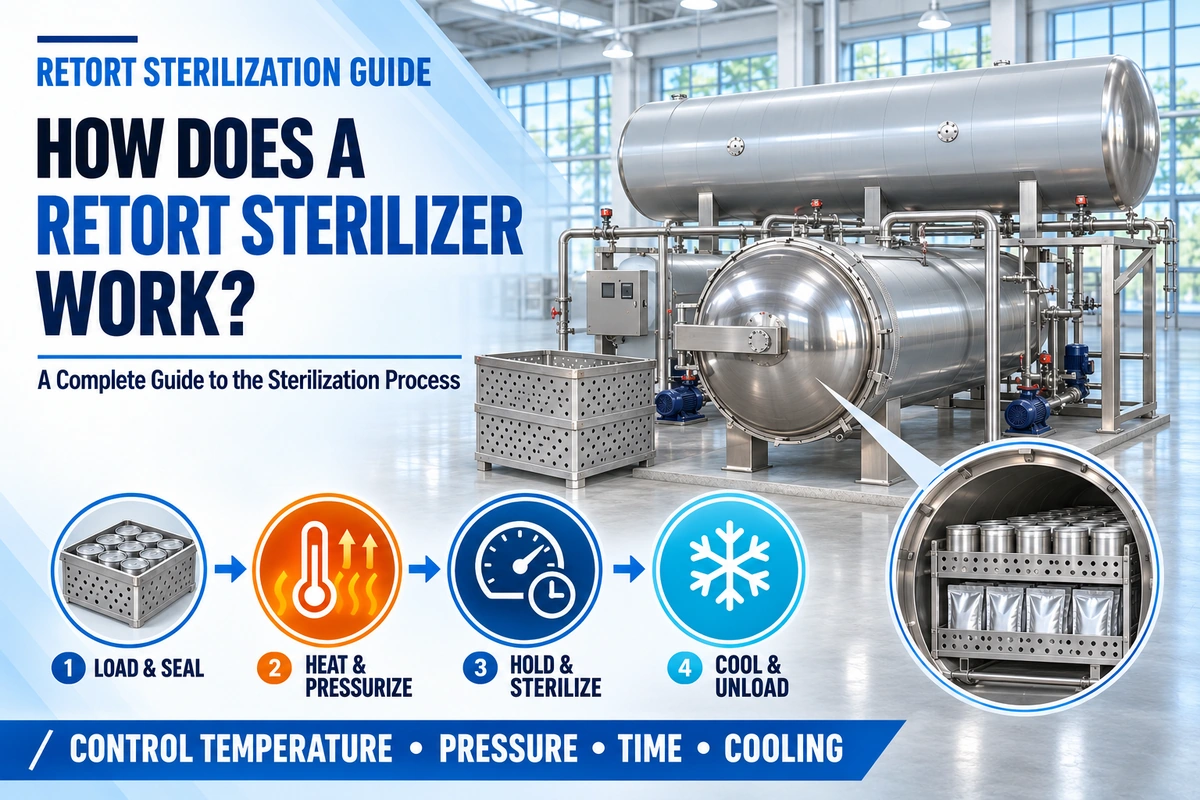
A retort sterilizer is an industrial thermal processing machine designed to heat food products after they have been filled and sealed inside suitable containers. The equipment uses a controlled combination of temperature, pressure, and processing time to achieve the required level of microbial destruction.
Retort sterilization is widely used for commercially sterile, shelf-stable foods, including canned vegetables, meat products, ready-to-eat meals, dairy beverages, sauces, and certain packaged liquid foods.
Unlike aseptic processing, where the product and packaging are sterilized separately before filling under controlled conditions, retort sterilization treats the food inside its final sealed package.
This provides an important manufacturing advantage: the sealed container acts as a barrier against post-processing contamination, provided that package integrity is maintained throughout processing, handling, and distribution.
How Does the Retort Sterilization Process Work?
A typical batch retort process consists of five main stages.
-
Loading and Preparation
Sealed containers are arranged in baskets, trays, or other loading systems. Their positioning must allow effective heat transfer and comply with the validated loading pattern.
-
Heating
Steam, hot water, or a controlled steam-air mixture transfers heat through the container walls into the food. The heating rate depends on the equipment design, packaging material, and product characteristics.
-
Sterilization and Holding
The process follows a validated temperature-time schedule designed to deliver the required thermal lethality at the product's critical heating location.
-
Controlled Cooling
Cooling water reduces product temperature while appropriate vessel pressure helps protect containers against deformation, leakage, or seal damage.
-
Unloading and Inspection
After completing the process and reaching safe unloading conditions, products are removed and inspected according to the factory's quality-control procedures.
The sterilization process must be developed and validated for the specific product and packaging combination. Reaching a particular chamber temperature does not automatically mean that the coldest-heating location inside every container has received sufficient thermal treatment.
Why Are Temperature, Pressure, and Sterilization Time Important?
Three operating parameters directly influence retort sterilization performance.
Temperature determines the rate of microbial inactivation and affects the heating behavior of the product. Higher temperatures can increase microbial destruction rates, but excessive thermal exposure may damage flavor, color, texture, and nutritional characteristics.
Processing time determines how long the product receives thermal treatment. The required duration depends on product properties, container dimensions, heating behavior, and the established sterilization process.
Pressure helps maintain the required processing environment and protects packaging during heating and cooling. For flexible pouches, plastic containers, and certain glass packaging systems, controlled external pressure is particularly important.
Manufacturers must evaluate these parameters together rather than independently.
What Are the Main Types of Retort Sterilizers?
Industrial retort sterilizers can be classified according to their heating medium and mechanical operating method.
Heating methods include water spray, water immersion, and steam-based systems. Mechanical operation can be static or rotary.
These classifications describe different aspects of equipment design. For example, a rotary retort may use either water spray or water immersion heating.
Water Spray Retort Sterilizer
A water spray retort sterilizer uses circulating hot water to transfer thermal energy to packaged food products.
During processing, heated water is distributed through a spray or circulation arrangement inside the sterilization chamber. Water contacts the container surfaces, transfers heat through the packaging, and returns to the circulation system.
Depending on the equipment configuration, water may be heated through a heat exchanger and circulated continuously during the sterilization process.
The main operating advantages include controlled heating, effective water circulation, and the ability to regulate vessel pressure for different packaging requirements.
Water spray systems can be suitable for:
-
Retortable flexible pouches and plastic containers
-
Glass bottles and jars
-
Metal cans
-
Packaged beverages and prepared foods
However, packaging compatibility depends on the complete system design, loading arrangement, and validated processing conditions.
For food manufacturers, water spray retorts are particularly worth evaluating when pressure control, packaging protection, and controlled heating and cooling are important purchasing considerations.
Water Immersion Retort Sterilizer
A water immersion retort sterilizer transfers heat by submerging packaged food products in hot water inside a pressurized chamber.
Unlike spray systems, which distribute water across container surfaces, immersion systems maintain the product load within a controlled hot-water environment.
Depending on the design, some water immersion retorts use a separate hot-water storage vessel to support heating and batch transitions.
Water immersion provides extensive contact between the heating medium and the packaging surfaces. However, effective temperature uniformity still depends on circulation performance, equipment design, and product loading.
Common applications include canned foods, bottled beverages, packaged meat products, and other foods that require controlled in-container thermal processing.
For factories processing relatively heavy product loads or rigid containers, water immersion may offer practical advantages. Nevertheless, its suitability should be evaluated against water consumption, heating requirements, cycle time, and operating costs.
Static vs. Rotary Retort Sterilizers
A second important classification concerns whether the packaged products remain stationary or move during sterilization.
A static retort sterilizer keeps containers stationary throughout the heating and cooling process. Heat enters the food through the packaging walls, with internal heat transfer occurring primarily through conduction, natural convection, or a combination of both.
Static retorts are widely applicable to products that do not require mechanical agitation.
A rotary retort sterilizer, by contrast, rotates the product baskets or loading assembly during processing.
For suitable liquid and semi-liquid foods, controlled rotation can promote internal product movement and improve heat transfer.
This may reduce the time required for heat to reach the critical heating location, although the actual improvement depends on product viscosity, container geometry, headspace, rotation speed, and processing conditions.
|
Selection Factor |
Static Retort |
Rotary Retort |
|---|---|---|
|
Product movement |
Stationary |
Controlled rotation |
|
Heat transfer |
Conduction and/or natural convection |
May enhance internal convection |
|
Mechanical complexity |
Generally lower |
Generally higher |
|
Product suitability |
Broad range of stationary-process products |
Products that benefit from agitation |
|
Maintenance requirements |
Fewer moving components |
Additional rotary components |
|
Capital investment |
Often lower for comparable specifications |
Often higher due to rotary mechanisms |
Rotary operation is not automatically superior. It should be selected when product testing demonstrates a meaningful processing or quality benefit.
Rotary Water Spray vs. Rotary Water Immersion Retorts: Key Differences
For manufacturers considering Weishu's rotary retort configurations, the main distinction is how thermal energy is transferred to the packaging while the products rotate inside the chamber.
Both systems can use controlled rotation to encourage internal movement in suitable products. Their heating-medium arrangements, circulation requirements, and operating characteristics differ.
|
Comparison Factor |
Rotary Water Spray Retort |
Rotary Water Immersion Retort |
|---|---|---|
|
Heating method |
Circulating hot-water spray |
Full hot-water immersion |
|
Container contact |
Water distributed across surfaces |
Containers submerged in water |
|
Product movement |
Controlled rotation |
Controlled rotation |
|
Water inventory |
Often lower |
Generally higher |
|
Temperature uniformity |
Depends on spray distribution and circulation |
Depends on immersion circulation and loading |
|
Pressure control |
Controlled vessel pressure |
Controlled vessel pressure |
|
Packaging suitability |
Flexible and rigid packages, subject to validation |
Flexible and rigid packages, subject to validation |
|
Selection priority |
Spray coverage, circulation, packaging protection |
Immersion performance, water management, thermal stability |
When Should Manufacturers Consider a Rotary Water Spray Retort?
A rotary water spray retort may be suitable when manufacturers need controlled water distribution, mechanical product movement, and carefully managed pressure conditions.
For example, a factory processing retortable packaged dairy beverages may evaluate rotary spray technology to determine whether product movement improves heating performance and reduces unnecessary thermal exposure.
However, the packaging must be compatible with rotation, and the process must be validated for the specific beverage formulation and container.
When Is a Rotary Water Immersion Retort More Suitable?
Rotary water immersion systems may be considered when full water contact and controlled product movement are desirable.
They can be evaluated for suitable bottled, canned, and packaged food products where internal agitation improves heating behavior.
The final decision should consider the water circulation design, package stability, product response to rotation, and the total energy required for heating and cooling.
The best choice is not determined by heating method alone. Manufacturers should compare both configurations using actual product samples and production requirements.
Which Food Products and Packaging Types Are Suitable for Retort Sterilization?
Different food products respond differently to thermal treatment. Product viscosity, particle size, acidity, packaging dimensions, and heat sensitivity all influence the selection of sterilization equipment.
Retort Sterilization for Milk and Dairy Beverages
Dairy beverages require careful thermal processing because proteins, fats, and other ingredients may undergo physical or chemical changes during heating.
Excessive thermal exposure can contribute to cooked flavors, color changes, protein instability, or sediment formation.
For suitable packaged dairy products, rotary retort sterilization may improve internal heat transfer and reduce unnecessary processing time compared with an otherwise comparable stationary process.
However, rotary agitation does not guarantee that protein coagulation or sedimentation will be prevented.
Before selecting a retort system, dairy manufacturers should evaluate the beverage formulation, viscosity, package geometry, required shelf life, and thermal stability.
For products where flavor preservation and rapid continuous processing are priorities, manufacturers should also compare retort sterilization with UHT processing and aseptic filling.
Retort Sterilization for Canned Foods and Ready-to-Eat Meals
Canned vegetables, meat products, soups, sauces, and ready-to-eat meals are common applications for industrial retort systems.
These products may contain solid particles, liquids, or mixtures with different heating characteristics.
For example, a thick meat-based product may heat primarily through conduction, while a liquid soup may experience significant natural convection.
Rotary agitation may improve heat penetration in some liquid-containing products, but it may also damage delicate ingredients or alter product appearance.
The sterilization system must therefore be selected according to the food's actual heating behavior rather than the product category alone.
Retort Sterilization for Glass Bottles, Plastic Containers, and Flexible Pouches
Packaging compatibility is one of the most important equipment-selection considerations.
How to Choose the Right Retort Sterilizer for Your Production Line
Selecting an industrial retort sterilizer requires more than comparing equipment prices or maximum operating temperatures.
Manufacturers should evaluate the complete production process, from product formulation and packaging design to batch capacity, utilities, and maintenance requirements.
1. Evaluate Product Characteristics and Packaging Requirements
Begin by identifying the food's physical and thermal properties.
Important characteristics include viscosity, acidity, particle size, fat and protein content, and sensitivity to mechanical agitation.
Liquid products may benefit from internal convection, while highly viscous foods often heat more slowly. Products containing large solid particles may require special attention to the location of the slowest-heating component.
Packaging must also be evaluated for thermal resistance, closure strength, headspace, and pressure tolerance.
A manufacturer processing canned meat may reach a different equipment decision from a factory producing bottled milk, even when both require commercial sterility.
2. Determine Sterilization Temperature and Heat Transfer Requirements
The required thermal process should be established for the specific food and package combination.
Low-acid shelf-stable foods generally require a validated process designed to control relevant microbial hazards, including heat-resistant bacterial spores.
The appropriate process depends on factors such as product composition, equilibrium pH, container size, heat penetration, and the intended storage conditions.
Manufacturers should not select sterilization temperature and holding time solely from general equipment specifications.
Instead, a qualified thermal-processing specialist should establish and validate the scheduled process.
Equipment selection should then ensure that the retort can consistently deliver the required heating, holding, cooling, and pressure-control conditions.
3. Calculate Production Capacity and Batch Cycle Time
Retort sterilizers typically operate in batches, making cycle time a major factor in production capacity.
A complete batch cycle includes loading, heating, sterilization, cooling, depressurization, and unloading.
For example, consider a factory with the following planning assumptions:
Illustrative Batch Capacity Calculation
Containers per batch
2,000
Total batch cycle
90 minutes
Scheduled operating time
12 hours/day
Theoretical batches
8/day
Theoretical daily production
16,000 containers
This is a simplified planning example, not a Weishu equipment specification. Actual throughput may be lower because of downtime, loading constraints, and process variations.When comparing retort models, buyers should request actual basket capacity, validated cycle time, container dimensions, and loading arrangements.
A larger chamber does not automatically provide higher practical throughput if heating and cooling cycles are significantly longer.
4. Compare Pressure Control, Automation, and Energy Consumption
Modern retort systems may incorporate programmable control systems for temperature, pressure, water circulation, and batch records.
For industrial buyers, important automation functions include process recipe management, temperature monitoring, pressure regulation, alarm management, and historical batch data recording.
These functions support process consistency and make it easier to investigate operating deviations.
Energy consumption should also be considered.
Water spray and immersion systems may differ in circulating-water volume, heating arrangements, pump requirements, and cooling-water management.
However, no single heating method is always the most energy-efficient. Actual performance depends on equipment design, insulation, heat recovery, batch utilization, and plant utility conditions.
5. Consider Maintenance and Long-Term Operating Costs
Purchase price represents only part of the total cost of owning a retort sterilizer.
Routine maintenance may involve circulation pumps, valves, seals, temperature sensors, pressure instruments, control systems, and heat exchangers.
Rotary retorts also contain mechanical components associated with product movement, such as drive assemblies and supporting structures.
Before purchasing, manufacturers should evaluate spare-parts availability, service accessibility, cleaning requirements, and maintenance schedules.
A technically suitable machine that causes frequent downtime may ultimately be more expensive than a higher-investment system with reliable production performance.
Retort Sterilizer Equipment Selection Checklist
The following checklist can help procurement teams prepare technical requirements before requesting a quotation.
|
Evaluation Item |
Questions to Ask |
|---|---|
|
Food characteristics |
Is the product liquid, viscous, or solid-containing? |
|
Packaging |
What are the material, dimensions, closure, and heat resistance? |
|
Thermal process |
What validated temperature-time conditions are required? |
|
Heating method |
Is water spray or immersion more suitable? |
|
Rotary requirement |
Does product agitation improve processing performance? |
|
Production capacity |
How many containers must be processed per hour or day? |
|
Pressure control |
Can the system maintain appropriate pressure during heating and cooling? |
|
Automation |
What process monitoring, alarms, and records are available? |
|
Utilities |
What are the steam, electricity, water, and compressed-air requirements? |
|
Maintenance |
What routine servicing and spare parts are required? |
A well-prepared technical specification allows equipment suppliers to recommend an appropriate configuration rather than simply quoting a standard machine.
How Does Weishu Customize Retort Sterilization Equipment?
At Weishu, we understand that industrial food manufacturers have different production requirements.
A dairy beverage producer may prioritize controlled heating and product quality, while a canned-food factory may focus on batch capacity, loading efficiency, and consistent thermal processing.
Our equipment-selection approach begins with understanding the customer's food product, packaging format, sterilization requirements, and expected production output.
Matching Retort Configurations to Production Needs
Weishu focuses on retort sterilization solutions including rotary water spray and rotary water immersion configurations.
For suitable applications, these systems combine controlled heating with product rotation to support effective heat transfer during sterilization.
Equipment selection should account for chamber capacity, loading arrangement, circulation design, pressure-control requirements, and the intended degree of automation.
The objective is to identify a configuration that can consistently support the required thermal process without introducing unnecessary mechanical complexity or operating costs.
Supporting Product Quality and Production Efficiency
Efficient retort sterilization is not simply about reaching the highest possible temperature.
It involves delivering the required thermal treatment while avoiding excessive heating, unnecessary processing time, and packaging damage.
For this reason, Weishu recommends evaluating actual product characteristics and packaging specifications before finalizing an equipment configuration.
Where appropriate, process testing and thermal validation can help determine whether rotary agitation or a particular heating method offers a measurable advantage.
Request a Retort Sterilizer Configuration from Weishu
If you are planning a new packaged-food production line or upgrading an existing sterilization system, Weishu can help you evaluate suitable retort equipment configurations.
To begin the selection process, provide your product type, packaging material, container size, required production capacity, and intended sterilization conditions.
Our team can use these requirements to discuss suitable equipment options and prepare a technical quotation.
Conclusion: Choosing the Right Retort Sterilizer
A reliable retort sterilizer must provide controlled thermal processing while supporting packaging integrity, product quality, and efficient factory operation.
Water spray and water immersion systems offer different heating arrangements, while static and rotary configurations address different product movement requirements.
For some liquid and semi-liquid products, rotary agitation may improve heat transfer. For other products, a static system may provide the more practical and economical solution.
The correct selection depends on the relationship between food characteristics, packaging materials, validated sterilization requirements, and production capacity.
Weishu helps food manufacturers evaluate these factors and identify retort sterilization equipment suited to their production needs.
Frequently Asked Questions About Retort Sterilizers
1. What is the difference between a water spray retort and a water immersion retort?
A water spray retort distributes circulating hot water over packaged products, while a water immersion retort submerges the product load in hot water. Both methods can provide effective thermal processing when properly designed and validated. The choice depends on packaging, product characteristics, circulation requirements, and operating conditions.
2. Is a rotary retort sterilizer better than a static retort?
Not necessarily. Rotary retorts can improve internal heat transfer for suitable products, particularly some liquids and semi-liquids. Static retorts may be preferable for products that do not benefit from agitation or that could be damaged by movement. The selection should be based on product-specific testing.
3. Can a retort sterilizer be used for bottled milk?
Yes, provided that the milk formulation, bottle material, closure system, and sterilization process are suitable for retort treatment. Manufacturers should evaluate heat stability, packaging resistance, and product quality before selecting a system. UHT processing with aseptic filling may be an alternative for certain dairy applications.
4. How do manufacturers determine retort sterilization time?
Sterilization time is established through a validated thermal process that considers microbial safety requirements, product composition, packaging dimensions, heat penetration, and processing temperature. It should not be determined solely by a general equipment recommendation.
5. What information is needed before purchasing a retort sterilizer?
Manufacturers should provide product characteristics, packaging specifications, expected production capacity, processing requirements, and available utilities. These details help the equipment supplier recommend a suitable heating method, chamber size, rotary configuration, and automation level.
Table of Contents
- What Is a Retort Sterilizer and How Does It Work?
- What Are the Main Types of Retort Sterilizers?
- Rotary Water Spray vs. Rotary Water Immersion Retorts: Key Differences
- Which Food Products and Packaging Types Are Suitable for Retort Sterilization?
- How to Choose the Right Retort Sterilizer for Your Production Line
- 2,000
- 90 minutes
- 12 hours/day
- 8/day
- 16,000 containers
- Retort Sterilizer Equipment Selection Checklist
- How Does Weishu Customize Retort Sterilization Equipment?
- Conclusion: Choosing the Right Retort Sterilizer
-
Frequently Asked Questions About Retort Sterilizers
- 1. What is the difference between a water spray retort and a water immersion retort?
- 2. Is a rotary retort sterilizer better than a static retort?
- 3. Can a retort sterilizer be used for bottled milk?
- 4. How do manufacturers determine retort sterilization time?
- 5. What information is needed before purchasing a retort sterilizer?