
 EN
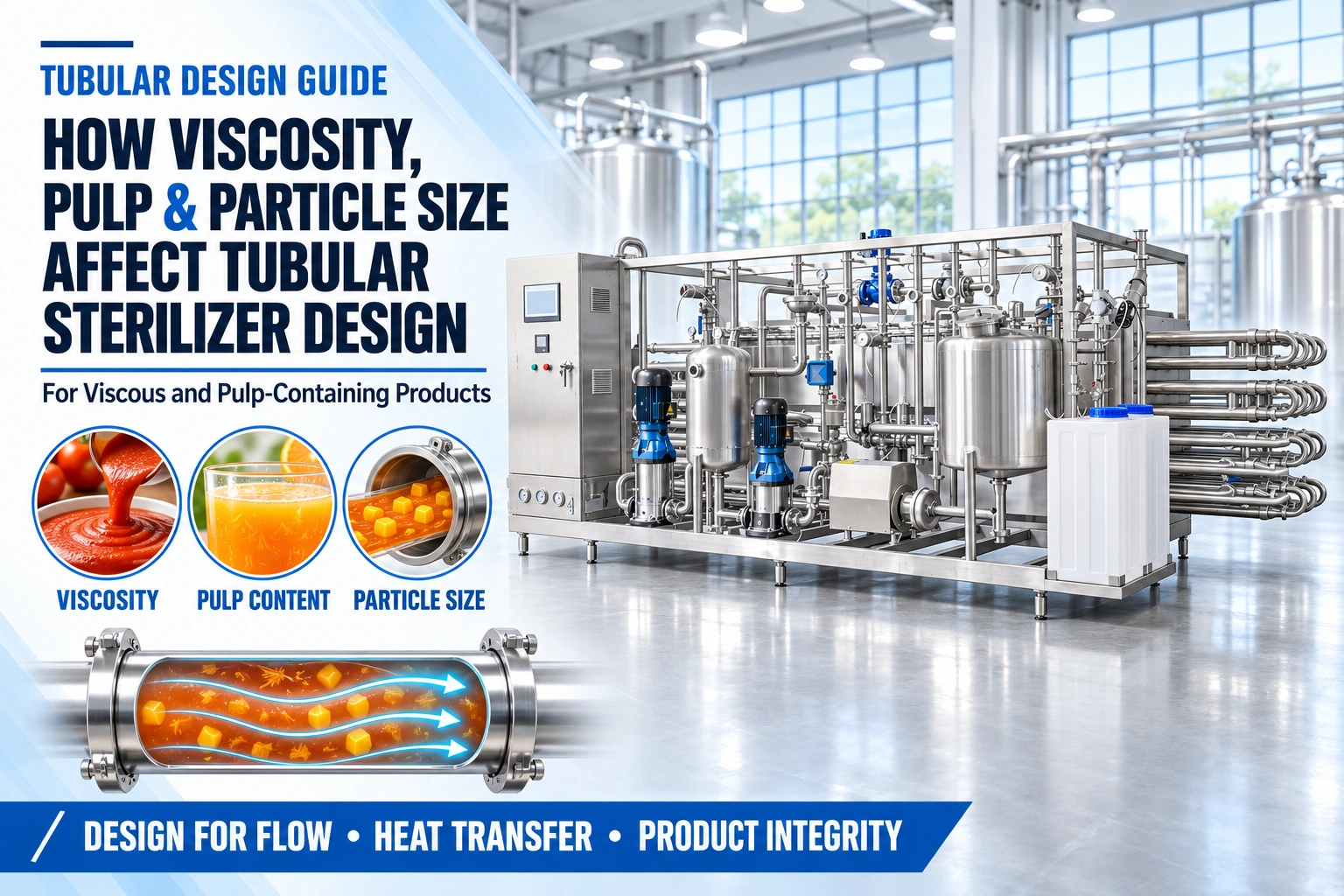
In the industrial food and beverage processing sector, configuring an Ultra-High Temperature (UHT) thermal system is never a one-size-fits-all engineering task. When processing complex fluids—such as fruit purees, concentrates, crushed tomatoes, or dairy formulations containing pulp—standard pasteurizers quickly fail. For these heavy applications, a specialized tubular sterilizer for viscous products is required.
B2B buyers, plant engineers, and purchasing managers often struggle with system overpressurization, product burning (fouling), and destroyed particle integrity. Resolving these challenges requires understanding how fluid dynamics and physical product attributes dictate the mechanical blueprint of the machinery. In this technical article, Weishu explores how product viscosity, pulp percentage, and solid particle size dictate custom UHT engineering design.
What Makes a Tubular Sterilizer for Viscous Products Graphically Different?
Standard thermal systems designed for low-viscosity fluids like milk or water rely on high fluid velocities within narrow channels to create turbulent heat exchange. If you feed a dense fruit pulp into that same machinery, the system will instantly stall.
The Hidden Costs of Using Standard Sterilizers for Thick Fluids
Attempting to process thick fluids in a standard heat exchanger results in extreme "fouling"—the burnt-on product coating the inner tube walls. Fouling creates an insulating barrier that ruins thermal efficiency, damages product flavor, and causes dark specks in the final product. To clean this, factories suffer heavy hidden costs from frequent operational shutdowns, excessive water consumption during CIP cycles, and shorter equipment lifespans.
Targeted Applications: From Fruit Purees to Tomato Pastes
A highly customized non-standard design is essential for modern plants handling high-value, high-viscosity applications. These include:
- Concentrated fruit purees (mango, banana, peach)
- Chunky tomato pastes, sauces, and ketchups
- Fruit juices containing distinct sacs or pulp
- High-solid dairy puddings, custards, and infant formulas
How Does Liquid Viscosity Influence the Tube Diameter and Flow Dynamics?
Viscosity is the internal friction of a moving fluid. In aseptic processing, viscosity dictates whether your product moves in a predictable, layered laminar flow or a well-blended turbulent flow. Because thick fluids naturally resist turbulence, the mechanical design must compensate to ensure uniform heat penetration without overheating the product skin.
Managing Pressure Drop in High-Viscosity Aseptic Processing
As product viscosity increases, the frictional resistance against the internal tube walls generates a massive pressure drop (Δ P) across the heat exchanger loop. If the tube diameter is too narrow, the backpressure will exceed safe mechanical limits, causing seals to rupture or pumps to trip. Engineering a tubular sterilizer for viscous products requires calculating precise internal cross-sectional areas. Expanding the internal tube diameter directly reduces linear resistance and lowers backpressure to safe operational thresholds.
Choosing Between Smooth and Corrugated Tubes
For viscous fluids, Weishu replaces traditional smooth piping with specialized Corrugated Tubes. Smooth tubes allow thick fluids to form a stagnant, insulating boundary layer along the wall while the core stays cold. Our corrugated profiles alter fluid boundary layers, inducing continuous mixing and shear forces even at low velocities. This dramatically enhances the heat transfer coefficient, shortens the heating residence time, and eliminates the risk of localized product scorching.
Why Do Pulp and Particles Demand Custom Corrugation and Gap Sizes?
When a product contains delicate pulp or solid fruit/vegetable particles, the engineering focus shifts from basic fluid friction to physical clearance and precise thermal penetration time.
Preventing Product Clogging and Channel Blockage
To prevent structural blockages, the internal channel clearance (tube gap) must follow strict engineering proportions relative to the largest solid particle. As a benchmark, the inner tube diameter must be at least 3 to 4 times larger than the maximum particle size. If you are sterilizing 8mm diced apples in a fruit base, the minimum product channel clearance must exceed 24–32mm. Furthermore, any internal tube bends must feature a wide radius to prevent structural accumulation and blockages.
Balancing Heat Penetration and Particle Integrity
Sterilizing particulate matter introduces a dual thermodynamic problem. While the liquid carrier heats up quickly, the thermal energy takes longer to reach the exact center of a solid particle to achieve commercial sterility (the required F₀ value). If you over-heat the system to speed up this process, the outer liquid burns and the mechanical shear destroys the fruit particles into a unappealing mush. Weishu resolves this by extending the holding tube length and utilizing gradual multi-stage cooling zones. This ensures the particle core achieves complete microbial destruction while preserving the structural integrity and crunchy texture of the fruit pulp.
How to Select the Right Pump and Valves for Chunky, Viscous Fluids?
Moving and controlling a heavy, particle-laden fluid stream requires rugged, specialized ancillary components that treat the product gently.
Rotary Lobe Pumps vs. Piston Pumps for High-Pressure Lines
Standard centrifugal pumps are entirely unsuitable for thick fluids because their high-speed impellers shred delicate fruit pulp and lack the power to push viscous matrices.
- Rotary Lobe Pumps: Ideal for low-to-medium pressure lines. Their synchronized, non-contacting lobes scoop and transfer delicate particles with minimal shear damage.
- High-Pressure Piston/Plunger Pumps: Necessary for highly viscous pastes (like 30° Brix tomato paste) that generate huge backpressures. These positive-displacement pumps supply the constant volumetric force needed to maintain smooth, steady flow rates across extensive tubular networks.
Aseptic Valve Selection to Eliminate Dead Spaces
Standard industrial valves contain internal pockets and sharp orientation shifts where fibers and particles trap, ferment, and ruin the aseptic status of the line. A high-performing aseptic line must utilize Full-Bore Aseptic Double-Seat Mixproof Valves or specialized diaphragm valves. These designs feature a straight-through flow path and integrated steam blocks, ensuring particles never lodge in dead spaces and can be fully flushed during automated CIP sequences.
How Does Weishu Optimize Tubular Sterilizer Design for Your Specific Material?
Every food matrix possesses unique rheological properties. At Weishu, we do not sell off-the-shelf machinery; we engineer custom aseptic processing systems based on your exact ingredient profile.
Intelligent Recipe Control Dynamically Adjusted by Siemens PLC
Managing diverse product runs on a single processing line requires automated adaptability. Weishu tubular sterilizers feature advanced Siemens PLC automation systems with intuitive touchscreen HMIs.
The Siemens PLC stores multiple "Viscosity Recipes." When changing production from a light juice to a heavy puree, the control system automatically recalibrates pump flow rates, backpressure thresholds, and heating loops. Depending on your plant infrastructure, our systems support both Steam Heating Integration (utilizing highly efficient steam-water heat exchangers) and self-contained Electric Heating Systems for precise, boiler-free temperature regulation.
Get a Tailored Quotation: Submit Your Material Parameters Today
Investing in a UHT system should not involve guesswork. Weishu minimizes your procurement risk by simulating fluid dynamics and thermal distribution profiles using your actual material characteristics before manufacturing begins.
Ready to eliminate fouling, prevent downtime, and protect your product's flavor profile? [Contact our technical engineering team today] to submit your specific material parameters—including Brookfield viscosity (cPs), pulp percentage (%), maximum particle dimensions (mm), and target hourly capacity (L/h)—to receive a customized, high-efficiency UHT system design and quotation.
Table of Contents
- What Makes a Tubular Sterilizer for Viscous Products Graphically Different?
- The Hidden Costs of Using Standard Sterilizers for Thick Fluids
- Targeted Applications: From Fruit Purees to Tomato Pastes
- How Does Liquid Viscosity Influence the Tube Diameter and Flow Dynamics?
- Managing Pressure Drop in High-Viscosity Aseptic Processing
- Choosing Between Smooth and Corrugated Tubes
- Why Do Pulp and Particles Demand Custom Corrugation and Gap Sizes?
- Aseptic Valve Selection to Eliminate Dead Spaces
- How Does Weishu Optimize Tubular Sterilizer Design for Your Specific Material?
- Get a Tailored Quotation: Submit Your Material Parameters Today