
 EN
EN
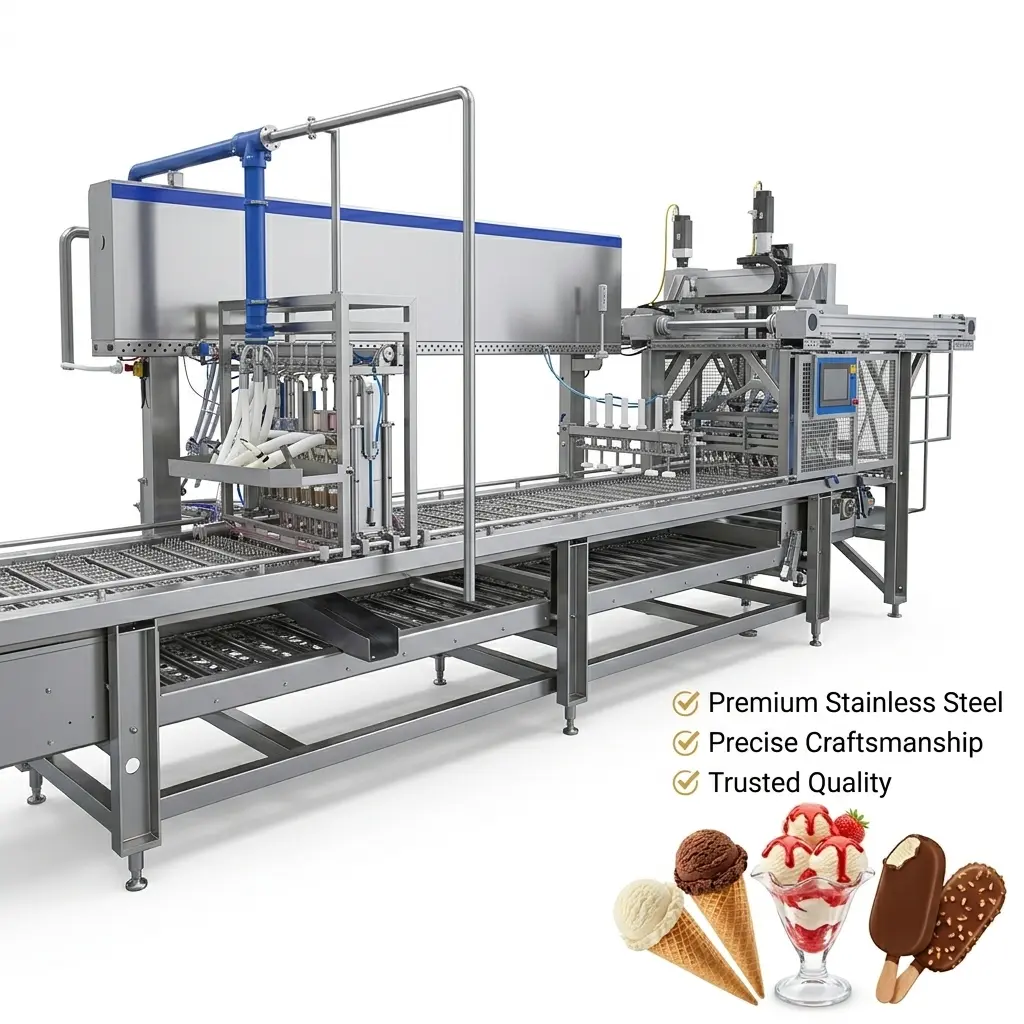
For many dairy manufacturers and frozen dessert startups, purchasing an ice cream filling machine is not simply about buying one piece of equipment. It is about designing an entire production system that balances product quality, operational efficiency, factory capacity, and investment return.
In recent years, global demand for cup ice cream, cones, stick bars, and premium frozen desserts has increased rapidly. At the same time, manufacturers face growing pressure from labor costs, food safety regulations, energy consumption, and market competition. As a result, choosing the right equipment configuration has become a critical business decision.
From the perspective of production line planning, the real challenge is not only “Which machine should I buy?” but also:
-
What production capacity matches my market demand?
-
How much automation do I actually need?
-
Which equipment determines future scalability?
-
How can I control long-term operating costs?
-
What hidden investment costs are often overlooked?
This article explores ice cream filling machine applications from the perspective of factory planning, equipment configuration, and investment budgeting.
Why Ice Cream Filling Machine Selection Impacts Factory Profitability
The Relationship Between Equipment Configuration and ROI
Many first-time investors focus only on machine prices. However, experienced food engineers understand that the true value of a production line lies in total operational efficiency.
A lower-cost machine may lead to:
-
Higher product waste
-
Frequent downtime
-
Inconsistent filling accuracy
-
Increased labor dependency
-
Higher maintenance costs
In contrast, a properly configured automated system improves long-term profitability through stable production and reduced operational risks.
For industrial dairy factories, return on investment depends on:
-
Production stability
-
Product consistency
-
Energy efficiency
-
Labor optimization
-
Flexible product capability
The ice cream filling machine often becomes the “core coordination center” of the entire frozen dessert line.
Common Investment Mistakes in Frozen Dessert Projects
Many manufacturers overinvest in capacity during the early stages of business development.
For example:
-
A startup may purchase a high-speed industrial line that exceeds actual market demand.
-
Some factories ignore cold storage capacity during budgeting.
-
Others underestimate utility requirements such as refrigeration, compressed air, and water treatment.
Another common mistake is choosing equipment without considering future product diversification.
Today’s consumers demand:
-
Multi-flavor products
-
Premium toppings
-
Seasonal packaging
-
Health-oriented frozen desserts
-
Small-batch specialty products
Production flexibility is now just as important as output volume.
Ice Cream Filling Machine Applications in Different Product Categories
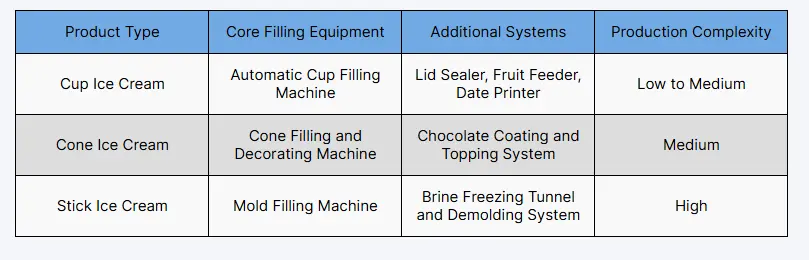
Cup Ice Cream Production Systems
Cup ice cream remains one of the most stable and scalable frozen dessert categories worldwide.
A modern cup filling line typically includes:
-
Automatic cup dispenser
-
Volumetric filling system
-
Fruit or chocolate feeder
-
Lid sealing unit
-
Date coding system
-
Conveyor packaging section
The key advantage of cup production is packaging flexibility. Manufacturers can easily switch between different cup sizes and flavor combinations.
For export-oriented factories, automated sealing systems also improve packaging consistency and shelf stability.
Cone Filling and Decorative Topping Solutions
Cone products require more synchronized automation because filling, topping, and decoration occur simultaneously.
Typical cone production systems include:
-
Cone feeding mechanism
-
Ice cream extrusion filler
-
Chocolate coating module
-
Nut and sprinkle applicator
-
Lid placement station
High-end cone products often require ripple injection and decorative finishing systems to create premium visual appeal.
In this segment, production accuracy directly influences brand positioning.
Stick Ice Cream and Molded Product Processing
Stick ice cream production involves more complex temperature management and freezing technology.
A complete molded ice cream line may include:
-
Mold filling station
-
Stick insertion system
-
Brine freezing tunnel
-
Automatic demolding equipment
-
Chocolate dipping line
-
Flow wrapping machine
Compared with cup products, stick ice cream production requires higher refrigeration investment and more precise process control.
However, molded products often generate stronger retail margins due to their premium market positioning.
Core Equipment Required in an Ice Cream Production Line
Mixing, Pasteurization, and Homogenization Systems
Before filling begins, raw materials must undergo stable thermal processing.
Core upstream equipment includes:
-
Pasteurizers
-
Sugar dissolving systems
-
Filtration equipment
Proper homogenization improves texture stability and enhances final product smoothness.
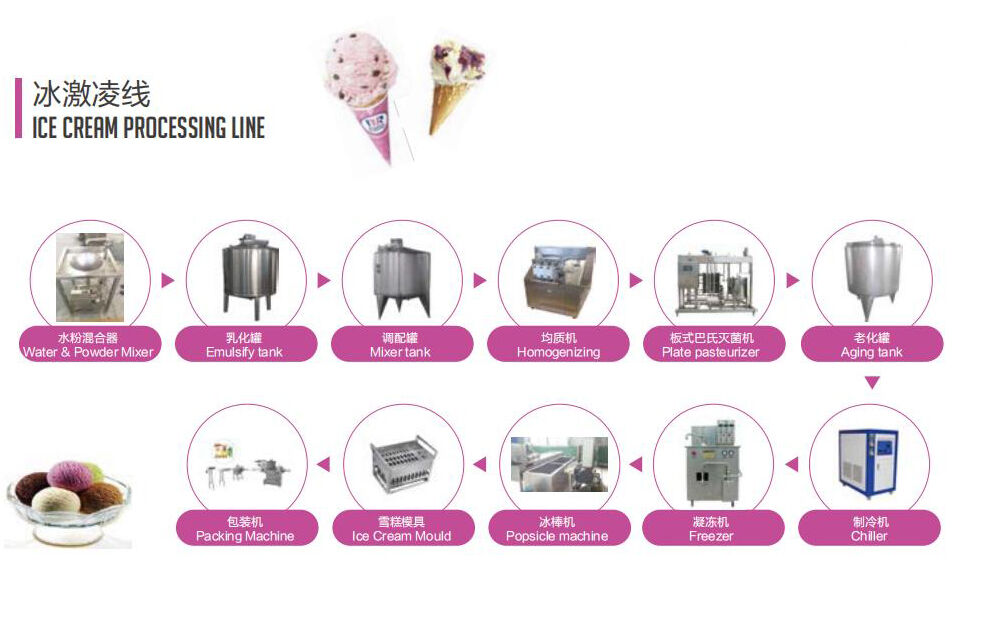
Aging Tanks and Continuous Freezers
After pasteurization, the ice cream mix enters the aging stage.
Aging tanks help:
-
Stabilize fat structure
-
Improve whipping performance
-
Enhance texture consistency
Continuous freezers then inject controlled air into the mix while rapidly lowering temperature.
This stage directly impacts overrun percentage and mouthfeel quality.
Filling, Sealing, and Packaging Equipment
The ice cream filling machine connects upstream processing with downstream packaging.
Modern filling systems feature:
-
Servo-controlled filling accuracy
-
PLC automation
-
Multi-lane operation
-
Automatic cleaning functions
-
Recipe memory systems
Packaging automation also reduces labor requirements significantly.
Hardening Tunnel and Cold Storage Systems
Hardening is one of the most energy-intensive stages in frozen dessert production.
Industrial hardening tunnels rapidly freeze products to maintain:
-
Structural stability
-
Surface quality
-
Shelf life
-
Transportation durability
Cold storage planning is equally important because insufficient freezing storage can create production bottlenecks.
How to Plan Ice Cream Factory Capacity Correctly
Small-Scale Startup Production Lines
Startups usually prioritize flexibility over maximum speed.
Recommended characteristics include:
-
Compact footprint
-
Semi-automatic operation
-
Multi-product compatibility
-
Lower initial investment
This approach reduces financial risk during market validation.
Medium-Capacity Commercial Ice Cream Plants
Medium-sized factories often serve regional supermarkets and food service channels.
Key priorities include:
-
Stable continuous production
-
Improved packaging automation
-
Moderate labor reduction
-
Better production efficiency
This stage is where many manufacturers begin upgrading to fully automatic filling systems.
Fully Automated Industrial Production Facilities
Large-scale industrial plants prioritize:
-
High-speed output
-
Continuous production
-
Integrated packaging
-
Centralized PLC management
-
Energy optimization
At this level, production stability becomes more important than machine purchase price alone.
Investment Budget Analysis for Ice Cream Production Projects
Equipment Cost Breakdown
A complete production line investment may include:
-
Processing systems
-
Filling machines
-
Refrigeration units
-
Packaging equipment
-
Conveyors
-
CIP cleaning systems
The filling section itself is only one part of the total project budget.
Utility and Infrastructure Expenses
Many investors underestimate infrastructure costs such as:
-
Electrical installation
-
Water systems
-
Drainage engineering
-
Refrigeration piping
-
Air compressors
-
Factory insulation
Infrastructure often accounts for a significant percentage of total project investment.
Labor, Energy, and Maintenance Costs
Operational expenses continue long after equipment installation.
Factories must consider:
-
Daily energy consumption
-
Operator salaries
-
Spare parts inventory
-
Refrigeration maintenance
-
Cleaning chemical usage
Energy-efficient systems can substantially reduce long-term operating expenses.
Hidden Costs Buyers Often Ignore
Hidden costs may include:
-
Equipment downtime
-
Product recalls
-
Production inefficiency
-
Delayed spare parts delivery
-
Training limitations
Choosing a reliable supplier becomes extremely important for minimizing operational risk.
How Automation Reduces Long-Term Operating Costs
Improving Filling Accuracy and Reducing Waste
Modern servo-controlled filling systems reduce overfill and minimize raw material waste.
Even a small reduction in filling deviation can create substantial annual savings for high-volume factories.
Reducing Downtime Through CIP Cleaning
CIP cleaning systems shorten sanitation time while improving hygiene consistency.
Benefits include:
-
Faster cleaning cycles
-
Lower labor requirements
-
Improved food safety compliance
-
Reduced contamination risk
Smart PLC Systems and Production Monitoring
Modern production lines increasingly use digital monitoring systems to track:
-
Production speed
-
Filling accuracy
-
Temperature stability
-
Energy consumption
-
Maintenance schedules
These technologies support predictive maintenance and improve factory management efficiency.
How Weishu Helps Clients Optimize Ice Cream Production Investments
Customized Equipment Solutions Based on Market Positioning
Weishu provides customized production solutions based on:
-
Product category
-
Market positioning
-
Factory scale
-
Budget planning
-
Automation goals
This helps clients avoid unnecessary overinvestment.
Flexible Expansion Planning for Future Growth
Future scalability is critical in frozen dessert manufacturing.
Weishu helps factories design production lines that support:
-
Additional filling lanes
-
New packaging formats
-
Increased production capacity
-
Future automation upgrades
Technical Support, Installation, and After-Sales Service
Professional technical support improves long-term equipment reliability.
Weishu provides:
-
Installation guidance
-
Operator training
-
Spare parts support
-
Remote troubleshooting
-
Preventive maintenance recommendations
Reliable after-sales service reduces operational risk and production interruptions.
Future Trends in Ice Cream Manufacturing Technology
Energy-Efficient Refrigeration Systems
Energy consumption continues to be a major concern in frozen dessert manufacturing.
Modern systems focus on:
-
Efficient compressors
-
Heat recovery technology
-
Improved insulation
-
Smart cooling controls
Sustainable Packaging Compatibility
Manufacturers are increasingly adopting:
-
Paper cups
-
Biodegradable containers
-
Reduced-plastic packaging
-
Eco-friendly sealing materials
Flexible equipment design supports these packaging transitions.
Smart Factory and Digital Automation Trends
Future production lines will rely heavily on:
-
AI-assisted monitoring
-
Cloud-based diagnostics
-
Remote production management
-
Data-driven process optimization
Digital automation is becoming a competitive advantage for large dairy manufacturers.
Conclusion
Investing in an ice cream filling machine is ultimately an investment in production strategy, operational efficiency, and future business scalability.
For dairy factory managers and food engineers, successful project planning requires more than simply comparing machine prices. It involves balancing capacity, flexibility, automation, energy efficiency, and long-term operating costs.
By approaching ice cream production from a system-level perspective, manufacturers can build more competitive, efficient, and profitable frozen dessert operations.
Weishu continues helping global dairy manufacturers design customized ice cream production solutions that support sustainable growth, reliable performance, and long-term investment value.
Table of Contents
- Why Ice Cream Filling Machine Selection Impacts Factory Profitability
- Ice Cream Filling Machine Applications in Different Product Categories
- Core Equipment Required in an Ice Cream Production Line
- How to Plan Ice Cream Factory Capacity Correctly
- Investment Budget Analysis for Ice Cream Production Projects
- How Automation Reduces Long-Term Operating Costs
- How Weishu Helps Clients Optimize Ice Cream Production Investments
- Future Trends in Ice Cream Manufacturing Technology
- Conclusion