
 EN
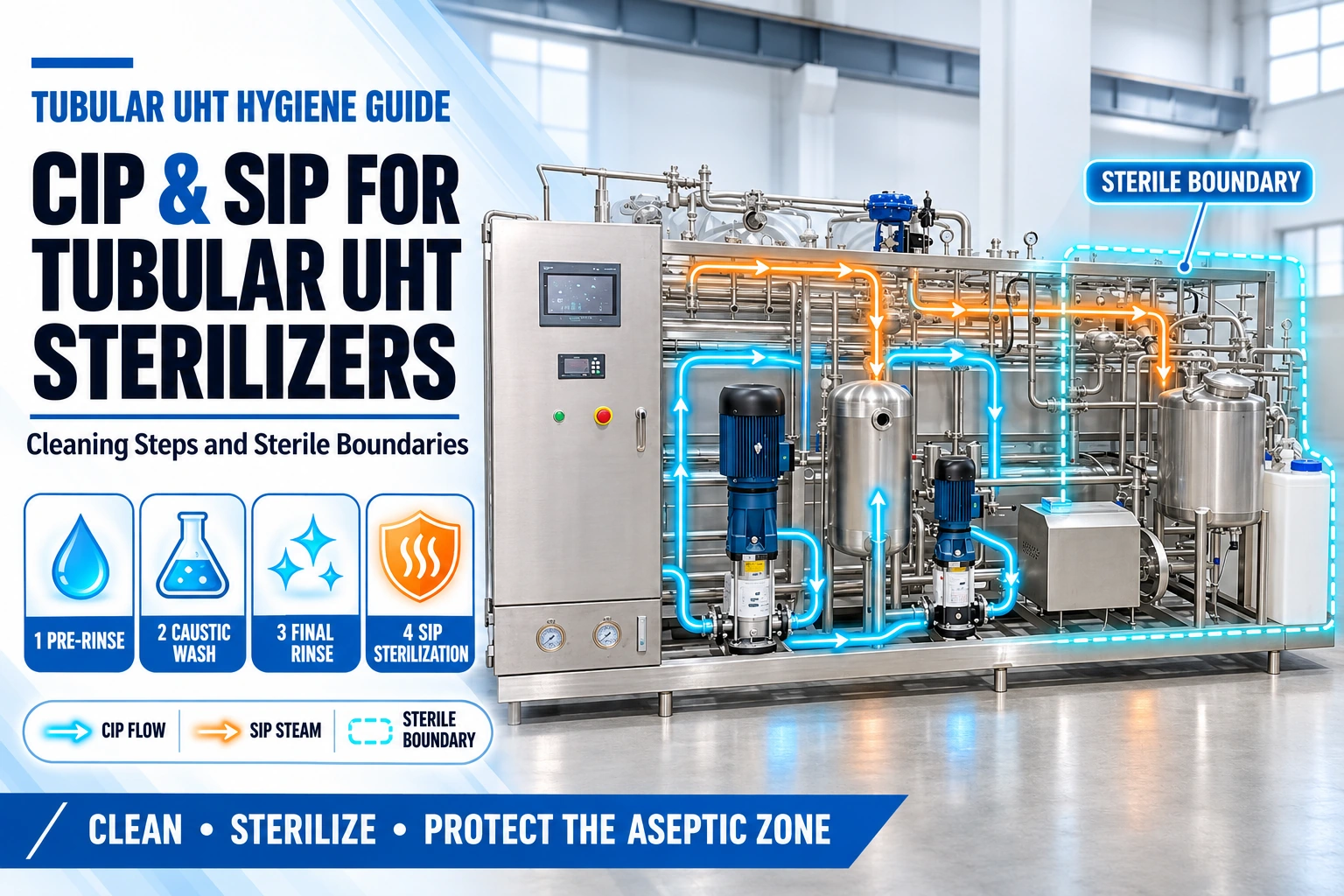
For industrial food and beverage manufacturers, maintaining commercial sterility is the absolute foundation of operational success. In product lines like dairy, juices, tea, and plant-based milks, the Ultra-High Temperature (UHT) tubular sterilizer acts as the heart of the production line. However, the system is only as reliable as its cleaning and sterilization protocols.
Implementing a robust tubular sterilizer CIP SIP (Cleaning-in-Place and Sterilization-in-Place) routine is not just a matter of regulatory compliance; it directly impacts your plant’s uptime, utility consumption, and product shelf life. In this technical guide, Weishu outlines the precise engineering steps, sterile boundary controls, and automation technologies required to achieve flawless aseptic processing.
What is CIP and SIP in Tubular UHT Sterilizers?
While often mentioned together, CIP and SIP serve two distinct, sequential functions within an aseptic processing line. Understanding their individual goals is the first step toward optimizing your plant’s sanitation cycle.
The Core Differences Between CIP and SIP
- CIP (Cleaning-in-Place): This process focuses on physical and chemical cleanliness. It removes product residues, organic fats, proteins, and inorganic mineral scales from the internal surfaces of the heat exchanger tubes without dismantling the equipment. It uses sequential water rinses and chemical solutions (acids and alkalis).
- SIP (Sterilization-in-Place): This process focuses on biological sterility. Executed after a successful CIP cycle, SIP uses thermal energy—typically superheated water or pure steam—to eliminate all viable microorganisms and spores, rendering the entire system commercially sterile before production begins.
Why Tubular Sterilizers Demand Strict CIP/SIP Protocols
Unlike plate heat exchangers, tubular sterilizers operate under higher pressures and temperatures, often processing complex fluids containing pulp, fibers, or high protein loads. During long production runs, these thermal dynamics lead to "fouling" (burnt-on product coating the inner tube walls). If your CIP cycle lacks sufficient turbulent flow, or if your SIP cycle fails to reach the cold spots, bacterial contamination will ruin subsequent batches, leading to catastrophic product recalls.
How to Execute the Perfect Tubular Sterilizer CIP Cleaning Steps?
To thoroughly eliminate organic soils and mineral scales from a corrugated tube heat exchanger, a systematic 4-step CIP protocol must be rigidly followed. For a Weishu tubular sterilizer, the system automatically regulates fluid velocity to maintain a turbulent flow (minimum 1.5 m/s) inside the channels, creating the mechanical shear force necessary for effective cleaning.
- Step 1: Pre-rinsing with Water
The system initiates a forward flush using soft water to displace and recover residual milk, juice, or beverage matrix from the tubular loops. This step removes up to 90% of loose soil, drastically reducing the chemical and water load required for the next phases. - Step 2: Caustic Wash (Alkali) for Organic Soil Removal
A 1.5% to 2.0% Sodium Hydroxide (NaOH) solution is circulated at 75°C to 85°C. The alkaline chemical breaks down complex proteins and emulsifies fats that have adhered to the hot tube walls during UHT processing. - Step 3: Acid Wash for Inorganic Scale Dissolution
Following an intermediate water rinse to flush out the caustic solution, a 1.0% to 1.5% Nitric Acid (HNO₃) solution is circulated at 65°C to 70°C. This targeted acid wash dissolves mineral deposits, calcium oxalate, and "milk stone" that alkali washes cannot break down. - Step 4: Final Rinse and CIP Verification
Fresh, deionized or softened water flushes the entire system. Embedded conductivity sensors monitor the discharge water. The CIP cycle concludes only when the return water's conductivity matches that of the incoming fresh water, guaranteeing zero chemical residue inside the food-contact zones.
How Does the SIP Process Ensure Aseptic Readiness before Production?
Once the tubular sterilizer is chemically clean, it must be sterilized. The SIP process transitions the machinery from "clean" to "sterile" by subjecting every internal surface to sustained thermal energy.
Superheated Water vs. Steam Sterilization for Tubular Systems
While pure steam is excellent for tanks and short pipe networks, Superheated Water (SHW) circulation is highly preferred for tubular UHT sterilizers. Circulating pressurized water at lethal temperatures ensures absolute temperature uniformity throughout the massive length of the heat exchanger tubes, eliminating the risk of air pockets that can cause cold spots during steam-only sterilization.
Critical SIP Parameters: Temperature and Holding Time
During a standard SIP cycle, the water loop is pressurized to prevent boiling and heated to 121°C to 130°C. This temperature must be held continuously for a minimum of 30 minutes. Calibrated PT100 temperature sensors are strategically placed at the furthest and coldest points of the loop (such as the return line and valve manifolds). If any sensor registers a temperature drop below the critical setpoint for even a second, the safety timer resets to zero, ensuring no shortcut compromises biological safety.
Why is the Sterile Boundary Design Critical in an Aseptic Tubular Sterilizer?
A perfect CIP and SIP routine is meaningless if the aseptic zone cannot be isolated from the outside environment during production. This is where physical engineering and sterile boundaries come into play.
Understanding the Sterile Barrier and Double-Seat Valves
The sterile boundary is a physical barrier that prevents non-sterile fluids (like raw product, utilities, or unhygienic air) from crossing into sterilized zones. Weishu utilizes specialized aseptic double-seat mixproof valves. These valves feature a sterile steam block (steam barrier) in the cavity between the two valve seats. If a seal fails, the product leaks outward into a steam-flushed chamber rather than cross-contaminating the sterile process stream.
Maintaining Positive Pressure in the Aseptic Zone
Following the SIP cycle and during the entire production run, the internal aseptic circuit must maintain a continuous positive pressure relative to the service media (such as cooling water or heating media) and the atmospheric environment. By keeping the sterile product side at a higher pressure, any micro-leakage that could theoretically occur will always push sterile product outward, rather than sucking non-sterile fluids inward.
Sealing Technology: O-rings and Gaskets under High Temperature
A sterile boundary is only as resilient as its elastomers. Because CIP/SIP processes subject components to extreme thermal shocks (moving rapidly from 15°C water to 130°C steam) and harsh chemical exposures, Weishu utilizes premium, FDA-compliant EPDM or PTFE gaskets. These high-grade seals resist deformation and cracking, preventing microscopic structural gaps where bacteria could harbor.
How to Optimize Your Tubular Sterilizer CIP SIP Efficiency?
In high-capacity manufacturing, profitability relies on minimizing the turnaround time between production cycles. Maximizing your tubular sterilizer CIP SIP efficiency requires a smart combination of processing power and reliable automation.
Fully Automated Control via Siemens PLC
Manual CIP/SIP tracking is highly prone to human error, leading to wasted utilities or failed sterilizations. Weishu tubular UHT sterilizers are fully integrated with advanced Siemens PLC control systems and intuitive touchscreen HMIs.
The Siemens PLC fully automates the sequencing of valves, pumps, and chemical dosing. It logs all critical data points—flow rates, chemical concentrations, and sterilization hold times—creating a traceable digital record for quality assurance. If a utility fluctuation occurs, the intelligent PLC automatically compensates or alerts operators, removing guesswork and ensuring strict compliance with global GMP and FDA benchmarks.
Flexible Heating Options: Steam or Electric Heating
To accommodate diverse factory infrastructures, Weishu offers two high-efficiency heating configurations for your CIP/SIP thermal loops:
- Steam Heating Integration: Designed for facilities with a central boiler system. It utilizes highly efficient steam-water heat exchangers to rapidly elevate chemical fluids or generate superheated water, offering the lowest operational cost for high-volume lines.
- Electric Heating System: A self-contained, eco-friendly solution engineered for plants without a centralized industrial steam boiler. Equipped with heavy-duty electric heating elements, this setup delivers ultra-precise temperature regulation, rapid thermal responses, and simplifies your plant's overall utility layout.
Partner with Weishu for Custom Aseptic Processing Solutions
Achieving a flawless sterile boundary and optimal CIP/SIP performance requires an engineering design tailored specifically to your product's characteristics. Weishu customizes industrial tubular sterilization lines based on your unique application variables.
Whether you are processing high-viscosity fruit purees containing delicate pulp or low-viscosity dairy formulations, our technical team will configure the exact tube diameter, corrugation profile, and Siemens PLC recipe management to match your goals.
Ready to upgrade your processing efficiency? [Contact our technical experts today] to submit your material parameters—including product viscosity, particle size, and target hourly capacity—and receive a customized UHT system design and quotation.
Table of Contents
- What is CIP and SIP in Tubular UHT Sterilizers?
- Why Tubular Sterilizers Demand Strict CIP/SIP Protocols
- How to Execute the Perfect Tubular Sterilizer CIP Cleaning Steps?
- How Does the SIP Process Ensure Aseptic Readiness before Production?
- Why is the Sterile Boundary Design Critical in an Aseptic Tubular Sterilizer?
- How to Optimize Your Tubular Sterilizer CIP SIP Efficiency?
- Partner with Weishu for Custom Aseptic Processing Solutions