
 EN
EN
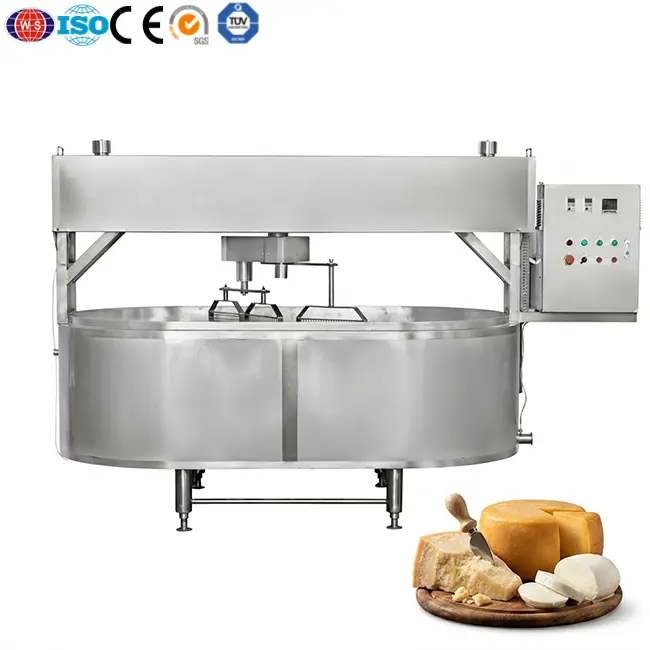
Cheese manufacturing is often viewed as a straightforward process: milk enters one side of the production line, and cheese comes out the other. The reality is far more complex. Every commercial dairy processor faces a hidden challenge that directly impacts profitability—cheese production loss. These losses occur at nearly every stage of production, from milk storage and pasteurization to curd cutting, whey drainage, and final pressing.
What makes the issue particularly important is that even tiny inefficiencies can accumulate into significant financial losses. Imagine losing just 1% more fat or protein during processing. In a facility handling tens of thousands of liters of milk every day, that small percentage can translate into hundreds of kilograms of lost cheese annually. Those losses represent raw material costs, labor costs, energy expenses, and missed revenue opportunities.
Industry research shows that during commercial Cheddar production, approximately 6.5% of milk fat and 4–5% of casein can be lost during cheesemaking, with most losses occurring in the cheese vat itself. That means many processors are unknowingly sending valuable product components down the drain with the whey. Understanding where these losses occur is the first step toward building a more efficient and profitable operation.
Why Cheese Production Loss Matters More Than Most Processors Realize
Many dairy operators focus heavily on increasing production volume. While volume is important, yield efficiency often determines whether a cheese plant thrives or struggles. Think of it like filling a bucket with water that has multiple holes in the bottom. Increasing the flow into the bucket helps, but sealing the leaks creates a much bigger impact.
Cheese yield is directly connected to profitability because milk solids are expensive. Protein and fat are the building blocks of cheese. When these components escape into whey streams due to poor process control, the plant essentially pays for ingredients it never sells. Research from commercial cheese facilities shows that recovery rates can vary dramatically depending on processing conditions, equipment design, and operator performance.
The financial impact becomes even more dramatic in large-scale operations. A study examining commercial cheese factories found that relatively small measurement inaccuracies could result in yield variations equivalent to more than 1,400 kilograms of cheese per day in large facilities. (This demonstrates how sensitive cheese production economics can be.
Processors who actively monitor losses gain several advantages. They improve product consistency, reduce waste disposal costs, and increase revenue from the same milk volume. In today's industry, where processors must navigate [fluctuating dairy market trends], reducing cheese production loss is no longer just a technical objective—it is a strategic business decision.
Understanding Cheese Yield and Production Efficiency
Cheese yield refers to the amount of finished cheese produced from a given quantity of milk. It serves as one of the most important performance indicators in commercial cheesemaking because it directly reflects how effectively valuable milk components are converted into saleable products.
The science behind yield is relatively simple. Cheese is primarily composed of casein proteins, milk fat, moisture, and minerals. The more effectively these components are retained throughout production, the higher the final yield becomes. Problems arise when fat globules, protein particles, or curd fines escape during processing and enter the whey stream.
Several variables influence cheese yield simultaneously. Milk quality, protein concentration, coagulation performance, pasteurization parameters, cutting techniques, stirring intensity, equipment design, and operator experience all contribute to final recovery rates. Research consistently shows that both milk composition and manufacturing technologies significantly affect yield outcomes.
The challenge for commercial processors is that yield losses rarely occur in a single obvious location. Instead, they accumulate through multiple small inefficiencies. A slight temperature deviation during pasteurization, a minor curd cutting error, or excessive agitation can each contribute incremental losses. Individually, these issues may appear insignificant. Collectively, they can dramatically reduce profitability.
What Counts as Cheese Production Loss?
Not every material leaving the cheese vat should be considered waste. Whey itself remains a valuable byproduct used in protein powders, animal feed, and food ingredients. The real concern lies in the unintended loss of cheese-forming components.
Cheese production loss generally includes:
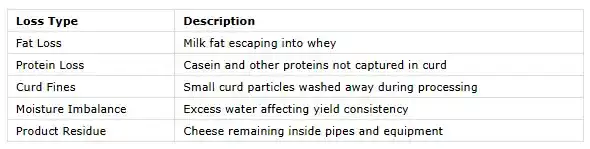
Fat losses are particularly costly because milk fat contributes significantly to cheese value. Protein losses also reduce yield because casein serves as the structural framework of cheese. Research indicates that typical Cheddar operations recover approximately 90–93% of milk fat and 94–96% of casein under optimized conditions.
Whenever recovery rates fall below these benchmarks, production losses increase and profitability declines.
The Hidden Cost Behind Every Kilogram of Lost Curd
A kilogram of lost curd represents far more than a kilogram of missing cheese. That curd contains milk solids, labor, processing time, utilities, cleaning expenses, and packaging capacity that have already been invested.
Imagine a processor producing 20 tons of cheese per day. A modest 1% yield improvement could generate an additional 200 kilograms daily. Over a year, this translates into tens of thousands of kilograms of extra saleable product without increasing milk purchases.
The hidden nature of curd losses makes them especially dangerous. Unlike equipment failures or downtime events, yield losses often occur quietly. Operators may not notice slightly elevated whey fat content or subtle curd breakage during production. Yet these small inefficiencies can accumulate into substantial financial leakage.
This is why modern cheese plants increasingly rely on real-time monitoring systems, automated controls, and advanced process analytics. By measuring losses at multiple production stages, processors gain visibility into where profit is literally slipping away.
Where Cheese Production Loss Occurs Throughout the Manufacturing Process
Cheese production losses can emerge from the moment raw milk arrives at the plant. Every transfer, temperature change, and mechanical operation creates an opportunity for valuable solids to escape.
Rather than viewing cheesemaking as a single process, successful manufacturers analyze it as a chain of interconnected steps. Weak performance at any stage can influence everything that follows. The result is often lower yields, inconsistent product quality, and increased operating costs.
Understanding the primary loss points allows processors to focus improvement efforts where they will generate the greatest returns.
Raw Milk Reception and Storage
The foundation of cheese yield begins with milk quality. Poor-quality milk creates problems that cannot be fully corrected later in production.
Milk storage conditions significantly affect protein stability and coagulation performance. Extended storage times may lead to protein degradation, reduced curd firmness, and increased losses during whey separation. Research examining cheese manufacturing efficiency consistently identifies milk composition and handling practices as key yield determinants.
Temperature management is equally important. Improper cooling can encourage microbial growth, while excessive agitation during storage may affect fat distribution. Both situations can reduce processing efficiency.
Processors seeking higher yields often invest heavily in raw milk handling systems because strong performance at the beginning of production supports better results throughout the entire line.
Standardization and Fat Adjustment
Milk standardization helps establish consistent protein-to-fat ratios before cheesemaking begins. This step plays a critical role in yield optimization because imbalances can increase losses later in the process.
When fat content exceeds optimal levels, excess fat may escape into whey. Conversely, insufficient fat can affect cheese texture, flavor, and value. Achieving the correct ratio ensures that protein and fat interact effectively during coagulation.
Advanced standardization systems use automated measurement technologies to maintain tight specifications. These systems help reduce variability and improve yield consistency across production batches.
The economic benefits extend beyond yield alone. Consistent standardization supports predictable product quality, making it easier to meet customer expectations and regulatory requirements.
The Cheese Pasteurization Process and Its Impact on Yield
The cheese pasteurization process is one of the most critical stages in commercial cheesemaking. Its primary purpose is food safety, but it also influences protein functionality, curd formation, and final yield.
Pasteurization alters milk proteins through heat exposure. If temperatures become excessive, protein denaturation may occur, reducing coagulation efficiency and increasing losses. Research shows that pasteurization affects protein interactions and can influence cheese characteristics throughout production and aging.
The challenge is finding the ideal balance. Insufficient pasteurization creates safety concerns, while excessive heating may compromise yield performance. Modern dairy facilities rely on precise heat exchangers and automated controls to maintain optimal processing conditions.
Processors increasingly recognize that pasteurization should not be viewed solely as a safety step. It is also a major contributor to yield optimization and profitability.
Temperature Control and Protein Retention
Temperature control acts as the steering wheel of the pasteurization process. Small variations can influence protein retention and curd quality.
Studies examining cheese manufacturing show that heat treatment impacts protein recovery and moisture retention. Certain processing approaches have demonstrated improved protein capture compared to conventional methods.
When proteins remain functional and properly structured, they form stronger curd networks capable of retaining more fat and moisture. This directly improves cheese yield.
Modern pasteurization systems therefore emphasize precise temperature regulation, rapid heat transfer, and automated monitoring. These features help processors minimize variability while maximizing protein retention.
Curd Formation: The Largest Source of Cheese Production Loss
If cheese production were a football game, curd formation would be the championship quarter. Most of the outcome is determined here.
Research indicates that the majority of cheese manufacturing losses occur within the cheese vat itself. During commercial Cheddar production, significant percentages of milk fat and casein may be lost during coagulation, cutting, and early curd handling.
The reason is simple. This is the stage where liquid milk transforms into solid curd. Any inefficiency during this transition affects the capture of valuable milk components.
Coagulation Efficiency and Casein Recovery
Coagulation converts milk proteins into a gel structure capable of trapping fat and moisture. Effective coagulation maximizes casein recovery while minimizing losses.
Weak coagulation leads to fragile curds that break apart easily. These fragments often escape into whey streams, reducing yield. Studies examining cheese manufacturing efficiency have shown strong relationships between coagulation performance and recovery rates.
Milk quality, rennet activity, pH control, and processing temperatures all influence coagulation success. Even minor deviations can affect curd strength and final recovery levels.
Commercial processors therefore invest heavily in monitoring systems that track coagulation behavior in real time.
Curd Cutting Errors That Increase Whey Losses
Curd cutting appears deceptively simple. In reality, it represents one of the most sensitive operations in cheesemaking.
Cutting too early produces fragile curds prone to shattering. Cutting too late may trap excess moisture and create downstream processing challenges. Research involving commercial cheese production confirms that cutting intensity influences whey losses and yield outcomes.
Blade condition also matters. Dull or poorly aligned cutting systems generate irregular curd particles that release fat and protein more readily.
The goal is uniform particle size because consistent curds drain predictably and retain valuable solids more effectively.
How Mechanical Stress Damages Curd Structure
Curd is surprisingly delicate. Excessive mechanical stress can destroy the microscopic structure responsible for retaining fat and moisture.
When curds experience aggressive handling, protein networks rupture and release trapped components into surrounding whey. This phenomenon increases production losses while reducing final yield.
Many traditional systems unintentionally create excessive stress through inefficient mixing designs, worn equipment, or poor process control. Modern equipment addresses this issue through gentler handling mechanisms that preserve curd integrity throughout production.
Protecting curd structure is often one of the fastest ways to improve yield without increasing milk input.
The Relationship Between Stirring Speed and Fat Loss
Stirring serves essential purposes during cheesemaking, including temperature distribution and moisture control. However, excessive stirring can become a major source of fat loss.
Higher agitation speeds increase curd collisions, which may damage particle surfaces and release trapped fat. Industry observations show that curd damage contributes directly to whey fat losses.
Finding the ideal stirring speed requires balancing moisture management against curd protection. Modern automated vats help achieve this balance through programmable mixing systems capable of adjusting intensity throughout production.
The result is improved fat retention and higher overall cheese recovery.
Draining, Molding, and Pressing Losses
Many processors assume that major losses end once curd formation is complete. Unfortunately, additional opportunities for waste remain during draining, molding, and pressing.
These stages determine how effectively whey is removed while preserving valuable cheese solids. Poor control can increase fat losses and reduce product consistency.
Whey Separation Challenges
Efficient whey separation requires careful process control. Removing whey too aggressively may carry curd fines and fat particles away from the product stream.
Studies evaluating cheese-making efficiency use residual whey composition as a key indicator of production losses. Elevated concentrations of protein or fat in whey often signal opportunities for process improvement.
Advanced drainage systems help reduce these losses by improving separation precision. Better flow control and optimized screen designs minimize the escape of valuable solids.
Fat Retention During Pressing
Pressing consolidates curd particles into a unified cheese structure. However, excessive pressure can force fat and moisture from the curd matrix.
The challenge lies in applying sufficient pressure to achieve desired texture without sacrificing yield. Automated pressing systems provide significant advantages because they maintain consistent force throughout production cycles.
When pressing conditions remain stable, fat retention improves and product quality becomes more predictable.
Equipment Design and Automation as Yield Drivers
Equipment design plays a larger role in cheese yield than many processors realize. Two facilities using identical milk can produce different yields simply because their equipment performs differently.
Modern processing systems prioritize gentle product handling, precise control, and reduced dead zones where product may accumulate or become trapped.
Automation also improves repeatability. Human operators remain essential, but automated systems reduce variability by executing critical steps with greater consistency.
Modern Cheese Vats vs Traditional Systems
One of the clearest examples of equipment influence involves cheese vat design. Industry observations indicate that older open vats may produce whey fat levels between 0.3% and 0.5%, while optimized modern enclosed systems can reduce whey fat levels to approximately 0.15%.
That difference may seem small, but over millions of liters of milk, it represents substantial product recovery.
Modern vats also offer improved temperature control, automated cutting systems, programmable stirring profiles, and enhanced cleaning performance. Together, these features support higher yields and more consistent product quality.
How Weishu Intelligent Machinery Helps Reduce Production Losses
Weishu Intelligent Machinery focuses on designing dairy processing solutions that help manufacturers improve production efficiency while reducing waste throughout the cheesemaking process.
Modern cheese lines require more than simple processing equipment. They need integrated systems capable of controlling temperatures, minimizing curd damage, optimizing whey separation, and maintaining consistent operating conditions. This is where advanced engineering becomes a major competitive advantage.
By incorporating automated controls, precision pasteurization systems, efficient cheese vats, and optimized transfer technologies, processors can reduce unnecessary fat and protein losses. Consistent operation helps maintain recovery rates while improving product quality across production batches.
For growing dairy facilities, the right equipment investment often delivers returns through increased yield rather than increased capacity alone. Recovering more cheese from the same volume of milk creates an immediate financial benefit that compounds over time.
Strategies to Minimize Cheese Production Loss and Improve ROI
Reducing cheese production loss requires a systematic approach rather than a single solution. The most successful processors continuously evaluate performance across the entire manufacturing chain.
Key strategies include:
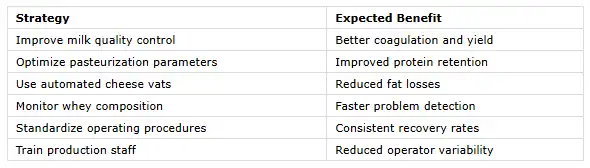
The common thread among these strategies is control. Every improvement reduces uncertainty and helps valuable milk components remain inside the cheese rather than escaping into waste streams.
Facilities that embrace data-driven decision-making typically identify yield opportunities faster and sustain improvements more effectively than competitors relying solely on experience.
Conclusion
Commercial cheese production loss is one of the most overlooked profit drains in the dairy industry. While some losses are unavoidable, many result from process inefficiencies that can be corrected through better equipment, stronger process control, and smarter operational practices.
The largest losses typically occur during curd formation, where protein recovery, fat retention, cutting precision, and mechanical handling determine how much cheese ultimately reaches the customer. The cheese pasteurization process also plays a critical role because it influences protein functionality and curd performance long before whey drainage begins.
Research consistently shows that cheese yield depends on both milk quality and manufacturing efficiency. Facilities that actively monitor whey losses, optimize processing conditions, and invest in modern automation can recover substantial amounts of product that would otherwise be lost.
For dairy processors focused on growth, reducing cheese production loss is often the fastest path to improved ROI. Every gram of fat or protein retained inside the cheese represents money that stays inside the business.
Frequently Asked Questions
1. What is the average cheese production loss in commercial plants?
Losses vary by cheese type and processing conditions. Research indicates that commercial Cheddar production may lose approximately 6.5% of milk fat and 4–5% of casein during manufacturing.
2. Why is the cheese pasteurization process important for yield?
Pasteurization affects protein structure and coagulation performance. Proper temperature control helps retain proteins that contribute directly to cheese yield and product quality.
3. Where do the biggest cheese production losses occur?
Most significant losses occur during curd formation, including coagulation, cutting, stirring, and whey separation. These stages determine how effectively fat and protein are captured within the curd.
4. How can processors measure cheese production loss?
Many plants monitor whey composition, particularly fat and protein levels. Elevated concentrations often indicate inefficiencies and opportunities for process optimization.
5. Can modern equipment improve cheese yield?
Yes. Modern enclosed vats, automated controls, and optimized processing systems can significantly reduce fat losses and improve recovery rates compared to older equipment designs.
Table of Contents
- Why Cheese Production Loss Matters More Than Most Processors Realize
- Understanding Cheese Yield and Production Efficiency
- Where Cheese Production Loss Occurs Throughout the Manufacturing Process
- Curd Formation: The Largest Source of Cheese Production Loss
- Draining, Molding, and Pressing Losses
- Equipment Design and Automation as Yield Drivers
- How Weishu Intelligent Machinery Helps Reduce Production Losses
- Strategies to Minimize Cheese Production Loss and Improve ROI
- Conclusion
- Frequently Asked Questions