
 EN
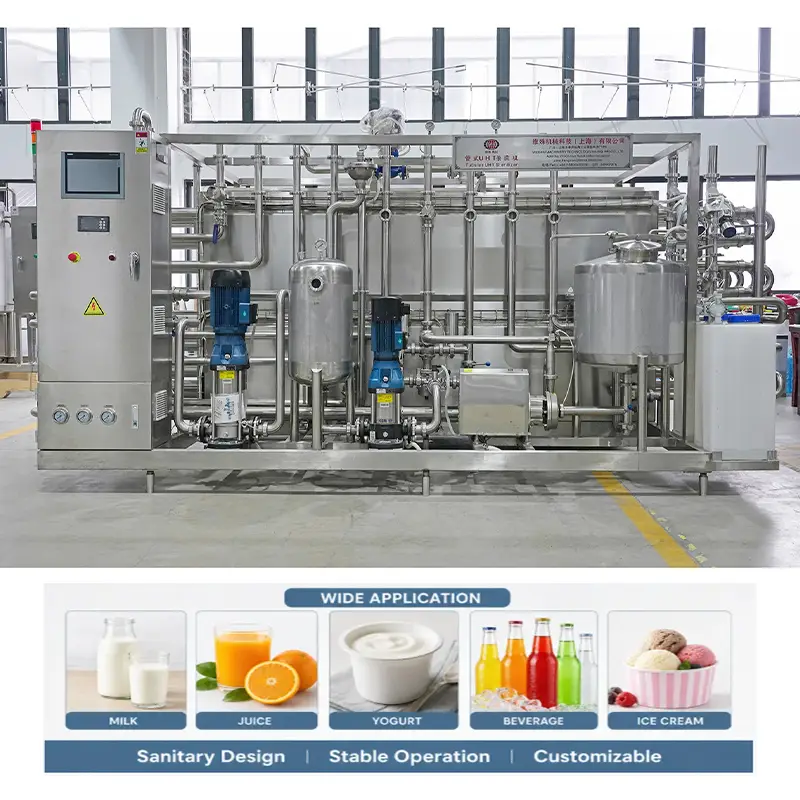
In the production of food and beverages, sterilization is the most critical step to ensure product safety and quality.
For liquid products such as milk, juices, and tea drinks, the effectiveness of sterilization is paramount, as it directly impacts the shelf life and flavor profile of the end product.
Currently, there are various sterilization methods available on the market. Among them, UHT flash sterilization technology has become the definitive equipment for the food and beverage industry due to its high efficiency and stability.
What is a UHT High-Temperature Sterilizer?
A UHT High-Temperature Sterilizer (Ultra-High Temperature Sterilizer) is an industrial system designed to flash-heat liquid products at extreme temperatures to rapidly destroy bacteria, yeasts, molds, and heat-resistant bacterial spores. This equipment is widely applied in the thermal processing of liquid foods such as dairy products, juices, and brewed beverages.
As a premier manufacturer in sanitary fluid engineering, Weishu builds these systems with three core technical characteristics:
- Instantaneous Thermal Treatment: It elevates liquid temperatures to over 135°C within a fraction of a second (typically 2 to 5 seconds). This rapid cycle achieves commercial sterility while minimizing chemical thermal damage, preventing the "cooked flavor" and preserving natural proteins and fresh taste.
- Fully Automated Precision Control: The system utilizes highly automated programmable logic controllers (PLCs) to monitor flow rates, backpressure, and product temperatures in real-time, ensuring processing parameters always remain within safe limits.
- Integrated Clean-in-Place (CIP) Systems: Equipped with automatic forward and reverse CIP cycles, the machine executes thorough chemical flushes after each production batch, restoring heat transfer surfaces to a 100% bare-metal state to eliminate cross-contamination risks.
Core Comparison of Industrial Sterilization Equipment
To help procurement managers and plant engineers evaluate the best thermal solution for their lines, the table below highlights the technical differences between Weishu's core sterilization configurations:
| Technical Metrics | Indirect Plate Pasteurizer | Indirect Tubular Pasteurizer | Direct UHT Sterilizer (Injection) |
|---|---|---|---|
| Core Heat Exchange Element | Corrugated ultra-thin stainless steel plates | Sanitary multi-tube or single-tube bundles | Steam injector / Vacuum flash vessel |
| Optimal Product Application | Low-viscosity liquids(pure milk, beer, clear juices, tea) | Medium-to-high viscosity(fruit pulp, concentrate, ice cream mix) | Highly heat-sensitive fluids(premium baby-grade dairy) |
| Fouling & Particle Resistance | Moderate (Narrow channels; requires precise Δ T control) | High (Wide channels; tolerates fibers and pulp without clogging) | Extremely High (Heating occurs in milliseconds; virtually no wall fouling) |
| Heat Recovery Efficiency | **Extremely High (Up to 90% - 95%)**; lowest steam cost | High (Approx. 75% - 85%) | Lower (Direct steam condensation requires flash cooling; higher energy draw) |
| Initial Capital Investment | Economical, maximum ROI for clear liquids | Moderate | Premium, highly complex system |
Preventing Thermal Fouling in Low-Viscosity Processing Lines
While low-viscosity fluids are unlikely to cause mechanical blockages, processing them above 135°C triggers intense chemical reactions. Proteins denature, and sugars undergo caramelization, forming a stubborn layer of thermal fouling on the tube walls or plate packs of your plate heat exchanger pasteurizer. This layer acts as a thermal insulator, causing heat transfer efficiency to drop and forcing pump backpressure to spike.
To resolve this engineering bottleneck, a qualified UHT High-Temperature Sterilizer must deploy these specific anti-fouling designs:
- Tight Wall Temperature Controls: Weishu utilizes an indirect closed hot water loop as the heating medium. By avoiding direct exposure to superheated steam, the system prevents localized hot spots that flash-burn the product on the stainless steel surface.
- High-Shear Turbulent Hydraulic Profiles: By optimizing the chevron geometry inside a plate pasteurizer, low-viscosity liquids generate heavy turbulence even at standard flow rates. This intense fluid activity generates a continuous shearing force that washes micro-deposits away before they can anchor.
- Electropolished Surface Finishes: All product contact piping is forged from sanitary 316L stainless steel and subjected to premium electropolishing. This microscopic mirror-like finish eliminates surface roughness, depriving protein and mineral molecules of the mechanical grip needed to form a scale layer, effectively extending continuous factory runtime by over 50%.
FAQ: Essential Insights on UHT High-Temperature Sterilizers
Q1: What is the fundamental difference between UHT sterilization and standard pasteurization?
A1: The main differences are the thermal intensity and the resulting shelf life. A standard plate pasteurizer operates at lower ranges (e.g., 72°C–85°C) for several seconds, killing active pathogens but leaving spores alive, which requires cold-chain logistics and offers a 7-to-15-day shelf life. A UHT High-Temperature Sterilizer heats product above 135°C for 2–5 seconds to achieve full commercial sterility, allowing ambient storage for 6 to 12 months when paired with aseptic packaging.
Q2: Should my factory choose a plate-type or a tubular-type UHT sterilizer?
A2: Base your selection entirely on product viscosity and particle content. For thin, sediment-free fluids like cow's milk, black tea, or clarified apple juice, an indirect plate heat exchanger pasteurizer is ideal because it offers unmatched energy recovery and a lower capital footprint. If your recipe includes orange pulp, tomato paste, or thick yogurt, you must opt for a tubular system to prevent instant channel clogging.
Q3: How do operators prevent proteins and minerals from burning onto heat exchanger surfaces?
A3: Prevention relies on three factors: maintaining an optimal, fast product velocity to minimize residence time in peak heat zones; maintaining a low temperature differential (Δ T) between the hot water medium and the product; and utilizing high-precision electropolished fluid components (standard on all Weishu machinery) to minimize fouling adhesion.
Q4: How does automated CIP impact the service life of an industrial UHT sterilizer?
A4: It is absolutely critical. High-temperature thermal processing inevitably creates micro-scaling. Running a structured chemical CIP regimen—using a caustic wash (1.5%–2.0% NaOH) to dissolve organic proteins and fats, followed by an acid wash (1.0% HNO₃) to strip away inorganic calcium scale—ensures the system starts every batch with clean metal surfaces, preventing localized stress corrosion and extending the operational lifecycle of the core heat exchangers.
Conclusion
Investing in a robust UHT High-Temperature Sterilizer is more than a food safety measure—it is a strategic upgrade toward automated operations and reduced thermal waste. Weishu engineers customized thermal processing lines that optimize heat recovery while protecting your product’s organic integrity. Contact the Weishu technical team today to configure a high-efficiency, long-cycle sterilization solution for your facility.