
 EN
EN
Introduction: Choosing between fully automatic and semi-automatic ice cream production lines
When purchasing an ice cream production line, many customers' first decision is: should they choose a fully automatic or semi-automatic line?
This isn't a simple "expensive vs. cheap" question. It will affect you:
- Initial investment amount
- How many workers are needed per shift?
- Daily production capacity limit
- Product Consistency
- Even the operating costs for the next three years
This article will make a direct comparison of four dimensions: cost, capacity, labor, and quality consistency, and provide recommended solutions for different business scenarios.
Regardless of which option you ultimately choose, Weishu Intelligent Machinery offers modular configurations that support future upgrades.
Definition and Core Differences
What is a semi-automatic ice cream production line?
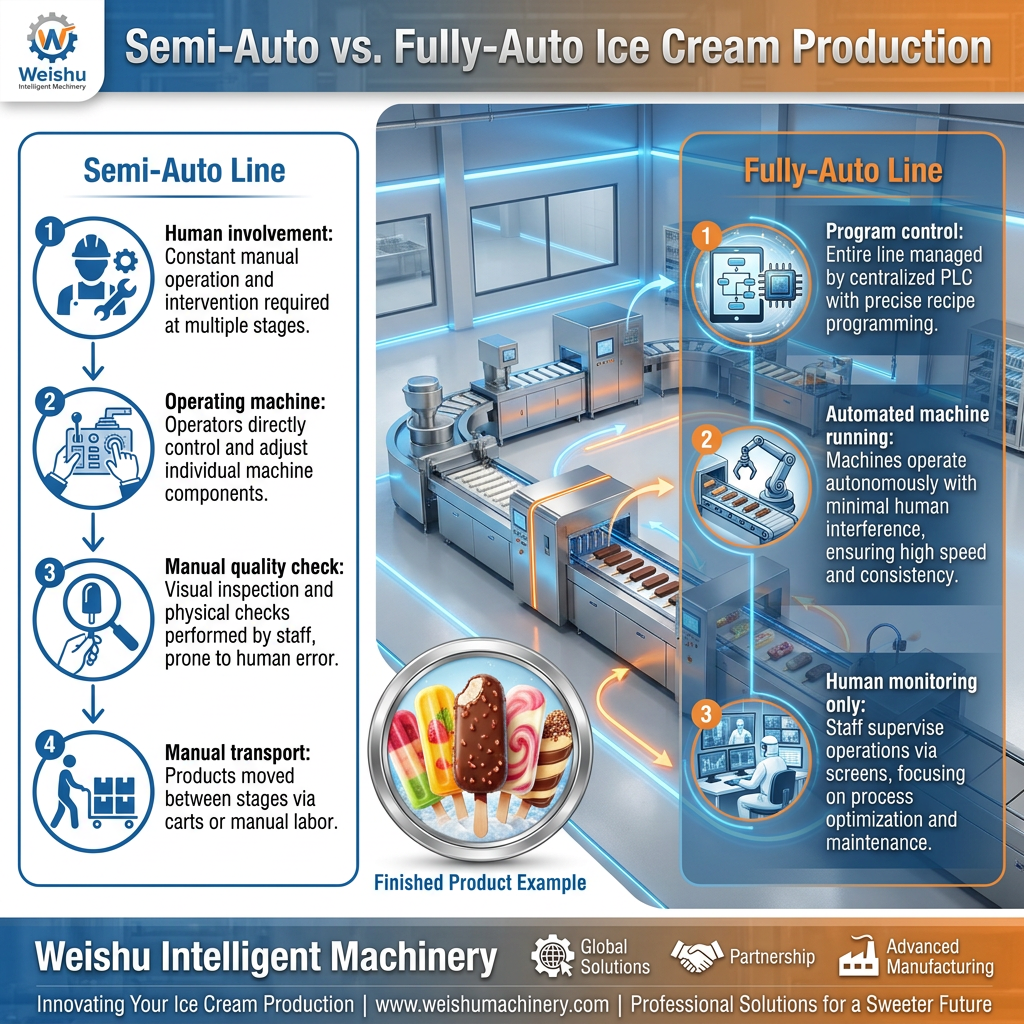
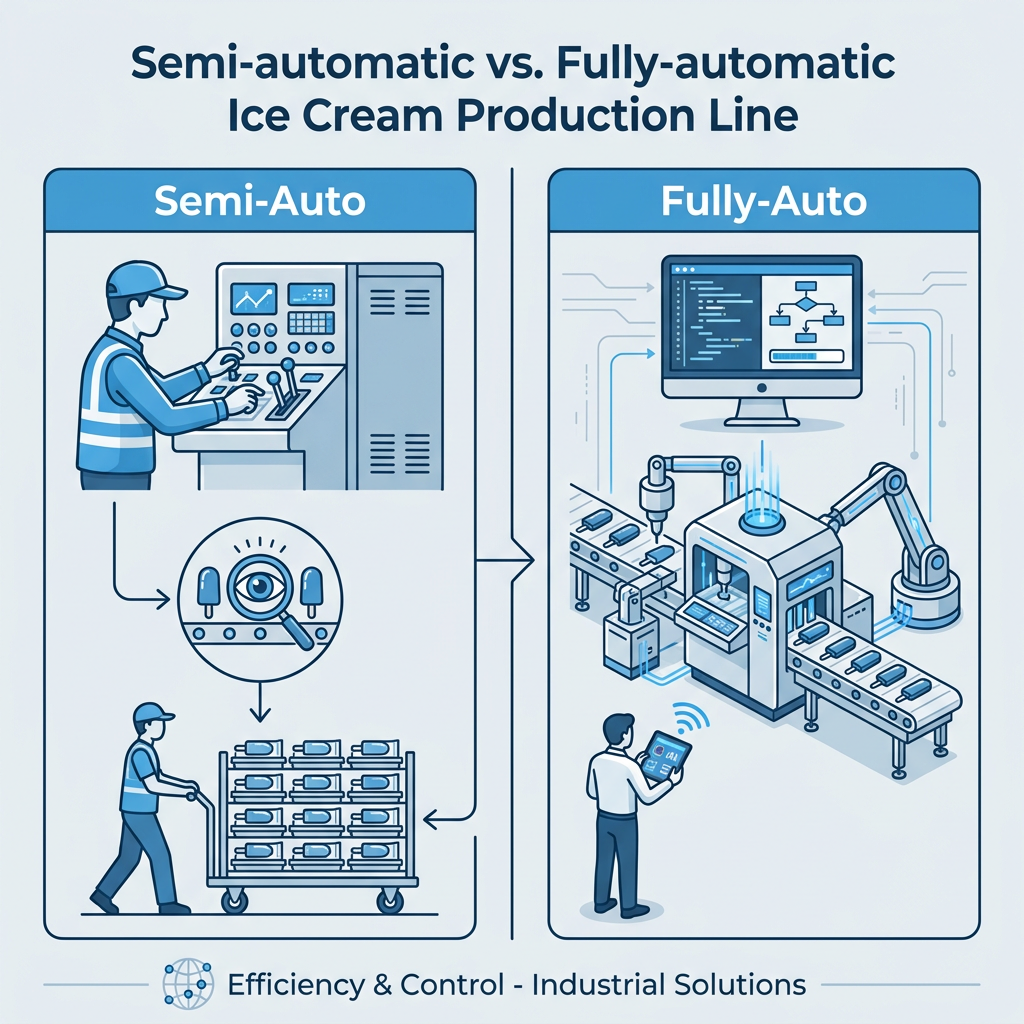
Semi-automatic production lines require manual intervention in certain stages, typically including:
- Empty cups/cones are manually placed at the workstation.
- Manually start filling or sealing
- Finished products are inspected manually and defective products are removed.
Applicable scenarios : low production volume, frequent product switching, and limited budget.
What is a fully automated ice cream production line?
Fully automated production lines operate continuously from upstream to downstream, with human labor only responsible for:
- Feeding
- monitoring screen
- Handling abnormal alarms
Typical process : Automatic cup sorting → Automatic filling → Automatic feeding → Automatic sealing → Automatic coding → Automatic boxing.
The core difference can be summarized in one sentence.
Semi-automatic: The person follows the machine.
Fully automatic: The machine follows the program.
Comparison 1: Costs (Initial Investment & Operating Costs)
Initial equipment investment
|
type |
Typical price range (for reference) |
Contents |
|
semi-automatic production line |
lower |
Manual/semi-automatic filling machine + simple conveyor belt |
|
Fully automated production line |
higher |
Automated feeding, filling, sealing, inspection, and packing line |
The investment in a fully automated production line is typically 2-4 times that of a semi-automated one , depending on the speed and configuration.
Maintenance and spare parts costs
- Semi-automatic: Simple structure, low maintenance cost, can be handled by ordinary electricians.
- Fully automatic: Requires more sensors, PLCs, and servo motors, and necessitates professional engineers.
Hidden costs (easily overlooked)
|
Hidden cost items |
semi-automatic |
Fully automatic |
|
Operation training |
Low |
Medium and high |
|
Downtime losses |
(Shift change/Rest) |
Low (continuous production) |
|
Rework costs |
High (human error) |
Extremely low |
Customer feedback from Weishu Intelligent Machinery: Many customers only look at the initial price when buying semi-automatic equipment, only to find two years later that the labor and rework costs far exceed their expectations .
Comparison 2: Capacity and Efficiency
Hourly output range
|
Production line type |
Typical production capacity (cups/hour) |
Continuous production |
|
semi-automatic |
600 – 1800 |
Limited by manual speed |
|
Fully automatic |
3000 – 12000+ |
Can be used continuously for 24 hours |
Product changeover time (changing flavor/cup type)
- Semi-automatic: 5-15 minutes , can be quickly adjusted manually.
- Fully automatic: 20-60 minutes , requires program adjustment and mechanical fine-tuning.
✅ If you switch flavors or cup types more than 3 times a day , a semi-automatic machine is actually more flexible.
Continuous production capacity
- Semi-automatic: Humans need rest, shift changes, and meals → Effective operating time is approximately 70-80%.
- Fully automatic: Can operate continuously except for maintenance → Effective operating time can reach 90-95%.
Comparison 3: Labor Demand and Skill Level
Number of operators required per shift
|
Production line type |
Recommended number of people |
Main tasks |
|
semi-automatic |
3-5 people |
Place cup, start, check, pack, clean |
|
Fully automatic |
1-2 people |
Monitoring, feeding, and alarm handling |
Skill Requirements
- Semi-automatic: General workers, short-term training
- Fully automatic: Must understand basic PLC interfaces and electrical knowledge, or at least be able to interpret alarm messages.
Long-term labor cost calculation (example)
Taking a two-shift system and 300 operating days per year as an example:
|
Production line type |
Number of students per class |
Monthly labor costs (estimated) |
Annual labor costs |
|
semi-automatic |
4 people |
Approximately 12,000 |
Approximately 144,000 |
|
Fully automatic |
1.5 people |
Approximately 5,000 |
Approximately 60,000 |
Over two years, the labor cost savings from full automation can offset the initial investment difference.
Comparison 4: Product Consistency and Quality Control
Filling weight accuracy
- Semi-automatic: Affected by operator condition, ±3-5%
- Fully automatic: Servo/piston control, ±0.5-1%
Defect rate
- Semi-automatic: Approximately 2-5% (missed irrigation, insufficient irrigation, poor sealing)
- Fully automatic: ≤ 1%
Automatic detection capability
|
Test items |
semi-automatic |
Fully automatic |
|
Missing cup detection |
artificial |
✅ Photoelectric/proximity switch |
|
Weight inspection |
❌ Random inspection |
✅ Online weighing |
|
Sealing inspection |
artificial |
✅ Visual or pressure detection |
|
Automatic rejection |
❌ |
✅ |
If you supply supermarkets or chain brands , consistent quality from fully automated production lines is often a prerequisite for entry.
Which one is suitable for your business scenario?
Scenario A – Small Ice Cream Shop / Startup Brand
- Daily output: 1000-3000 pieces
- Recommendation: Semi-automatic production line
- Reasons: Low investment, flexible in changing flavors
Scenario B – Regional Brand / Medium-Sized Factory
- Daily output: 5000-20000 pieces
- Recommendation: Automated key processes + semi-automated auxiliary processes
- Reason: Balancing investment and efficiency
Scenario C – Export OEM/Large Factory
- Daily output: 30,000+
- Recommendation: Fully automated production line
- Reasons: High labor costs and strict quality requirements
Scenario D – Multi-channel supply (online + offline + OEM)
- Recommendation: Fully automated + modular design
- Reason: Facilitates production line replication and standardization.
a tiered upgrade plan from semi-automatic to fully automatic , without replacing existing equipment.
Weishu Intelligent Machinery's Hybrid Solution
Many customers' actual needs are not "either/or," but rather:
The cost of semi-automation + the key workstations of full automation
Our hybrid solutions include:
Option 1: Semi-automatic line + automatic filling module
- Manual cup placement at the front end
- Automatic filling and automatic sealing at the back end
- Suitable for: People with limited budgets who want to improve consistency
Option 2: Modular Upgrade Path
- Year 1: Semi-automatic line
- Year 2: Install automatic cup sorter
- Year 3: Add online weighing and automatic rejection.
Real export cases
A Southeast Asian customer initially purchased a semi-automatic line, but as orders increased, they gradually upgraded to a fully automatic line within two years. The original equipment was not scrapped ; some components were moved to the pre-processing section at the front end of the new line.
→ Read more: Modular upgrade path from semi-auto to fully auto
Conclusions and Recommendations
Comparison Summary Table
|
Dimension |
semi-automatic |
Fully automatic |
|
Initial investment |
Low |
high |
|
Long-term labor costs |
high |
Low |
|
Production capacity |
medium to low |
high |
|
Production flexibility |
high |
middle |
|
Quality Consistency |
middle |
high |
|
Skill Requirements |
Low |
Medium and high |
|
Suitable Scale |
Small/Startup |
Medium and large |
One-sentence advice
- Tight budget, low output, frequent flavor changes → semi-automatic
- Pursuing long-term labor savings, stable quality, and expansion plans → Fully automated
- Uncertainty about future needs → Choose an upgradeable solution
Next step
If you would like a personalized comparison plan based on your production volume, flavor preferences, and labor costs , please contact Weishu Intelligent Machinery.
- Production line configuration recommendations
- Investment return calculation
- Evaluation of automation upgrades for existing semi-automatic lines
Table of Contents
- Introduction: Choosing between fully automatic and semi-automatic ice cream production lines
- Definition and Core Differences
- Comparison 1: Costs (Initial Investment & Operating Costs)
- Initial equipment investment
- Comparison 2: Capacity and Efficiency
- Comparison 3: Labor Demand and Skill Level
- Comparison 4: Product Consistency and Quality Control
- Which one is suitable for your business scenario?
- Weishu Intelligent Machinery's Hybrid Solution
- Conclusions and Recommendations