
 EN
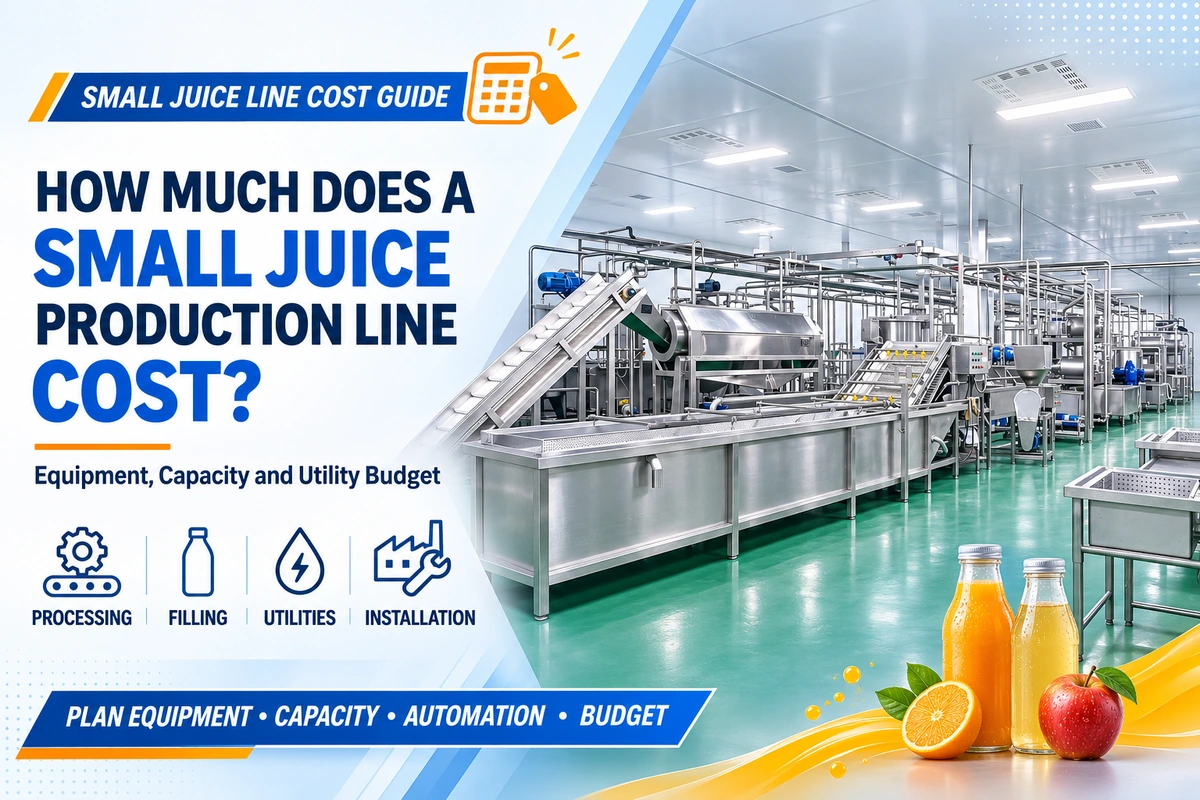
Starting a juice factory can be a promising business opportunity, but one question often determines whether a project moves forward: How much does a small juice production line actually cost?
The answer depends on much more than the price of individual machines. Two juice factories with the same production capacity may require significantly different investments because of their raw materials, beverage formulations, sterilization methods, packaging formats, and automation requirements.
At Weishu, we believe that controlling juice production line cost starts with selecting the right processing configuration—not simply purchasing the cheapest available equipment. An oversized homogenizer, an unsuitable pasteurizer, or unnecessary packaging automation can increase initial investment without improving production efficiency.
For small commercial projects operating at approximately 1,000–2,000 liters per hour (L/H), manufacturers should evaluate equipment costs, utility requirements, installation expenses, operating costs, and future expansion opportunities before making purchasing decisions.
Weishu manufactures four important beverage processing systems: water treatment systems, homogenization systems, sterilization systems, and automatic CIP cleaning systems. These systems can be integrated with other processing and packaging equipment to create a production line suited to specific products and budgets.
This guide explains the main investment categories, compares different juice production models, and provides practical budgeting methods to help manufacturers avoid unnecessary expenditure.
How Much Does a 1,000–2,000 L/H Juice Production Line Cost?
A small juice production line does not have one universal price. Its investment depends on the equipment configuration and the scope included in the supplier's quotation.
For example, a factory producing juice beverages from purchased concentrate may require water treatment, blending, product-dependent homogenization, pasteurization, filling, and cleaning equipment.
A factory processing fresh apples or oranges requires additional washing, sorting, extraction, and separation equipment.
Even when both facilities target 1,000 L/H, their equipment requirements and total investment may differ substantially.
The most reliable way to estimate the project cost is to separate the investment into individual equipment categories and calculate the total based on the selected processing method.
Estimated Investment for a 1,000 L/H Juice Production Line
A 1,000 L/H juice production line can be a practical starting point for manufacturers entering commercial beverage production.
At its nominal processing capacity, the line can process approximately 1,000 liters of juice per operating hour. However, actual finished output depends on production scheduling, cleaning time, product losses, and filling efficiency.
For a concentrate-based juice beverage, a possible configuration includes:
-
Water treatment equipment selected according to source-water quality
-
Ingredient preparation and blending tanks
-
Filtration equipment
-
A homogenizer if required by the formulation
-
A suitable pasteurization system
-
A CIP cleaning arrangement
-
Filling and packaging equipment
The cost of each component depends on technical specifications, materials, automation, and supplier scope.
For example, a pasteurizer with advanced temperature monitoring and heat recovery may require a higher initial investment than a simpler configuration. However, the additional investment may be justified if it reduces utility consumption or improves process control.
Similarly, a centralized automatic CIP system may cost more initially than a smaller mobile cleaning unit, but it may offer operational advantages when several processing circuits require frequent cleaning.
A 1,000 L/H factory should therefore be designed around its expected product range and operating schedule rather than a fixed equipment package.
Estimated Investment for a 2,000 L/H Juice Production Line
A 2,000 L/H juice production line offers greater nominal processing capacity, but doubling capacity does not necessarily double equipment investment.
Some equipment costs increase with capacity, while others depend more heavily on configuration and automation.
For example, a larger pasteurizer may require increased heat transfer area and utility capacity, but the associated control system does not necessarily double in cost.
Likewise, one properly designed CIP system may serve several compatible processing circuits, depending on cleaning schedules and hydraulic requirements.
However, increasing capacity may require larger blending tanks, higher-capacity pumps, additional cooling capacity, and faster filling equipment.
A 2,000 L/H line operating for eight hours has a theoretical processing volume of:
2,000 L/H × 8 hours = 16,000 liters/day
This figure represents nominal processing capacity before accounting for cleaning, changeovers, downtime, and product losses.
Manufacturers should calculate the required saleable output and use that target to determine equipment capacity.
What Is Included in a Juice Production Line Quotation?
One of the biggest budgeting mistakes is comparing supplier quotations that cover different equipment scopes.
A quotation for processing equipment alone cannot be directly compared with a quotation that includes filling, packaging, utilities, installation, and commissioning.
The following worksheet provides a practical structure for evaluating a small juice production line investment.
This worksheet intentionally does not assign universal market prices. Accurate figures require confirmed equipment specifications and quotations.
When comparing suppliers, buyers should also verify whether sanitary piping, electrical connections, control integration, spare parts, and commissioning support are included.
What Are the Main Cost Components of a Small Juice Production Line?
Understanding the cost structure helps manufacturers identify where investment is necessary and where spending can be optimized.
Although equipment requirements vary, most small juice factory projects include several major cost categories.
Water Treatment System Costs
Water treatment is particularly important for factories producing juice beverages from concentrate.
In these applications, treated water may represent a substantial proportion of the finished beverage. Inconsistent water quality can affect formulation repeatability and equipment performance.
A typical water treatment system may include multimedia filtration, activated carbon filtration, cartridge filtration, reverse osmosis, disinfection, and treated-water storage, depending on the source-water analysis and required water specifications.
The investment depends on treatment capacity, source-water quality, membrane requirements, automation, and storage arrangements.
For example, groundwater with elevated dissolved mineral content may require a different treatment configuration from suitable municipal water.
Manufacturers should avoid purchasing a reverse osmosis system solely because it is commonly used in beverage factories. The treatment process should be selected according to actual water quality and production requirements.
Weishu manufactures industrial water treatment systems that can be configured for beverage processing applications.
Correct capacity selection helps prevent unnecessary investment while ensuring sufficient treated water for production.
Blending and Homogenization Equipment Costs
Blending equipment combines juice concentrate, water, sugar solutions, and other ingredients into a consistent formulation.
The cost of a blending system depends on tank capacity, mixing requirements, heating or cooling functions, ingredient dosing, and automation.
For some beverages, conventional mixing is sufficient. Other formulations may require specialized mixing equipment.
Homogenization represents a separate investment decision.
A high-pressure homogenizer may be useful for pulp-containing juices and beverages requiring improved particle dispersion.
However, clarified juices may not require homogenization.
This distinction is important for small factories because purchasing unnecessary equipment increases both capital expenditure and operating costs.
Weishu manufactures high-pressure homogenization systems for liquid food processing.
When selecting a homogenizer, buyers should evaluate product viscosity, pulp characteristics, operating pressure, production capacity, and cleaning requirements.
The objective is to achieve the required product characteristics without paying for excessive capacity or unsuitable specifications.
Pasteurization and Sterilization System Costs
Thermal processing equipment is a major investment category in many commercial juice production lines.
The selected system must provide a validated treatment appropriate for the beverage, its packaging method, and intended shelf life.
Plate pasteurizers are often suitable for relatively low-viscosity juices with limited suspended solids.
Tubular systems may be more appropriate for certain higher-viscosity or pulp-containing beverages.
The investment depends on processing capacity, heat exchanger design, temperature control, heat recovery, automation, and cleaning compatibility.
A system with effective heat recovery may require additional initial investment but can reduce heating and cooling demand under suitable operating conditions.
Manufacturers should compare the total ownership cost rather than purchase price alone.
Weishu manufactures plate and tubular thermal processing systems for liquid food applications.
For small factories, selecting the appropriate heat treatment technology is more important than purchasing the most expensive available system.
Automatic CIP Cleaning System Costs
Cleaning equipment is another important component of the production budget.
Juice processing equipment can accumulate sugar residues, fruit particles, and other deposits during operation.
An appropriate cleaning system is necessary to maintain hygienic processing conditions.
CIP systems circulate cleaning solutions through compatible tanks, pipelines, heat exchangers, and other equipment without routine full dismantling.
The cost depends on the number of cleaning circuits, tank configuration, automation level, heating requirements, pumps, instrumentation, and solution recovery arrangements.
Small factories may evaluate mobile CIP systems or semi-automatic configurations, while facilities with multiple production circuits may benefit from centralized automatic CIP.
Weishu manufactures automatic CIP cleaning systems designed for industrial liquid food processing.
The best investment depends on production frequency, cleaning requirements, and the number of connected machines.
Filling and Packaging Equipment Costs
Filling and packaging equipment can significantly influence total juice factory investment.
The selected packaging format affects filling technology, container handling, sealing requirements, and downstream equipment.
For example, PET bottle filling may require a different configuration from glass bottle or aseptic carton packaging.
Filling capacity must also match the upstream processing line.
A 2,000 L/H processing system cannot deliver its full nominal output if the filling equipment consistently operates below the required throughput.
Packaging automation also influences cost.
A startup may initially use semi-automatic labeling or case packing, provided the arrangement meets production and hygiene requirements.
As demand increases, these operations can be upgraded.
Utilities, Installation, and Commissioning Costs
Equipment purchase prices represent only part of the total project investment.
A juice factory may also require steam generation, cooling systems, compressed air, electrical distribution, sanitary piping, drainage, and suitable production facilities.
Installation costs depend on equipment layout, local labor requirements, utility availability, and the extent of on-site construction.
Commissioning may include equipment inspection, functional testing, control-system checks, process trials, and operator training.
These expenses should be included in the project budget before equipment purchasing begins.
Ignoring utility and installation requirements can create unexpected costs and delay production startup.
How Does Juice Type Affect Production Line Investment?
Different juice products require different processing equipment.
For manufacturers planning a small factory, choosing the production model is one of the most important cost decisions.
Concentrate-Based Juice Production Line
Concentrate-based juice production typically begins with purchased juice concentrate or fruit puree.
Because the raw material has already undergone upstream processing, the factory may not require fruit washing, sorting, crushing, or extraction equipment.
A typical process may include:
Water treatment → Ingredient preparation → Blending → Filtration → Optional homogenization → Pasteurization → Filling → Packaging
This configuration can reduce upstream equipment requirements.
It may be attractive for manufacturers seeking a simpler initial processing system, especially when concentrate supply is reliable.
However, operating costs still depend on concentrate prices, formulation, packaging, utilities, and production efficiency.
The economic advantage should be evaluated for the specific product rather than assumed.
NFC Fresh Juice Production Line
NFC juice production generally requires more extensive upstream processing when the factory starts with whole fruit.
Depending on the fruit, equipment may include washing machines, sorting conveyors, crushers, extractors, pulpers, separation equipment, and suitable storage systems.
These additional operations increase equipment requirements and may create higher labor, maintenance, and waste-handling costs.
Fresh fruit availability and seasonal supply can also influence factory utilization.
For example, a facility processing apples may require a different extraction configuration from one processing citrus fruit.
NFC production can support specific product positioning, but manufacturers should account for the full processing and raw material supply requirements before comparing investment costs.
Pulp-Containing Juice Production Line
Pulp-containing beverages require particular attention to product viscosity, particle characteristics, and physical stability.
Depending on the formulation, the line may need pulping equipment, suitable screening, homogenization, and thermal processing equipment designed for the product.
These requirements can increase investment compared with a simple clarified juice line.
However, not every pulp-containing beverage requires the same homogenization pressure or heat exchanger configuration.
Manufacturers should evaluate product characteristics through processing trials before selecting equipment.
| Juice Production Model | Main Equipment Requirements | Primary Investment Considerations |
|---|---|---|
| Concentrate-based juice | Water treatment, blending, thermal processing, filling | Ingredient preparation and processing integration |
| NFC juice | Washing, extraction, separation, thermal processing, filling | Upstream machinery and raw material handling |
| Pulp-containing juice | Pulp preparation, suitable homogenization, thermal processing | Product viscosity, particle handling, and stability |
Which Equipment Is Essential and Which Can Be Added Later?
When the budget is limited, manufacturers should separate equipment required for safe and consistent production from automation that can be introduced later.
This approach helps reduce unnecessary initial expenditure without compromising essential processing requirements.
Equipment Required for Initial Production
The first investment priority should be equipment necessary for the selected beverage process.
For a concentrate-based juice beverage, this may include ingredient preparation, suitable water treatment, blending, thermal processing, filling, and adequate cleaning infrastructure.
The exact configuration depends on the product and packaging requirements.
Equipment necessary for validated processing and hygiene should not be removed simply to reduce purchase cost.
For example, selecting a lower-cost filling machine that is incompatible with the required thermal process may create greater technical and financial risks than the initial savings justify.
Product-Dependent Processing Equipment
Some equipment is necessary only for particular beverage formulations.
A homogenizer may be important for certain pulp-containing beverages but unnecessary for clarified juice.
A vacuum deaerator may be useful when oxygen management is important to product quality.
Clarification equipment may be required for clear juice production but inappropriate for products intended to retain pulp.
Manufacturers should determine these requirements during product and process development.
This avoids investing in equipment that provides little value for the intended product.
Packaging Automation That Can Be Upgraded Later
Secondary packaging is often an area where phased investment can be considered.
For example, a small factory may begin with semi-automatic labeling or suitable manual case packing.
As production volume grows, automatic case packing, conveying, and palletizing equipment may become economically justified.
The factory layout should allow space for future upgrades.
This phased approach can help preserve capital for essential processing equipment and early operating expenses.
What Are the Operating Costs of a Small Juice Factory?
Initial equipment investment is only one part of the financial picture.
A factory must also account for recurring production expenses.
These costs influence profitability and determine whether the selected production line remains economical over time.
Raw Materials and Packaging
Raw materials often represent a substantial part of juice manufacturing expenses.
Depending on the product, these may include fresh fruit, juice concentrate, sugar, water, and other formulation ingredients.
Packaging materials include bottles, caps, labels, cartons, and protective packaging.
The cost per finished liter depends on ingredient prices, formulation, packaging format, and product losses.
Manufacturers should calculate these costs using realistic supplier quotations and expected production volumes.
Energy, Water, and Cleaning Costs
Thermal processing, cooling, pumping, compressed air, and cleaning operations consume utilities.
Energy costs depend on the processing temperature, production capacity, heat recovery efficiency, and local energy prices.
Water consumption may include ingredient water, equipment cleaning, cooling, and other process requirements.
CIP operations also consume cleaning chemicals and utilities.
A properly selected thermal processing system and well-designed cleaning arrangement may help control these expenses.
However, savings should be evaluated through project-specific calculations rather than assumed percentages.
Labor, Maintenance, and Product Losses
Labor requirements depend on the level of automation, production schedule, and number of processing operations.
Semi-automatic systems may require more operator involvement than highly automated lines.
Maintenance costs include replacement parts, seals, valves, pumps, instrumentation, and other equipment components.
Product losses can occur during startup, shutdown, transfer, filtration, filling, and cleaning.
Even small improvements in product recovery may influence production economics when the factory operates regularly.
How to Calculate Production Cost per Liter
A practical way to compare operating performance is to calculate the cost per saleable liter.
Production Cost per Liter = Total Production Costs ÷ Saleable Liters Produced
Consider the following hypothetical monthly operating budget for a small juice factory.
| Cost Category | Illustrative Monthly Cost |
|---|---|
| Raw materials | $52,000 |
| Packaging materials | $16,000 |
| Energy, water, and cleaning | $4,000 |
| Labor | $6,000 |
| Maintenance and quality control | $2,000 |
| Total monthly production costs | $80,000 |
| Saleable production volume | 100,000 liters |
| Estimated production cost | $0.80/L |
These figures are hypothetical examples for explaining the calculation, not verified market prices or Weishu project quotations.
Under these assumptions, the factory spends $80,000 per month to produce 100,000 saleable liters.
The estimated production cost is therefore:
$80,000 ÷ 100,000 liters = $0.80 per liter
This calculation excludes financing, depreciation, sales expenses, and other business overheads unless those costs are explicitly included.
For equipment investment decisions, manufacturers should also calculate annual operating costs and compare them with the expected benefits of alternative equipment configurations.
How Can You Reduce Juice Production Line Investment?
Reducing equipment investment does not necessarily mean choosing lower-quality machinery.
The most effective cost-saving opportunities often come from selecting an appropriate production process, avoiding unnecessary equipment, and planning for realistic production demand.
Choose the Right Production Process
The selected raw material has a major influence on equipment requirements.
For example, purchasing prepared juice concentrate may eliminate the need for fresh-fruit washing, crushing, and extraction machinery.
However, concentrate-based production and NFC production serve different product objectives.
Manufacturers should evaluate their intended market, product positioning, raw material supply, and processing requirements before choosing between them.
The lowest initial investment is not automatically the best long-term business decision.
Avoid Oversized Processing Equipment
Purchasing equipment with excessive capacity can increase capital expenditure and create inefficient operating conditions.
For example, a factory requiring 1,000 L/H of finished beverage output may not benefit from installing a much larger homogenizer or pasteurizer unless future expansion is realistically planned.
Equipment should be sized according to expected production demand, operating hours, product characteristics, and required flexibility.
Capacity planning should also consider the bottleneck equipment.
A high-capacity pasteurizer provides limited benefit if ingredient preparation or filling cannot support its output.
Plan for Phased Automation
Phased automation can help small factories manage initial investment.
Essential processing and hygiene requirements should be included from the beginning.
However, certain secondary packaging operations may be suitable for later automation.
For example, automatic case packing may become worthwhile when production volume increases and labor requirements become significant.
Planning equipment interfaces and factory space in advance can make future upgrades easier.
Consider Total Ownership Cost
Equipment purchase price should be evaluated alongside operating costs.
A lower-cost machine may require more energy, maintenance, labor, or cleaning time.
Conversely, a more advanced system may justify its initial investment through improved operating efficiency.
A practical total ownership cost comparison should include:
-
Initial equipment investment
-
Installation and commissioning
-
Energy and water consumption
-
Cleaning chemicals and labor
-
Maintenance and spare parts
-
Product losses and downtime
-
Expected equipment utilization
For example, when comparing two pasteurizers, manufacturers should evaluate both the purchase price and the expected heating and cooling costs under their actual production conditions.
This provides a more meaningful basis for equipment selection than comparing purchase prices alone.
How Weishu Helps Optimize Juice Processing Equipment Investment
Selecting the right juice production equipment requires balancing product requirements, production capacity, investment, and long-term operating costs.
At Weishu, our equipment manufacturing focus covers four important processing systems.
Water Treatment Systems: Designed according to source-water quality, required treatment capacity, and beverage processing requirements.
Homogenization Systems: Selected according to product viscosity, particle characteristics, and desired physical stability.
Sterilization Systems: Including suitable plate and tubular thermal processing equipment for different liquid food applications.
Automatic CIP Cleaning Systems: Configured to support repeatable cleaning of compatible processing equipment.
These systems can be integrated with blending, extraction, filling, and packaging equipment according to the project scope.
For small juice factories, the goal is to identify the equipment required for the selected beverage while avoiding unnecessary machinery and excessive capacity.
Before preparing a technical proposal, manufacturers should clarify their beverage type, raw materials, hourly capacity, packaging format, intended storage conditions, and available utilities.
This information allows equipment specifications and investment estimates to be developed around actual production requirements.
Conclusion
The cost of a small juice production line depends on the beverage type, production capacity, equipment configuration, automation level, and installation requirements.
A concentrate-based juice beverage factory may require fewer upstream machines than an NFC juice facility, while pulp-containing products may need additional homogenization or specialized processing equipment.
For manufacturers planning a 1,000–2,000 L/H project, the most effective approach is to prepare a complete equipment budget, distinguish essential machinery from optional modules, and calculate both initial investment and ongoing production costs.
Weishu manufactures water treatment, homogenization, sterilization, and automatic CIP cleaning systems for industrial liquid food processing.
If you are planning a new juice factory, share your product type, target capacity, packaging format, and available budget with Weishu to discuss a suitable equipment configuration and obtain a project-specific quotation.
Frequently Asked Questions
1. How much does a 1,000 L/H juice production line cost?
The investment depends on the beverage formulation, processing equipment, filling technology, automation, and installation scope. A reliable estimate requires a defined equipment list and supplier quotations. Processing-equipment-only prices should not be confused with complete installed factory costs.
2. Is a 2,000 L/H juice production line twice as expensive as a 1,000 L/H line?
Not necessarily. Some equipment costs increase with capacity, while others depend more on automation, design, and system configuration. The actual cost difference should be determined through comparable equipment specifications and quotations.
3. Which juice production model usually requires less upstream equipment?
Concentrate-based juice production often requires less upstream processing equipment because the factory can purchase prepared concentrate instead of extracting juice from whole fruit. However, the total investment still depends on the formulation, thermal processing requirements, and packaging system.
4. Can a small juice factory operate without a homogenizer?
Yes, depending on the product. Clarified juices may not require high-pressure homogenization. Certain pulp-containing beverages may benefit from homogenization to improve particle dispersion and physical stability.
5. How can manufacturers reduce juice production line investment?
Manufacturers can control investment by selecting an appropriate processing method, avoiding oversized machinery, purchasing product-dependent equipment only when necessary, and introducing certain packaging automation in stages. Essential safety, processing, and hygiene requirements must remain part of the initial configuration.
Table of Contents
- How Much Does a 1,000–2,000 L/H Juice Production Line Cost?
- What Are the Main Cost Components of a Small Juice Production Line?
- How Does Juice Type Affect Production Line Investment?
- Which Equipment Is Essential and Which Can Be Added Later?
- What Are the Operating Costs of a Small Juice Factory?
- How Can You Reduce Juice Production Line Investment?
- How Weishu Helps Optimize Juice Processing Equipment Investment
- Conclusion
-
Frequently Asked Questions
- 1. How much does a 1,000 L/H juice production line cost?
- 2. Is a 2,000 L/H juice production line twice as expensive as a 1,000 L/H line?
- 3. Which juice production model usually requires less upstream equipment?
- 4. Can a small juice factory operate without a homogenizer?
- 5. How can manufacturers reduce juice production line investment?