
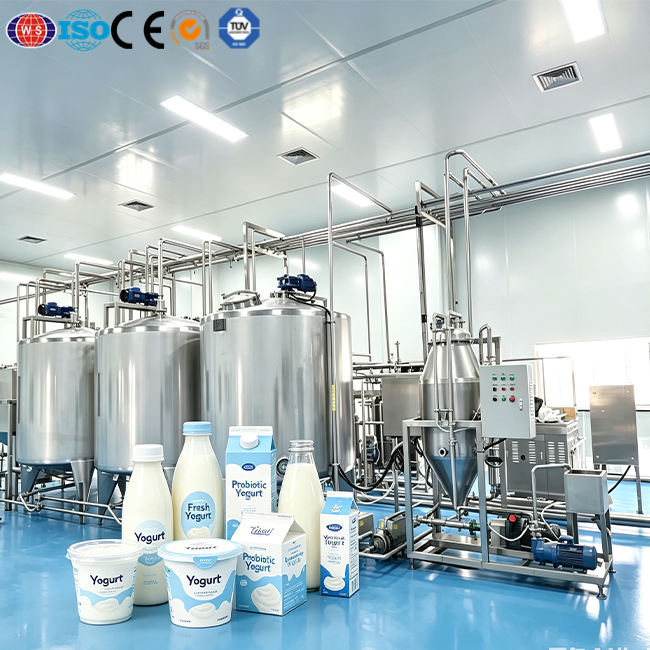
As dairy manufacturers expand their product portfolios, fruit yogurt offers an opportunity to introduce new flavors, textures, and packaging formats using a shared milk processing infrastructure.
However, producing fruit yogurt involves more than adding fruit ingredients to fermented milk. Milk composition, thermal treatment, fermentation conditions, cooling, and fruit incorporation must work together to achieve consistent product quality.
Weishu offers an integrated yogurt processing solution covering milk preparation, homogenization, pasteurization, fermentation, cooling, fruit blending, and automatic CIP cleaning.
The solution is intended for dairy factories establishing new yogurt production facilities or expanding their existing milk processing operations.
The proposed configuration allows manufacturers to produce plain stirred yogurt, flavored yogurt, and fruit yogurt using a shared processing system.
The main design objectives include:
Maintaining consistent yogurt texture and viscosity.
Providing controlled fermentation conditions.
Protecting yogurt structure during cooling and transfer.
Supporting different fruit ingredients and product formulations.
Simplifying equipment cleaning and product changeovers.
Rather than installing independent processing equipment for each yogurt variety, compatible products can share the same milk preparation, homogenization, pasteurization, and fermentation systems.
Product differentiation can take place during downstream blending and filling.
Fresh milk is received, filtered, and transferred to the preparation system. Depending on the finished product formulation, milk fat and solids content can be adjusted before processing.
The milk base then passes through the homogenization system to improve fat dispersion and support the development of a uniform yogurt structure.
Controlled ingredient mixing and homogenization provide a consistent foundation for subsequent heat treatment and fermentation.
The prepared milk enters the pasteurization system, where controlled heat treatment reduces unwanted microorganisms and promotes the protein changes required for yogurt texture development.
Weishu's plate or tubular pasteurization systems can be selected according to milk composition, solids content, and processing capacity.
After heat treatment, the milk is cooled to the appropriate starter culture inoculation temperature before entering the fermentation tanks.
The fermentation system uses insulated stainless steel tanks equipped with temperature monitoring and suitable agitation mechanisms.
Once the starter culture is introduced, the milk is maintained under controlled fermentation conditions until the required acidity and product characteristics are achieved.
For factories operating multiple batches, fermentation tanks can be arranged in parallel to coordinate milk preparation, fermentation, and filling schedules.
This arrangement helps balance continuous upstream processing with batch-based yogurt manufacturing.
After fermentation, the yogurt is gently stirred and cooled to limit further acidification.
Excessive mechanical shear during this stage can damage the yogurt structure and reduce finished product viscosity. Therefore, suitable pumps, pipelines, and cooling equipment are important considerations in the system design.
Prepared fruit ingredients can then be introduced through a dedicated blending or dosing system.
Depending on the formulation, the production line can accommodate strawberry, mango, blueberry, peach, and other suitable fruit preparations.
The finished yogurt is transferred to compatible filling equipment under hygienic conditions.
The packaging system can be configured for cups, bottles, or other suitable containers according to the manufacturer's market requirements.
Conventional stirred fruit yogurt requires an appropriate cold chain throughout storage and distribution.
| Processing Stage | Main Equipment | Application Function |
|---|---|---|
| Milk preparation | Storage and blending tanks | Milk formulation and ingredient mixing |
| Homogenization | High-pressure homogenizer | Fat dispersion and product consistency |
| Heat treatment | Plate or tubular pasteurizer | Controlled milk thermal processing |
| Fermentation | Temperature-controlled fermentation tanks | Yogurt culture development |
| Cooling | Suitable heat exchanger | Controlled cooling and texture preservation |
| Fruit incorporation | Blending or dosing system | Fruit distribution and flavor customization |
| Product transfer | Hygienic pumps and pipelines | Gentle yogurt handling |
| Cleaning | Automatic CIP system | Cleaning of compatible processing circuits |
The final equipment arrangement is customized according to product formulation, fermentation capacity, packaging requirements, and factory layout.
Fermentation capacity and production scheduling
Fermentation requires significantly more processing time than continuous milk pasteurization. The number and working volume of fermentation tanks must therefore be coordinated with upstream processing capacity and downstream filling schedules.
Product texture protection
Suitable agitation speeds, pump selection, and cooling arrangements help minimize unnecessary damage to the yogurt structure after fermentation.
Flexible product changeovers
A shared processing system allows manufacturers to produce different compatible yogurt varieties. Integrated automatic CIP cleaning supports repeatable cleaning procedures between production batches.
Energy management
Regenerative heat recovery can be incorporated into suitable milk pasteurization systems to reduce external heating and cooling requirements.
The modular configuration provides dairy manufacturers with opportunities to develop several product categories using shared processing infrastructure.
| Product | Configuration Adjustment |
|---|---|
| Plain stirred yogurt | Standard fermentation and cooling |
| Strawberry yogurt | Strawberry preparation dosing |
| Mango yogurt | Suitable fruit blending system |
| Flavored yogurt | Controlled flavor and ingredient addition |
| Drinking yogurt | Adjusted formulation, viscosity, and product handling |
This approach can help manufacturers expand their product range without duplicating every processing stage.
Weishu combines milk preparation, homogenization, thermal processing, fermentation, and automatic CIP cleaning into customized dairy manufacturing solutions.
For manufacturers planning to introduce fruit yogurt or expand an existing dairy production facility, our modular equipment configuration provides a practical approach to product diversification, production flexibility, and hygienic processing.
The proposed solution can be adapted to different production capacities, yogurt formulations, factory layouts, and automation requirements.
Contact Weishu to discuss your yogurt production project and receive a customized processing solution.







 EN